
Immune Peptide Side Effects: LL-37, KPV, and Thymalin
Side effects series · Part 13
Immune peptide side effects are one of the hardest topics to cover honestly, because for the three compounds in this guide — LL-37, KPV and thymalin — the real story is how little controlled human safety data actually exists. This installment of our side-effects series separates what is known from what is only theorized, and explains why the most concrete risk has almost nothing to do with the peptide itself. Informational only — not medical advice.
What these three immune peptides are
Grouping these as “immune peptides” is convenient, but each has a very different evidence base. LL-37 is the only human cathelicidin — a natural antimicrobial and immune-signaling peptide. KPV is a tiny three-amino-acid fragment (lysine–proline–valine) of the hormone alpha-MSH, studied for anti-inflammatory effects. Thymalin is not a single molecule at all but a mixture of polypeptides extracted from calf thymus, developed in the former USSR as an immune modulator.
LL-37: the double-edged host-defense peptide
LL-37 (a 37-residue peptide cleaved from the hCAP-18 precursor, encoded by the CAMP gene) is genuinely two-faced, and that is the heart of its safety story.

On one edge it is a broad antimicrobial that also supports wound healing and recruits immune cells. On the other, in the wrong place or at the wrong level it is pro-inflammatory and is repeatedly implicated in inflammatory and autoimmune disease. It is overexpressed in psoriasis, where it can bind a person’s own DNA and RNA to switch on an interferon-driven immune response, and it is described as a psoriasis autoantigen. Abnormal processing of the same precursor generates pro-inflammatory fragments in rosacea. LL-37–self-DNA complexes are also implicated in lupus, and cathelicidin dysregulation appears in atopic dermatitis. Its cancer biology is bidirectional: LL-37 has been explored as an immune stimulant to attack tumors, yet in other settings it can promote tumor growth and spread.
Human clinical experience is limited to early-phase work — for example, a Phase 1 trial injecting LL-37 into melanoma skin metastases — and a published case report described an inflammatory skin eruption in a patient receiving LL-37 injections that resolved within roughly two months after stopping. There is no FDA-approved injectable LL-37.
KPV: promising in the lab, nearly silent in humans
KPV is the C-terminal tail of alpha-MSH and keeps the anti-inflammatory activity of the parent hormone without its pigment-darkening effect. In cells and in mouse models of colitis it dampens NF-κB signaling and lowers inflammatory cytokines, and it is carried into inflamed gut tissue by the PepT1 transporter. That is a genuinely interesting preclinical story.
What is missing is people. In its own compounding-review materials, FDA stated it had not identified any human exposure data for drug products containing KPV by any route. So a candid “side effect profile” for injected KPV essentially does not exist. Claims of “mild injection-site irritation” that circulate online trace to vendor copy, not controlled studies — treat them as marketing, not evidence.
Thymalin: a thymus extract, not a single molecule
Thymalin is a lyophilized mixture of polypeptides pulled from calf or bovine thymus, developed by Russian researchers and registered in Russia as an immunomodulator since the early 1980s. Because it is a biological extract rather than a defined compound, it has no single formula, molecular weight or sequence — an important distinction from thymosin alpha-1 (thymalfasin / Zadaxin), which is one defined 28-amino-acid peptide with regulatory approval in a number of countries.
Most human data on thymalin comes from small studies by its originating group and has not been independently replicated in Western trials; specific longevity figures sometimes quoted for it trace back to those same authors and should be treated as unconfirmed. As a bovine-derived biological, allergenicity and immune reactions are a reasonable theoretical concern, but a rigorous adverse-event dataset is not available. It is not FDA-approved in the United States.
How much human evidence each one has
If you take one thing from this guide, let it be the size of the evidence gap.
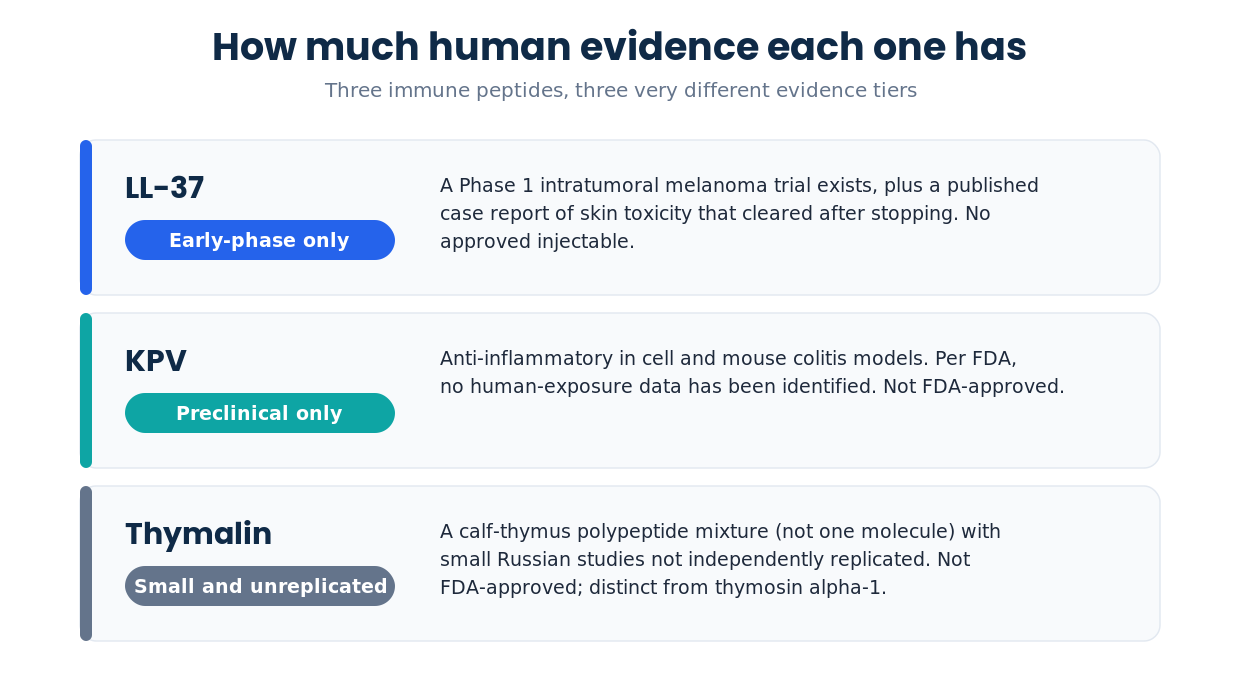
LL-37 has only early-phase human exposure plus a cautionary case report; KPV has essentially none; thymalin has small, unreplicated studies. This is why “no reported side effects” is so misleading for compounds like these: no reported side effects from something barely studied in people is not reassurance — it is an absence of data.
The side effect that actually applies: product quality
For research-grade material bought outside a regulated supply chain, the most concrete and verifiable hazard is not a well-mapped pharmacologic side effect — it is what is in the vial.

Endotoxin (bacterial breakdown products) can cause fevers or worse when injected, and survives ordinary handling because it is heat-stable; unregulated material may not be truly sterile; and identity, purity and net peptide content may not match the label. A critical, often-missed point: a high HPLC purity number is not a measure of sterility or endotoxin.
Frequently asked questions
Are LL-37, KPV or thymalin FDA-approved?
No — none is an FDA-approved drug in the United States. Several popular peptides sit in FDA’s 503A Category 2, and LL-37 is slated for advisory-committee review; see our FDA 503A categories explainer.
Is LL-37 dangerous because it is linked to autoimmune disease?
The autoimmune associations are real in the biology literature, but they describe LL-37’s role in disease processes, not a measured side-effect rate from taking it. Its human safety data is limited to early-phase work plus a case report.
Why is thymalin grouped with thymosin alpha-1?
Mostly by name. They are different: thymalin is a crude thymus-extract mixture; thymosin alpha-1 is a single defined peptide with approvals abroad. Do not treat data on one as data on the other — see our thymosin alpha-1 side-effects guide.
What is the safest assumption for an under-studied peptide?
That the absence of reported side effects reflects absence of study — and that product quality (endotoxin, sterility, identity) is the risk you can actually verify with a certificate of analysis.
References
- UniProt — CAMP_HUMAN (P49913), Cathelicidin antimicrobial peptide / LL-37.
- Vandamme et al. — Cathelicidin LL-37: an antimicrobial peptide with a role in inflammatory skin disease (PMC3346901).
- Immunomodulatory Role of the Antimicrobial LL-37 Peptide in Autoimmune Diseases and Viral Infections (PMC7565865).
- Dermatologic toxicity from novel therapy using antimicrobial peptide LL-37 in melanoma (PubMed 29665030; trial NCT02225366).
- Dalmasso et al. — PepT1-Mediated Tripeptide KPV Uptake Reduces Intestinal Inflammation, Gastroenterology (2008).
- Khavinson & Morozov — Peptides of pineal gland and thymus prolong human life (thymalin source).
Informational only — not medical advice; consult a qualified healthcare professional · 21+. None of these compounds is an FDA-approved drug for human use.