
What Is Ghrelin? The Hunger Hormone Explained
Peptide Biology
Ghrelin is the body’s main “hunger hormone” — a 28-amino-acid peptide released mostly by the stomach that rises when you are hungry and drives you to eat. It is also the natural key that fits the receptor targeted by an entire family of research growth-hormone secretagogues, which is why ghrelin sits behind so many compounds in the peptide world.
What is ghrelin?
Ghrelin was discovered in 1999 by Masayasu Kojima, Kenji Kangawa and colleagues, who were hunting for the body’s own version of a class of lab-made “growth-hormone secretagogues.” They found it in the stomach and named it ghrelin, after a root word meaning “grow.” It is a short peptide of 28 amino acids, and it is the only hormone known to circulate in the blood and actively increase appetite.
Most ghrelin is made by specialised endocrine cells — called X/A-like cells — in the lining of the stomach, with smaller amounts produced in the small intestine, pancreas and elsewhere. Once released, it acts on the brain and the pituitary gland. The acylated form of the peptide weighs roughly 3.4 kilodaltons.
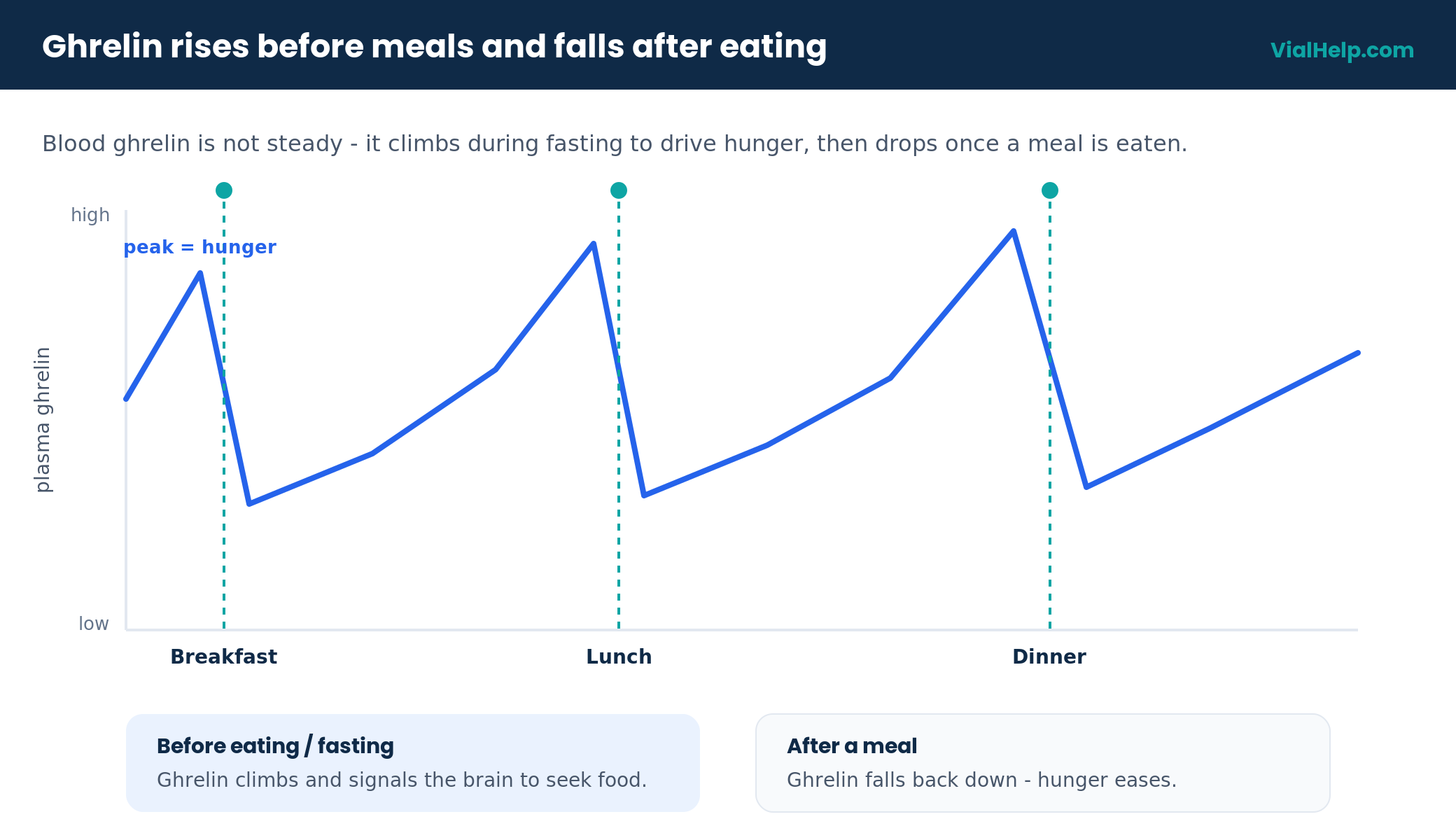
Ghrelin levels are not constant. They climb during fasting and in the hour or so before a usual mealtime, then drop sharply after eating. This rhythm is a large part of why ghrelin is described as the signal that tells the brain it is time to look for food.
The octanoyl tail: ghrelin’s on-switch
Ghrelin has an unusual and important quirk. To work on its main receptor, one specific amino acid — the serine at position 3 — must carry an attached fatty-acid tail, an eight-carbon chain called octanoate. This modification is added by a dedicated enzyme named GOAT (ghrelin O-acyltransferase), identified in 2008. Without that tail, ghrelin cannot switch its receptor on.
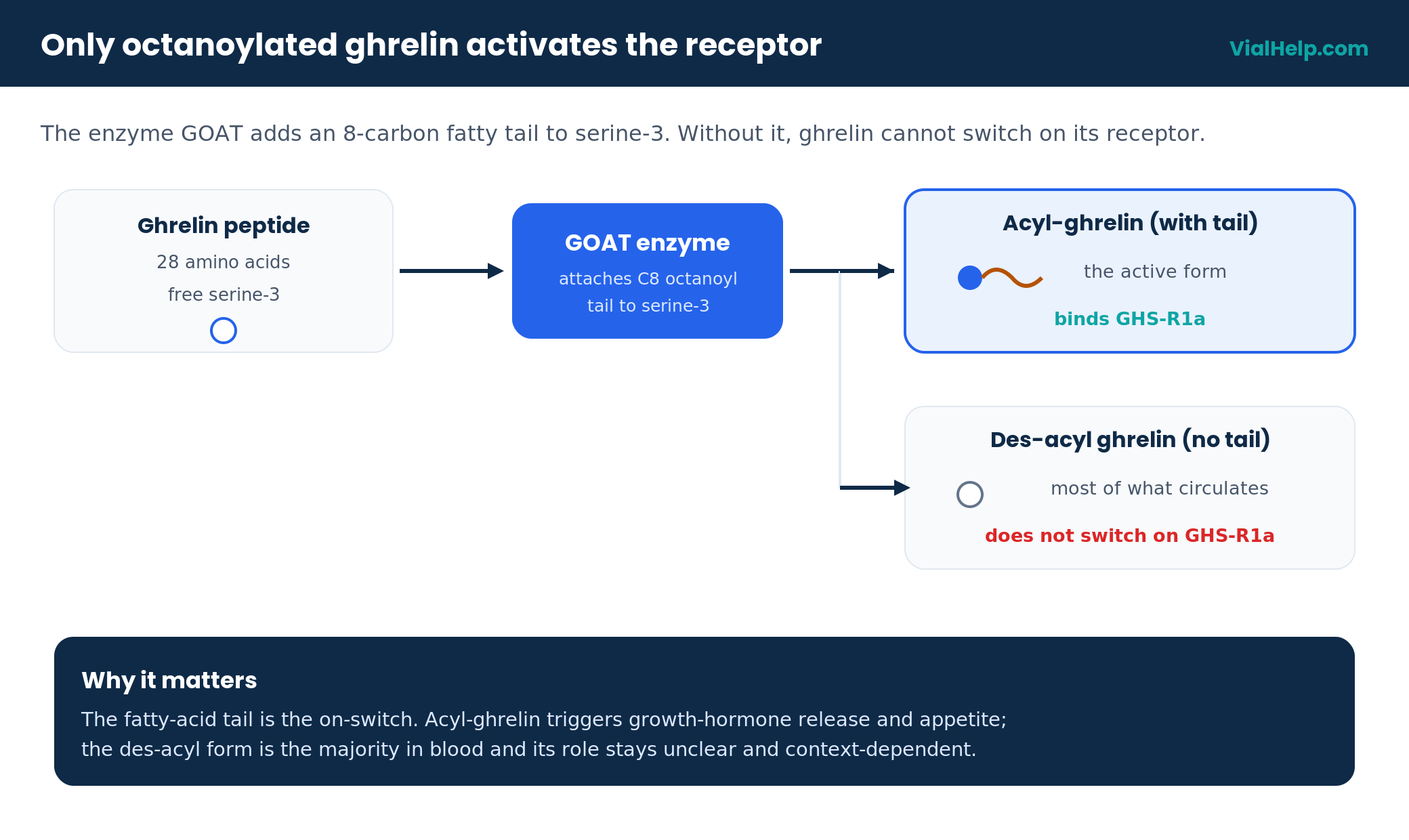
This gives ghrelin two circulating forms. Acyl-ghrelin — the version with the fatty tail — is the active hormone that stimulates appetite and growth-hormone release. Des-acyl (unacylated) ghrelin lacks the tail and makes up the majority of ghrelin in the blood, yet its biological role is still not fully understood; it is largely inactive at the main ghrelin receptor and its effects appear to be context-dependent. The octanoyl tail, in other words, is the difference between an on-switch and a molecule whose job scientists are still working out.
What ghrelin does in the body
Ghrelin’s best-known job is stimulating hunger. It does this by acting on a cluster of neurons in a brain region called the arcuate nucleus of the hypothalamus — specifically the “NPY/AgRP” neurons, which are the brain’s appetite accelerators. Beyond appetite, research links ghrelin to a range of other functions, including:
- Growth-hormone release — ghrelin stimulates the pituitary to secrete growth hormone, working alongside the hypothalamic hormone GHRH.
- Gut activity — effects on stomach emptying, gut motility and acid secretion.
- Glucose and energy metabolism — influences on insulin and blood-sugar handling and, over time, on fat storage.
- Reward and behaviour — involvement in food-seeking, motivation and aspects of learning and sleep.
Ghrelin and growth hormone: the GHS-R1a connection
Ghrelin’s receptor is called GHS-R1a (the growth-hormone-secretagogue receptor, type 1a). It is a G-protein-coupled receptor — the same broad family covered in our explainer on what a GPCR is — and it is notable for being unusually “busy” even without a hormone bound to it. In laboratory (in-vitro) studies it signals at roughly half its maximum activity with no ligand present at all, a property called constitutive activity that we explore in why the ghrelin receptor is 50% “on”.

Here is where ghrelin connects to the wider research-peptide world. GHS-R1a was actually characterised using synthetic compounds before ghrelin itself was found — ghrelin turned out to be the natural molecule those compounds were imitating. Today a whole class of research “growth-hormone secretagogues” works by mimicking ghrelin at this receptor, including the peptides GHRP-6, GHRP-2, hexarelin and ipamorelin, and the orally active non-peptide MK-677 (ibutamoren). Each has its own selectivity and profile, but all of them trace back to the same template. For how these compare with the GHRH side of the axis, see GHRH analogs vs GH secretagogues and growth-hormone peptide side effects.
Ghrelin in the clinic and the lab
Because ghrelin drives appetite, ghrelin-mimicking drugs have been studied for conditions involving wasting and poor appetite, and a related compound (relamorelin) has been investigated for slow stomach emptying. One ghrelin-receptor agonist is actually FDA-approved: macimorelin (Macrilen), cleared in December 2017 — but strictly as an oral diagnostic test for adult growth-hormone deficiency, not as a treatment.
Ghrelin itself is not an approved injectable therapy that people take; it is the natural hormone and a research and diagnostic target. Its very short active life in the blood — the acylated form persists only around ten minutes — is one reason the hormone itself is impractical as a drug, and part of why stable synthetic mimics were developed instead.
Frequently asked questions
Is ghrelin the same as growth hormone?
No. Ghrelin is a stomach hormone that, among other things, triggers the pituitary to release growth hormone. They are different molecules with different jobs.
Why is ghrelin called the “hunger hormone”?
Because it is the main circulating signal that increases appetite. Levels rise before meals and during fasting and fall after eating, tracking the urge to eat.
What is the difference between acyl and des-acyl ghrelin?
Acyl-ghrelin carries an octanoyl fatty tail on serine-3 and is the active form at the ghrelin receptor. Des-acyl ghrelin lacks the tail, is the more abundant form in blood, and its role is still being studied.
How does ghrelin relate to peptides like ipamorelin or MK-677?
Those are synthetic growth-hormone secretagogues that mimic ghrelin at its GHS-R1a receptor to drive growth-hormone release. Ghrelin is the natural template they copy.
References
- Kojima M, et al. Ghrelin is a growth-hormone-releasing acylated peptide from stomach. Nature. 1999;402:656–660. nature.com/articles/45230
- Müller TD, et al. Ghrelin. Molecular Metabolism. 2015;4(6):437–460. PMC4443295
- Yang J, et al. Identification of the acyltransferase that octanoylates ghrelin (GOAT). Cell. 2008;132(3):387–396. PubMed 18267071
- Holst B, et al. High constitutive signaling of the ghrelin receptor. Molecular Endocrinology. 2003;17(11):2201–2210. PubMed 12907757
- UniProtKB Q9UBU3 — Appetite-regulating hormone (ghrelin/obestatin precursor), Homo sapiens. uniprot.org/uniprotkb/Q9UBU3
- Macrilen (macimorelin) FDA prescribing information, approved Dec 2017. accessdata.fda.gov