
What Is Glucagon? The Hormone That Raises Blood Sugar
Peptide science
Glucagon is the 29-amino-acid hormone that raises blood sugar — the mirror image of insulin — and it sits quietly at the center of both emergency medicine and the newest generation of obesity drugs. Most people meet glucagon as “the opposite of insulin,” but its biology connects directly to GLP-1, the pancreas, and research peptides like retatrutide.
What is glucagon?
Glucagon is a peptide hormone made of 29 amino acids, secreted by the alpha cells of the pancreatic islets of Langerhans. It is cut out of a larger precursor protein called proglucagon, encoded by the GCG gene. Its job, in one line, is to raise blood glucose when the body needs fuel — during fasting, exercise, or a drop in blood sugar.
How glucagon works: the opposite of insulin
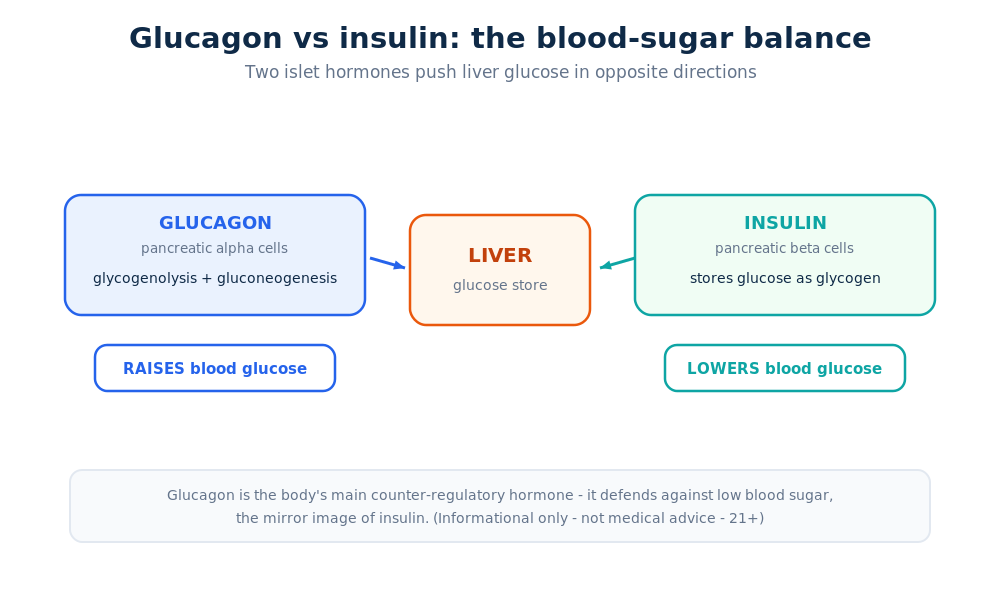
Glucagon and insulin are the two great counter-regulatory hormones of the pancreas, and they push blood glucose in opposite directions. When blood sugar falls, alpha cells release glucagon, which travels to the liver and triggers two processes: glycogenolysis (breaking stored glycogen back into glucose) and gluconeogenesis (making new glucose from other building blocks). The liver then releases that glucose into the blood.
Glucagon also promotes the breakdown of fat (lipolysis) and the production of ketones, and it modestly increases energy expenditure — details that turn out to matter a great deal for drug design.
The glucagon receptor
Glucagon acts through the glucagon receptor (GCGR), a class B G-protein-coupled receptor found mainly on liver cells. When glucagon binds, the receptor couples to a Gs protein, raising the second messenger cAMP and activating the PKA cascade that drives glucose production.
One gene, two famous hormones
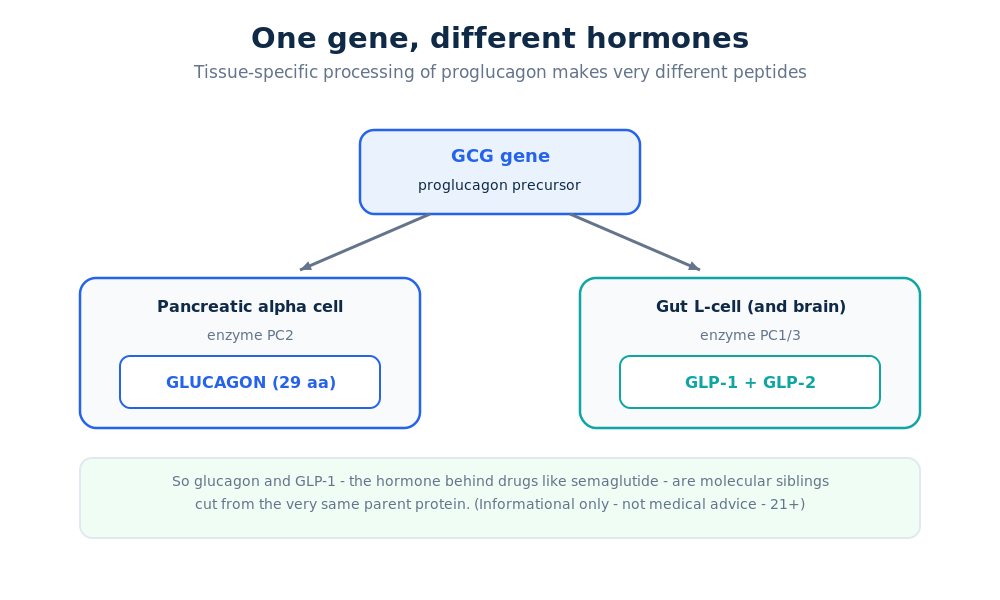
Here is the connection most people miss: glucagon and GLP-1 — the hormone behind drugs like semaglutide — come from the same precursor. Proglucagon is processed differently depending on the tissue. In the pancreas, an enzyme called PC2 cuts proglucagon into glucagon. In the L-cells of the gut (and in the brain), a different enzyme, PC1/3, cuts the identical precursor into GLP-1 and GLP-2. Same parent protein, different molecular scissors, very different hormones.
What controls glucagon
Glucagon release is switched on by low blood sugar (its most powerful trigger), fasting, exercise, and protein-rich meals. It is switched off by high blood sugar, by insulin, and — importantly — by GLP-1. That last point is part of why GLP-1-based drugs help control blood sugar: they suppress glucagon as well as boost insulin.
Glucagon as medicine — and in obesity research
Because its fastest, most reliable action is raising blood glucose, glucagon is the standard rescue treatment for severe hypoglycemia. FDA-approved products include injectable forms (such as Gvoke and GlucaGen) and a nasal powder (Baqsimi) that can be given when someone is too impaired to eat or drink.
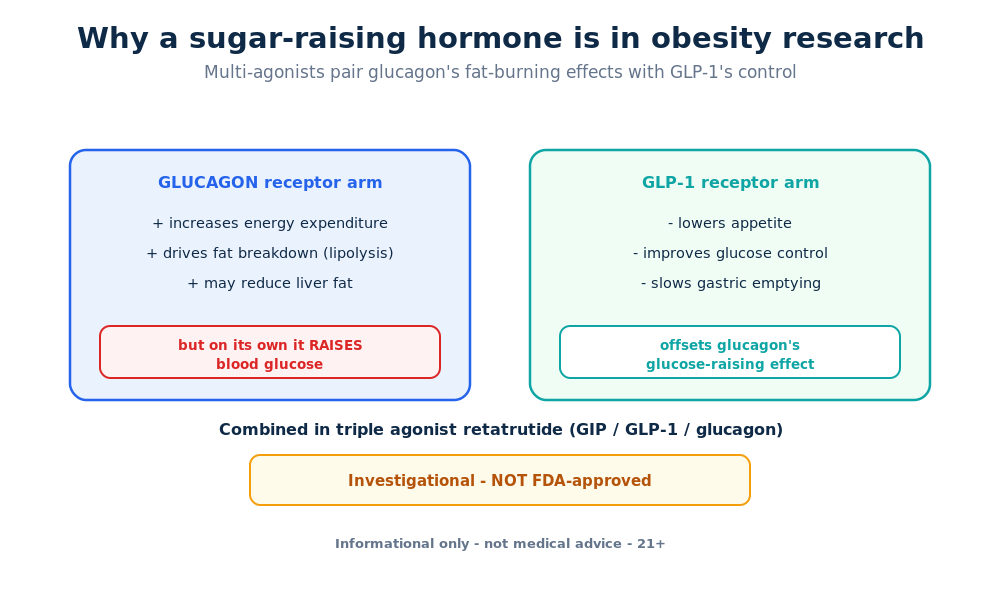
More surprisingly, drug developers are now deliberately activating the glucagon receptor for weight loss. The logic: glucagon’s fat-breakdown and energy-expenditure effects are useful, and its glucose-raising downside can be offset by pairing it with GLP-1. The triple agonist retatrutide hits the GIP, GLP-1, and glucagon receptors at once and produced substantial weight loss in a Phase 2 trial. Dual GLP-1/glucagon agonists are in development too.
Frequently asked questions
Is glucagon just the opposite of insulin?
In blood-sugar terms, essentially yes. Insulin lowers blood glucose by storing it; glucagon raises it by telling the liver to release and make glucose. They are the two main counter-regulatory hormones — insulin from beta cells, glucagon from alpha cells.
Why is a sugar-raising hormone in an emergency kit?
Because raising blood sugar quickly is exactly what is needed in severe hypoglycemia. A glucagon injection or nasal dose tells the liver to release glucose fast. These are FDA-approved rescue treatments — this is informational only, not medical advice.
How is glucagon related to GLP-1?
They are molecular siblings from the same gene, GCG. The pancreas processes proglucagon into glucagon; the gut processes the same precursor into GLP-1. That shared origin is why the two hormones show up together throughout metabolic biology.
Why would a weight-loss drug activate the glucagon receptor?
Beyond glucose, glucagon increases fat breakdown and energy expenditure. Multi-agonists like retatrutide combine glucagon-receptor activity with GLP-1’s appetite and glucose control, so the benefits add up while the glucose-raising effect is balanced out. These agents are experimental.
References
- Müller TD et al. The New Biology and Pharmacology of Glucagon. Physiol Rev 2017.
- Rix I et al. Glucagon Physiology. Endotext (NCBI Bookshelf).
- UniProtKB P01275 — GCG / Pro-glucagon (Homo sapiens).
- UniProtKB P47871 — Glucagon receptor (GCGR).
- BAQSIMI (glucagon) nasal powder — FDA/DailyMed label.
- Jastreboff AM et al. Triple-Hormone-Receptor Agonist Retatrutide for Obesity. NEJM 2023.
Informational only — not medical advice · 21+. This article explains hormone biology and related research compounds for educational purposes. It is not a recommendation to use any drug. Glucagon rescue products and investigational agents should only be used under the care of a qualified clinician.