
What Is a GPCR? G-Protein-Coupled Receptors and Peptides
Peptide pharmacology
A GPCR — a G-protein-coupled receptor — is one of the cell’s most important antennas, and it is how a large share of peptide hormones deliver their message. The receptor sits in the cell membrane, senses a signal on the outside, and flips a molecular switch on the inside. Understanding that relay explains a lot about how peptides like GLP-1, ghrelin and the melanocortins actually work.
What a GPCR is
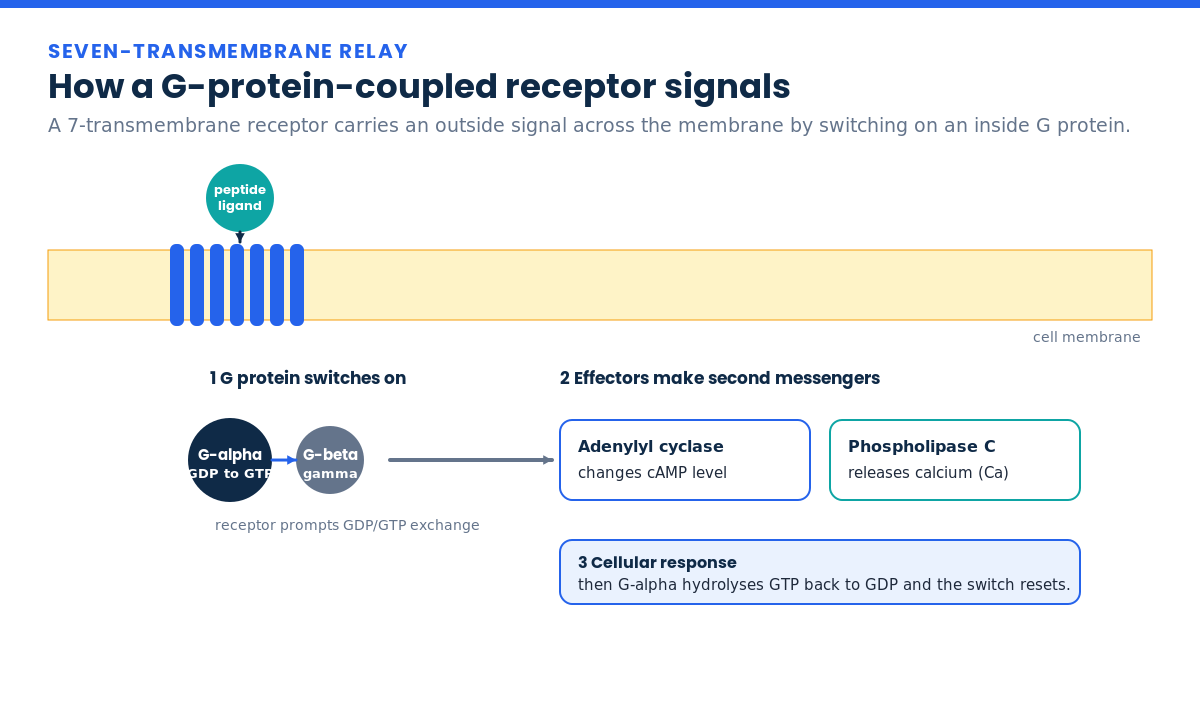
A G-protein-coupled receptor is a single protein chain that threads back and forth through the cell membrane seven times — hence the nickname seven-transmembrane, or 7TM, receptor. Its outer portion senses a signal from outside the cell (a hormone, a neurotransmitter, a peptide, even a photon of light or an odor molecule), and its inner portion passes that signal along. It does this by coupling to a heterotrimeric G protein, a three-part switch made of G-alpha, G-beta and G-gamma subunits. GPCRs are the single largest family of membrane receptors in the human body, which is exactly why so many signals — and so many drugs — run through them.
How the signal gets inside: the G-protein cycle
The relay follows a tidy cycle. A ligand binds the receptor and changes its three-dimensional shape. That reshaped receptor prompts the G-alpha subunit to swap a bound GDP molecule for GTP — the “on” state. Activated G-alpha then separates from the G-beta/G-gamma pair, and both halves go on to switch downstream effector proteins on or off.
Those effectors generate small intracellular signals called second messengers — for example cAMP (made by adenylyl cyclase) or a rise in calcium (via phospholipase C). The second messengers drive the cell’s actual response. Finally the switch resets: G-alpha slowly converts its GTP back to GDP, the subunits recombine, and the receptor is ready to fire again. One ligand, one binding event, but an amplified cascade inside the cell.
The four G-alpha families
Which second messenger changes depends on which kind of G-alpha the receptor couples to. There are four broad families, and a single receptor may use one or several of them.
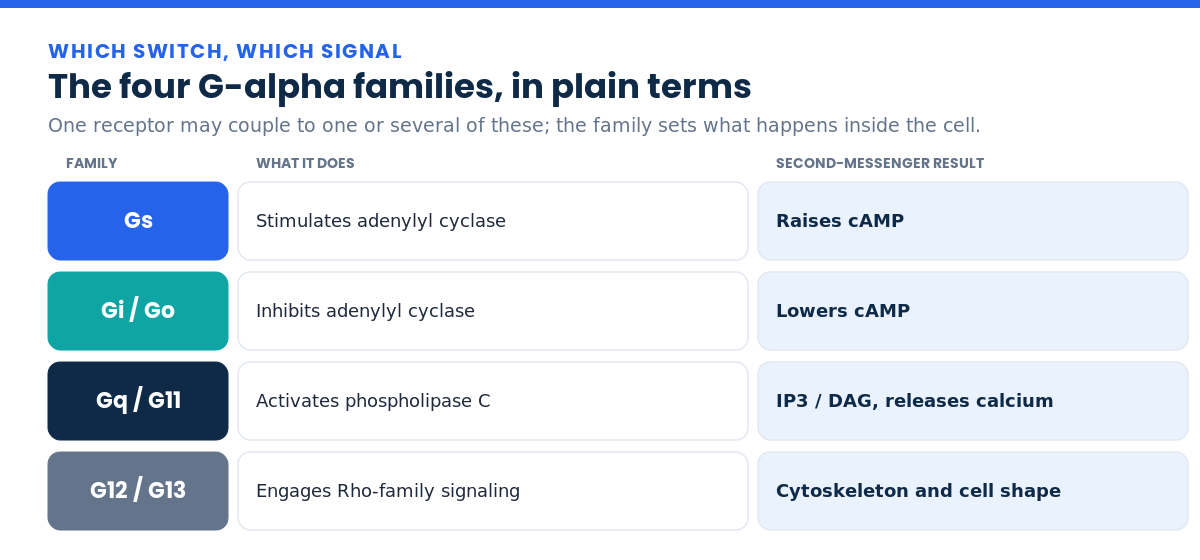
Gs stimulates adenylyl cyclase and raises cAMP; Gi/Go does the opposite, lowering cAMP; Gq/G11 activates phospholipase C to produce IP3 and DAG and release calcium; and G12/G13 engages Rho-family signaling that reshapes the cell’s cytoskeleton. The same outside signal can therefore mean very different things in different cells, depending on the wiring.
Switching the signal off: desensitization and bias
GPCR signaling is self-limiting. When a receptor stays active, enzymes called GRKs tag its inner tail with phosphate groups. That recruits a protein called beta-arrestin, which physically blocks further G-protein coupling and helps pull the receptor inside the cell. This machinery is the molecular basis of the tolerance seen with sustained agonist exposure — the reason a continuously present agonist can lose its punch. If that idea is useful to you, it is the same story told in plain terms in tachyphylaxis vs. tolerance vs. downregulation.
Beta-arrestin does more than switch receptors off; it can start its own signals. Because different ligands at the same receptor can favor the G-protein route versus the arrestin route, researchers talk about biased agonism or functional selectivity. It is a real and active area of GPCR pharmacology being explored to separate wanted from unwanted effects, but its payoff is still being worked out and should not be overstated. For the broader vocabulary of how molecules engage receptors, see agonists vs. antagonists.
Which peptide receptors are GPCRs (and which are not)
Many peptides discussed in peptide research act through GPCRs — but not all of them do, and that distinction matters.
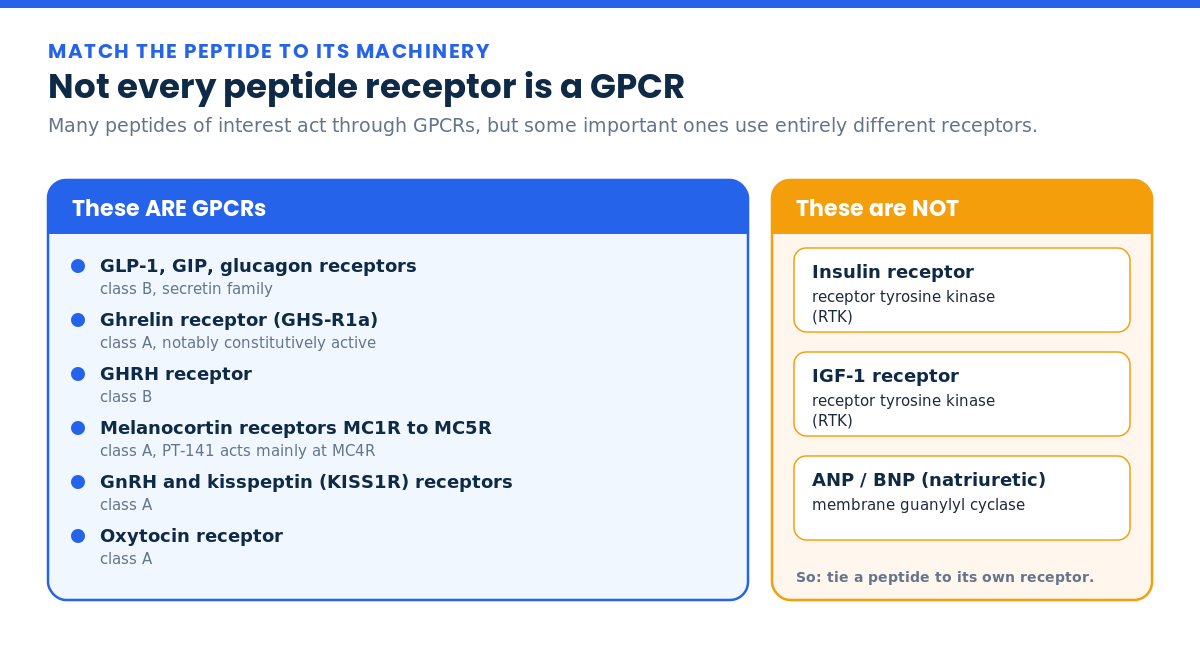
On the GPCR side sit the incretin and glucagon-family receptors (GLP-1, GIP and glucagon are class B, the “secretin” family), the ghrelin receptor GHS-R1a (class A, and notably active even without a ligand), the GHRH receptor, the melanocortin receptors MC1R–MC5R (PT-141 acts mainly at MC4R), the GnRH and kisspeptin receptors, and the oxytocin receptor. So do the receptors for GLP-1 that semaglutide targets.
Why GPCRs matter so much
GPCRs are the largest family of membrane receptors encoded by the human genome — on the order of 800 genes. Roughly half are sensory (about 400 olfactory receptors alone, plus taste and light), leaving a few hundred non-sensory GPCRs that respond to internal signals like hormones and peptides. They are also the richest source of medicines: about a third (roughly 34%) of all FDA-approved drugs act through GPCRs. The importance of the family was underscored when the 2012 Nobel Prize in Chemistry went to Robert Lefkowitz and Brian Kobilka for their studies of how these receptors work.
Frequently asked questions
Do all peptides act on GPCRs?
No. Many do — GLP-1, ghrelin, GnRH, the melanocortins and others — but the insulin and IGF-1 receptors are receptor tyrosine kinases, and natriuretic-peptide receptors are guanylyl cyclases. The receptor family depends entirely on the peptide.
Why can a continuously dosed peptide agonist lose its effect?
Sustained activation triggers GRK phosphorylation and beta-arrestin recruitment, which uncouple and internalize the receptor. That desensitization underlies tolerance and downregulation, explained further in this guide.
What is “constitutive activity”?
Some GPCRs generate a baseline signal even with no ligand bound. The ghrelin receptor (GHS-R1a) is a well-known example, which is why “inverse agonists” — ligands that push activity below baseline — are meaningful for such receptors.
What is the difference between class A and class B GPCRs?
Class A (rhodopsin-like) is by far the largest group and includes receptors for many small molecules and peptides. Class B (the secretin family) is smaller and specialized for larger peptide hormones such as GLP-1, GIP, glucagon and GHRH.
Related reading
Reconstitution calculator · Peptide library · Guides & how-tos
References
- Hauser AS, Attwood MM, Rask-Andersen M, Schiöth HB, Gloriam DE. Trends in GPCR drug discovery: new agents, targets and indications. Nat Rev Drug Discov 2017;16(12):829–842. nature.com
- Sriram K, Insel PA. G Protein-Coupled Receptors as Targets for Approved Drugs: How Many Targets and How Many Drugs? Mol Pharmacol 2018;93(4):251–258. PMC5820538
- The Nobel Prize in Chemistry 2012 — Lefkowitz and Kobilka. NobelPrize.org. nobelprize.org
- Rosenbaum DM, Rasmussen SGF, Kobilka BK. The structure and function of G-protein-coupled receptors. Nature 2009;459(7245):356–363. nature.com
- Wootten D, Christopoulos A, Sexton PM. Emerging paradigms in GPCR allostery: implications for drug discovery. Nat Rev Drug Discov 2013;12(8):630–644. nature.com
- IUPHAR/BPS Guide to Pharmacology — G protein-coupled receptors family overview. guidetopharmacology.org
Informational only — not medical advice. This article is educational and written for adults 21+. It does not recommend or instruct personal use of any substance.