
Solid-Phase Peptide Synthesis (SPPS): How Research Peptides Are Made
Peptide science
Solid-phase peptide synthesis (SPPS) is the chemistry behind almost every research peptide in a vial. Rather than build a peptide free-floating in solution, chemists anchor the growing chain to a tiny insoluble bead and add one amino acid at a time. That single idea — keep the chain tied down so everything else can be rinsed away — turned peptide-making from a painstaking art into a repeatable, automatable process.
What solid-phase peptide synthesis is
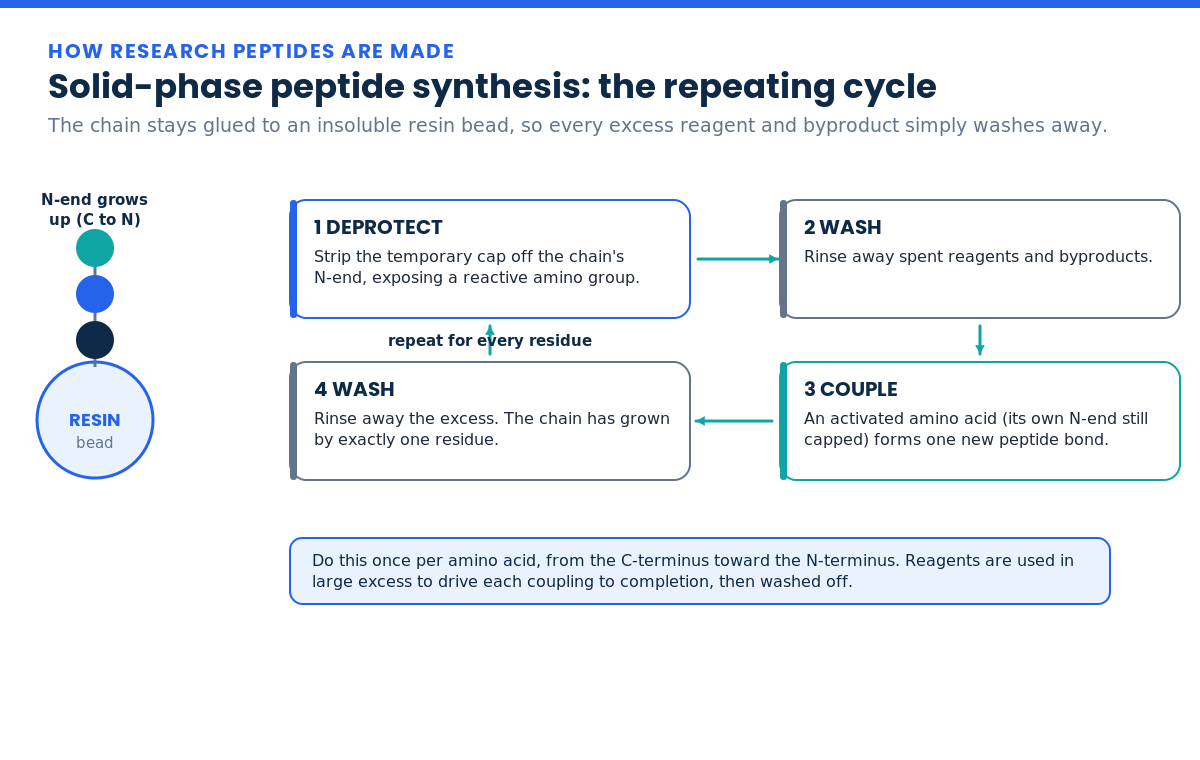
In solid-phase peptide synthesis the peptide is assembled while chemically bolted by one end to a solid support — a porous resin bead, usually polystyrene- or PEG-based. Because the chain is stuck to the bead, you can flood the vessel with reagents, let them react, then filter and wash: every excess reagent and byproduct that is not attached to the bead simply drains away. Before this approach, peptides were made in solution and laboriously purified after every single step.
The method was introduced by Robert Bruce Merrifield in 1963, and he received the 1984 Nobel Prize in Chemistry for it. As proof of concept he assembled the 9-residue hormone bradykinin and, later, the 124-residue enzyme ribonuclease A — showing that a full, working protein could be built this way. One quirk worth remembering: the chain is anchored by its C-terminus and grows toward the N-terminus, the opposite direction to how the ribosome builds proteins in living cells.
The repeating cycle, one amino acid at a time
Every residue is added by the same four-step loop shown above. Deprotect: strip the temporary cap off the chain’s exposed end. Wash. Couple: add the next amino acid, whose carboxyl group has been switched on by a coupling reagent (names you will see include DIC, HBTU and HATU) so it forms one new peptide bond. Wash again. Repeat for every residue in the sequence.
Each incoming amino acid arrives with its own reactive groups temporarily capped by protecting groups, so the chain can only ever grow by exactly one residue per cycle. Side chains carry their own caps too. The concept called orthogonality is the whole reason this works: the temporary end-cap is removed under one set of conditions while the side-chain caps survive untouched until the very end. If you have ever wondered what the letters in a peptide sequence actually stand for, this is the machinery that stitches them together.
Two chemistries: Boc versus Fmoc
Two protecting-group strategies define the field, and the difference is mostly about how the temporary cap is removed and how hazardous the final step is.
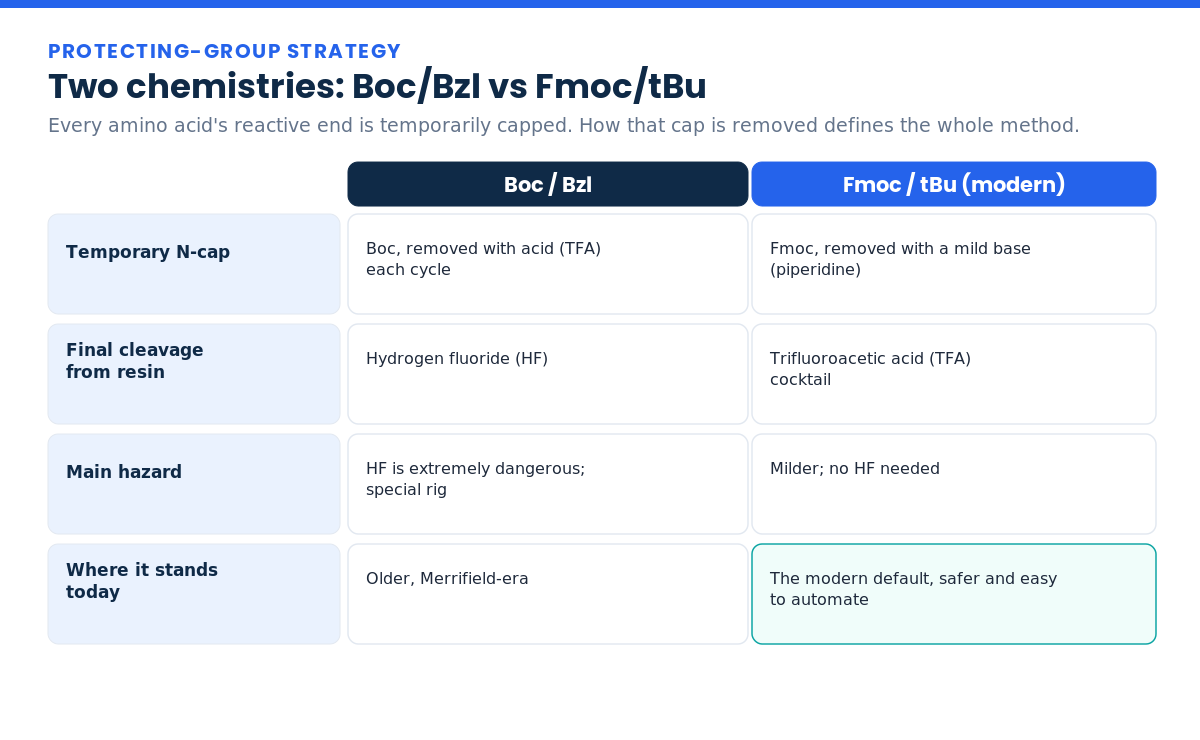
The older Boc/Bzl approach removes the temporary cap with acid each cycle and needs hydrogen fluoride (HF) for the final cleavage — effective but extremely hazardous, requiring special apparatus. The modern Fmoc/tBu approach removes the temporary Fmoc cap with a mild base (piperidine) and finishes with a trifluoroacetic acid (TFA) cocktail instead of HF. Because it is milder, safer and easier to automate, Fmoc/tBu is the default today.
Cleavage — and where the “TFA salt” comes from
Once the full sequence is assembled, a final cleavage step in Fmoc chemistry uses TFA together with scavengers (small additives such as water, triisopropylsilane and EDT that mop up reactive fragments so they cannot re-attach and damage the peptide). This one step does two jobs at once: it cuts the finished peptide off the resin and removes all the remaining side-chain caps, a move called global deprotection.
Why long sequences are hard
No coupling is ever perfectly 100% efficient, and small losses multiply. If a step occasionally fails, some chains end up missing a residue (a deletion sequence) or capped short (a truncation) — closely related impurities that are hard to separate from the target. Partly built chains can also fold and clump on the resin, physically blocking reagents so couplings stall; chemists call these “difficult sequences.”
For those reasons, stepwise SPPS is generally practical up to roughly 50 residues — treat that as a rule of thumb, not a hard wall, since optimized and microwave-assisted methods push higher. To reach larger proteins, chemists stitch two purified fragments together by native chemical ligation, or switch to recombinant expression (making the protein in engineered cells). Because the cycle is so repetitive, it was automated early, and most peptides today are made on automated synthesizers.
From crude peptide to a Certificate of Analysis
The material that comes off the resin is a crude mixture, not a pure product. It is purified by reverse-phase HPLC, its identity is confirmed by mass spectrometry, and the result is documented on a Certificate of Analysis.
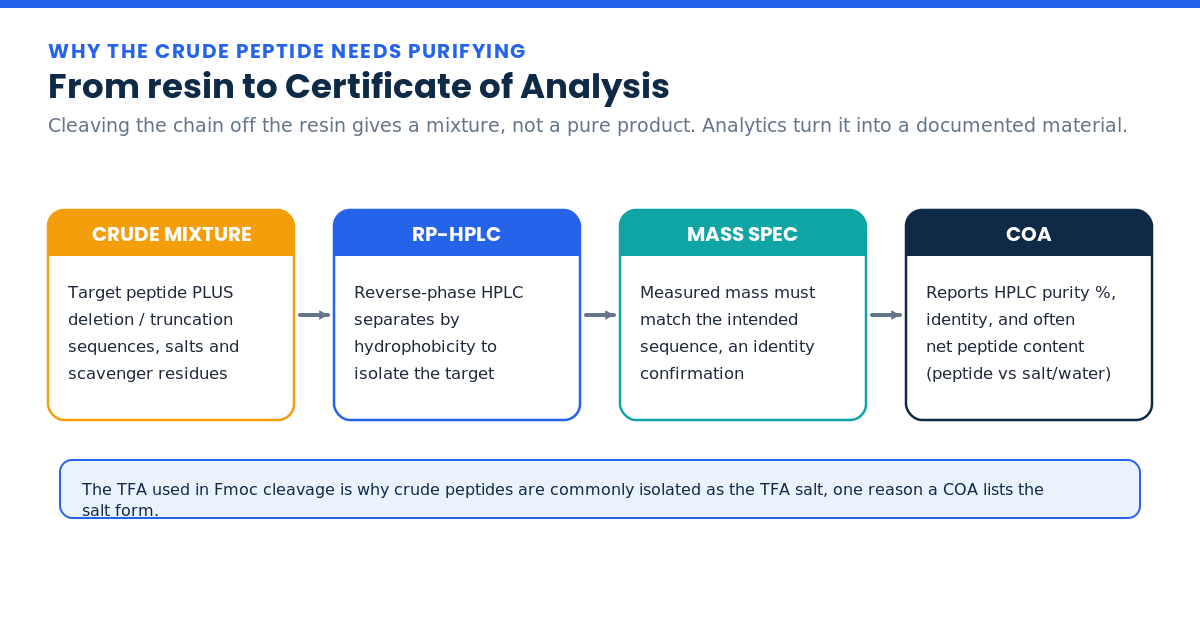
This is exactly why a COA matters: the label sequence alone tells you nothing about how much target versus impurity is actually in the vial — only the analytics do. Once you know the concentration you are working with, a reconstitution calculator handles the volume math.
Frequently asked questions
Is my research peptide made by SPPS?
Almost certainly, if it is a short-to-medium peptide. Fmoc solid-phase synthesis is the standard route for research peptides up to a few dozen residues. Much larger proteins are usually made recombinantly instead.
Why is my peptide sold as a “TFA salt”?
Because the final Fmoc cleavage step drenches the peptide in trifluoroacetic acid, leaving trifluoroacetate counter-ions attached. It is a normal consequence of manufacture; converting to an acetate or hydrochloride salt requires an extra salt-exchange step. See acetate vs TFA salt.
Does a high HPLC purity number mean I have more peptide?
No. Purity describes what fraction of the peptide material is the target versus related impurities; it says nothing about how much of the vial’s weight is peptide at all. Salt and residual water can make those two very different — that is the idea of net peptide content.
Can any peptide be built this way?
Up to roughly 50 residues, yes, in a single stepwise synthesis. Longer chains are typically assembled from purified fragments by native chemical ligation, or produced by recombinant expression.
References
- Merrifield RB. Solid Phase Peptide Synthesis. I. The Synthesis of a Tetrapeptide. J Am Chem Soc 1963;85(14):2149–2154. pubs.acs.org
- The Nobel Prize in Chemistry 1984 — Robert Bruce Merrifield. NobelPrize.org. nobelprize.org
- Amblard M, Fehrentz JA, Martinez J, Subra G. Methods and Protocols of Modern Solid Phase Peptide Synthesis. Mol Biotechnol 2006;33(3):239–254. springer.com
- El-Faham A, Albericio F. Peptide Coupling Reagents, More than a Letter Soup. Chem Rev 2011;111(11):6557–6602. pubmed
- Mäde V, Els-Heindl S, Beck-Sickinger AG. Automated Solid-Phase Peptide Synthesis to Obtain Therapeutic Peptides. Beilstein J Org Chem 2014;10:1197–1212. beilstein-journals.org
- Dawson PE, Muir TW, Clark-Lewis I, Kent SBH. Synthesis of Proteins by Native Chemical Ligation. Science 1994;266(5186):776–779. pubmed
Informational only — not medical advice. This article is educational and written for adults 21+. It does not recommend or instruct personal use of any substance.