
Light Sensitivity and Amber Vials: Protecting Photosensitive Peptides
Some peptides — and the solutions they are dissolved in — are sensitive to light. Storing light-sensitive peptides in amber vials and keeping them in the dark is a simple, well-established way to slow photodegradation and protect the integrity of the material.
Why light damages peptides
Light can degrade peptides through two different routes, and understanding both explains why “protect from light” matters even under ordinary room lighting.
The direct (UV) pathway. Ultraviolet light in the roughly 290–400 nm range is absorbed by aromatic amino-acid residues — tryptophan (Trp), tyrosine (Tyr) and phenylalanine (Phe). The absorbed energy can drive bond cleavage and cross-linking, altering the peptide directly.
The indirect (visible-light) pathway. Even visible light, which peptides barely absorb, can cause damage when trace photosensitizers (impurities or degradation products) absorb it and generate reactive oxygen species — chiefly singlet oxygen. These then oxidize nearby residues. Tryptophan and methionine are especially vulnerable, and tryptophan oxidation is largely irreversible.
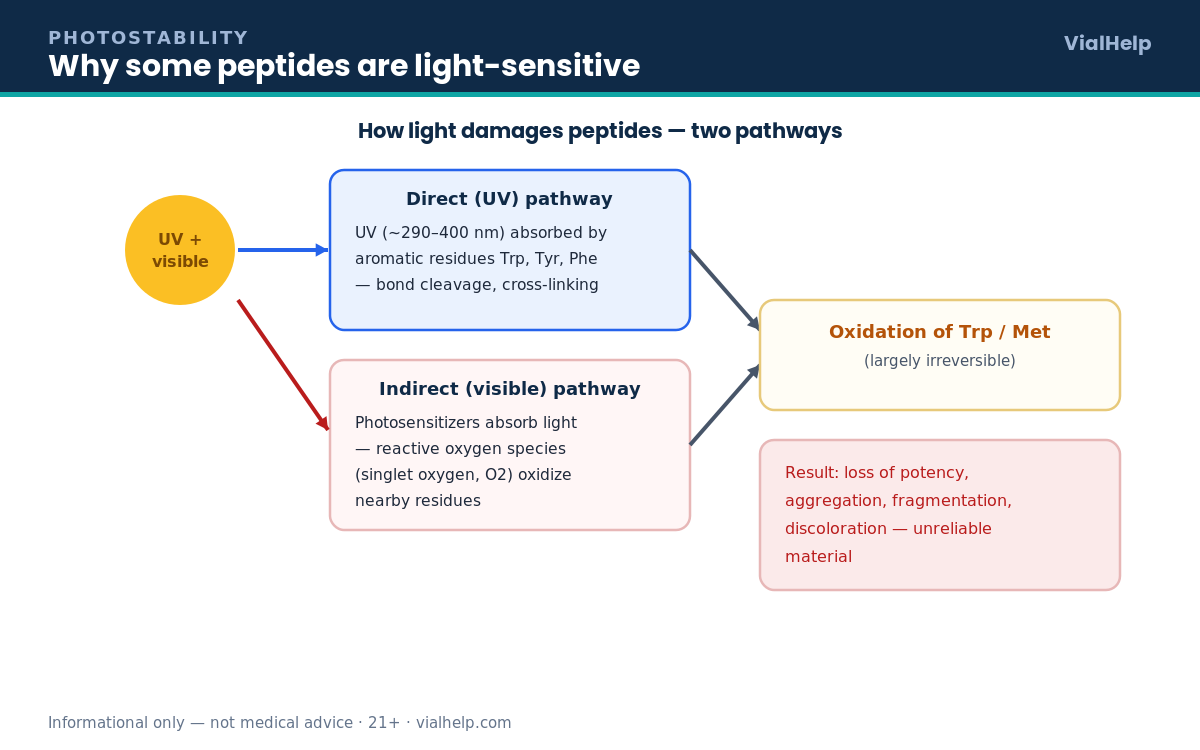
The practical consequences are loss of potency, aggregation, fragmentation and sometimes visible discoloration — in short, material you can no longer rely on.
Why amber vials work
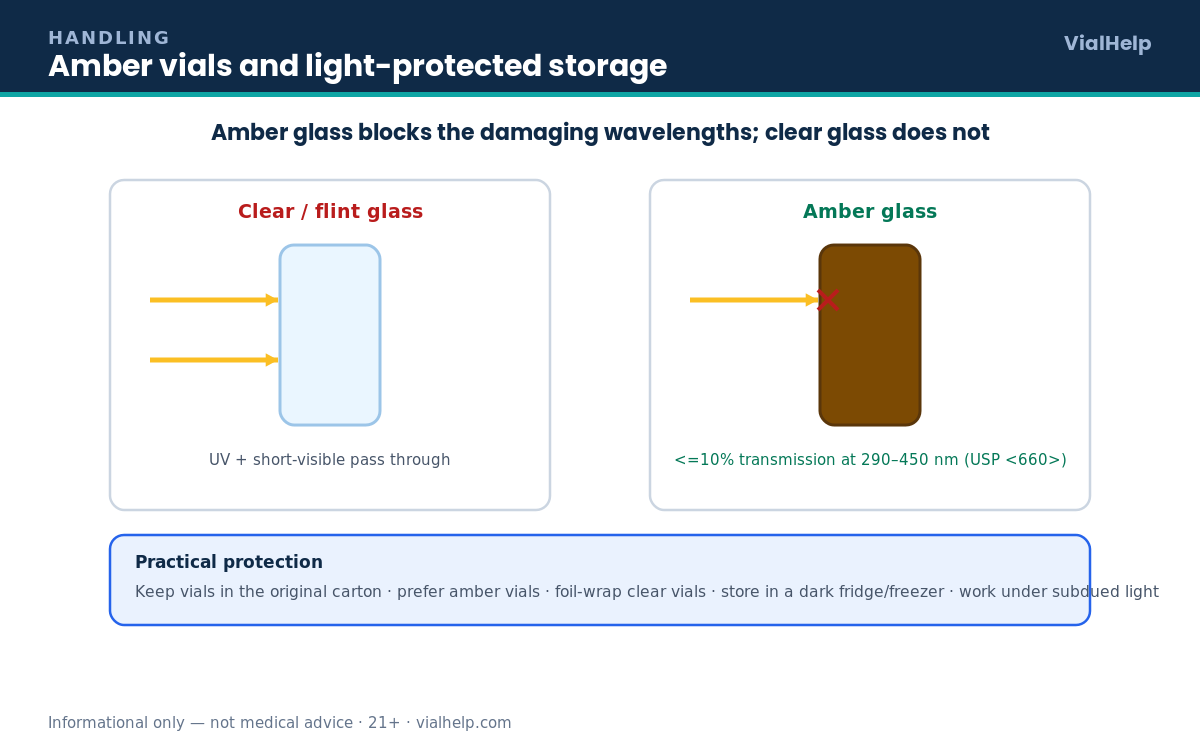
Amber glass is deliberately coloured with metal oxides so that it absorbs ultraviolet and short-wavelength visible light. Under the United States Pharmacopeia glass standard (USP General Chapter <660>), amber containers must keep light transmission low across the damaging 290–450 nm band — on the order of 10% or less for many container types. Clear (flint) glass offers little of this protection: UV passes straight through.
The regulatory benchmark (ICH Q1B)
Pharmaceutical photostability testing follows the ICH Q1B guideline, which defines a standard light “dose” a product should withstand: not less than 1.2 million lux-hours of visible light and not less than 200 watt-hours per square metre of near-UV energy. Importantly, Q1B tests the product inside its packaging precisely because the container and carton are the protective barrier. The key takeaway for handling is that light exposure is cumulative — both intensity and time add up.
Practical handling for light-sensitive material
For research handling, a few simple habits go a long way:
- Keep vials in their original carton and store them in a dark refrigerator or freezer.
- Prefer amber vials; if only clear vials are available, foil-wrap them.
- Work efficiently under subdued light — don’t leave a reconstituted solution sitting under bench or fluorescent lighting.
- Remember that ordinary visible room light, not just UV, can drive oxidation.
These principles pair naturally with the rest of good storage practice — see the peptide storage and stability guide, and use the reconstitution calculator when preparing solutions.
Frequently asked questions
Do all peptides need amber vials? Not all, but many peptides contain light-sensitive aromatic residues, and amber glass is a low-cost precaution. When in doubt, treat material as light-sensitive and store it dark.
Does refrigerator light harm peptides? Brief, intermittent exposure is minor compared with prolonged bench lighting, and most fridge interiors are dark when closed. Keeping vials in their carton removes the question entirely.
Is UV or visible light worse? UV carries more energy per photon and is absorbed directly by the peptide, but visible light can still cause oxidative damage through photosensitizers. Both are worth limiting.
References
- ICH Q1B — Photostability Testing of New Drug Substances and Products. ICH guideline (PDF)
- Kerwin BA, Remmele RL. “Protect from Light: Photodegradation and Protein Biologics.” J Pharm Sci, 2007. PubMed 17230445
- Ehrenshaft M, et al. “Tripping up Trp: oxidation of tryptophan by reactive oxygen species.” PMC4684788
- USP General Chapter <660> Containers—Glass (light-transmission limits for amber glass). USP
Informational only — not medical advice · 21+