
How to Read a Certificate of Analysis (COA) for Peptides
Learning to read a COA — a Certificate of Analysis — is one of the most useful skills for anyone evaluating research peptides. A COA is the one-page lab report a manufacturer issues for a specific batch of material. It tells you what the vial is supposed to contain, how pure it is, how much actual peptide is present, and whether it passed key safety tests. This guide walks through every field on a typical peptide COA, explains what each number really means, and flags the details people most often misread.
What a Certificate of Analysis actually is
A COA is batch-specific. It is generated after a particular lot is synthesized and tested, and it should reference that lot by number. A COA is not a marketing sheet or a general product description — it is a record of measured results for the exact material in front of you. If a seller only offers a generic “typical” COA that is not tied to your lot number, you are looking at a template, not a test report.
Most peptide COAs report a handful of standard analyses: appearance, purity by high-performance liquid chromatography (HPLC), identity by mass spectrometry (MS), net peptide content, counter-ion (salt) form, endotoxin level, and water content. The annotated example below shows where each of these usually sits and what it is telling you.
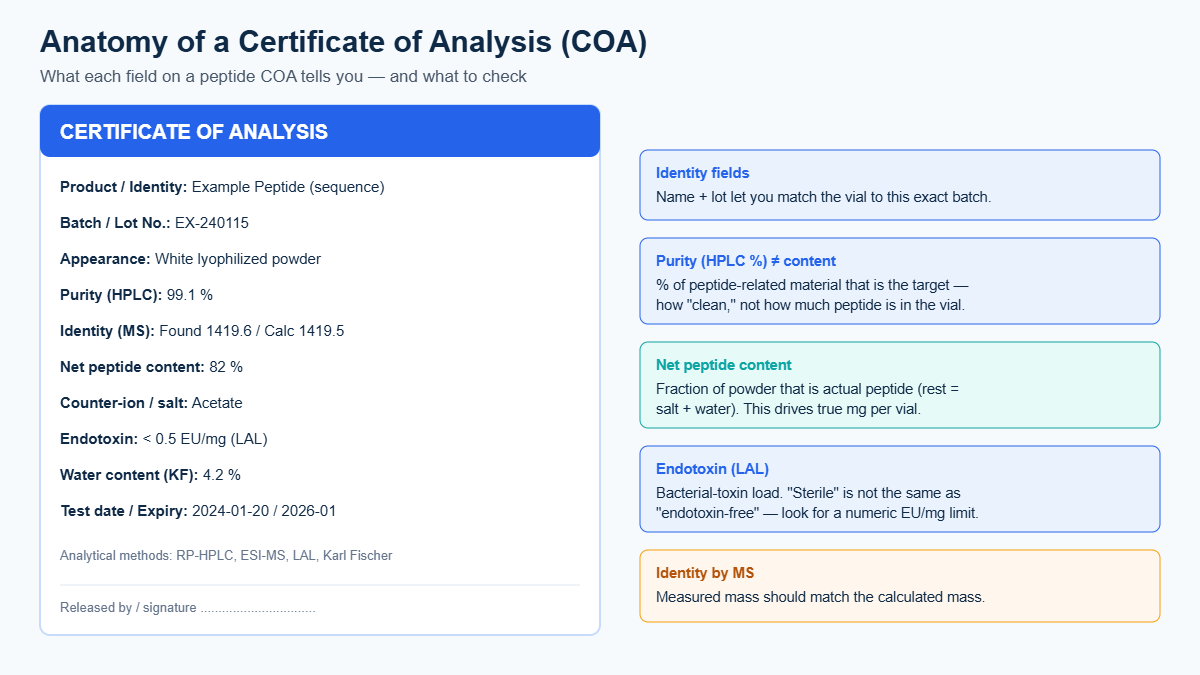
The identity section: name, sequence and lot
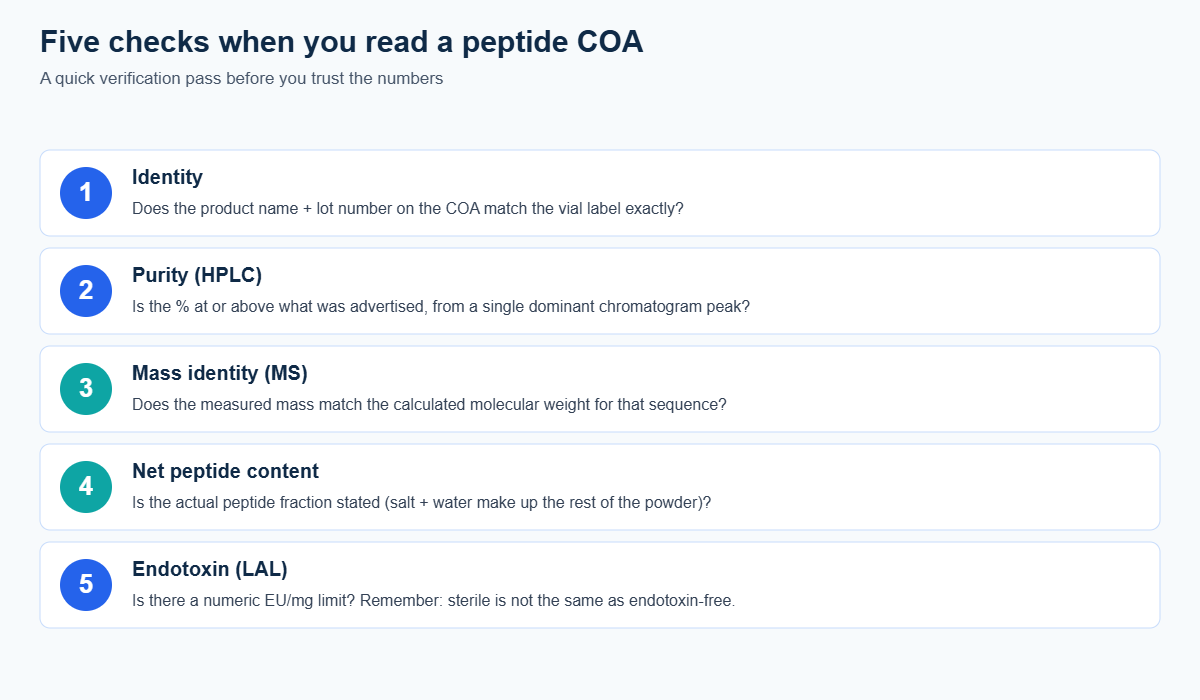
The top of the COA lists the product name, often the amino-acid sequence, and the batch or lot number. Your first check is simple: does this information match the vial label exactly? The lot number is the thread that ties the physical vial to this specific set of test results. A mismatch — or a missing lot number — means the document cannot be trusted to describe what you actually have.
Purity (HPLC): the headline number — and what it is not
Purity is usually reported as a percentage by HPLC, such as 99.1%. HPLC separates the components of a sample and measures the area of each peak; purity is the percentage of peptide-related material represented by the main (target) peak. A high number means the synthesis produced few closely related impurities such as deletion or truncation sequences.
The most common misconception is treating purity as “how much peptide is in the vial.” It is not. Purity describes how clean the peptide fraction is, not how much of the powder is peptide. A vial can be 99% pure and still contain a large fraction of salt and water. That distinction is what the net peptide content field addresses.
Identity by mass spectrometry (MS)
Mass spectrometry confirms that the molecule present is the one named on the label. The COA typically lists a found mass next to a calculated (theoretical) mass for the stated sequence. These should match within a small tolerance. HPLC tells you the sample is clean; MS tells you the clean thing is the right thing. A COA with purity but no identity confirmation is only telling half the story.
Net peptide content: the number that changes your math
Net peptide content is the fraction of the powder that is actually peptide. The rest is made up of the counter-ion (salt) left over from synthesis — commonly acetate or trifluoroacetate (TFA) — plus bound water. Net content is frequently in the 70–90% range. If a “10 mg” vial is 80% net peptide, it contains roughly 8 mg of peptide, not 10 mg.
This is the field that actually affects concentration math. If you reconstitute based on the gross powder mass while the true peptide mass is lower, every downstream figure is off. For the mechanics of that adjustment, see our companion explainer on net peptide content and what “mg” on a vial means, and run the numbers with the reconstitution calculator.
Endotoxin and the LAL test
Endotoxin is a heat-stable toxin from the outer membrane of Gram-negative bacteria. It is measured with the LAL (Limulus amebocyte lysate) test and reported as endotoxin units per milligram (EU/mg). A trustworthy COA states a numeric limit, such as < 0.5 EU/mg. A crucial point: sterile is not the same as endotoxin-free. Filtration can remove live bacteria while leaving their endotoxin behind, so the two are separate checks. Our deeper dive on endotoxins and the LAL test covers the methods in detail.
The remaining fields: appearance, water and salt form
- Appearance — usually “white lyophilized powder.” Discoloration or a description that does not match what you received is worth questioning.
- Water content (Karl Fischer) — residual moisture in the powder, part of what makes net content less than 100%.
- Counter-ion / salt form — acetate or TFA. TFA salts can carry slightly more mass per unit of peptide and are sometimes flagged for sensitive research applications.
- Test date and expiry — confirm the analysis is recent and the material is within its stated shelf life.
- Methods listed — RP-HPLC, ESI- or MALDI-MS, LAL and Karl Fischer are standard. A COA with results but no stated methods is weaker evidence.
COA red flags
- No lot number, or a lot number that does not match the vial.
- Purity stated with no chromatogram and no identity (MS) confirmation.
- No net peptide content — leaving you unable to know the true peptide mass.
- Endotoxin listed as “sterile” or “pass” with no numeric EU/mg value.
- A “typical” or undated template rather than a batch-specific report.
Frequently asked questions
Does 99% purity mean the vial is 99% peptide?
No. Purity is the cleanliness of the peptide fraction by HPLC. The share of the powder that is peptide is the separate net peptide content figure, which is typically lower because of salt and water.
What is a good endotoxin limit?
Trustworthy COAs report a specific numeric value in EU/mg rather than a vague “pass.” Lower is better, and the key is that a real number is stated and measured by LAL.
Why do HPLC and MS both appear on a COA?
They answer different questions. HPLC measures how pure the sample is; MS confirms the molecule is the correct one for the stated sequence. You want both.
Can I verify a COA myself?
You can sanity-check internal consistency — that the lot matches, the calculated mass fits the sequence, and net content is stated — but only the issuing lab can vouch for the underlying measurements. Independent third-party testing is the strongest form of verification.
Related reading
- Reconstitution calculator — turn vial mg and water volume into concentration.
- Net peptide content: what “mg” on a vial means.
- Endotoxins and the LAL test.
- IU vs mL: why “units” is not a dose.
- Peptide reference library.