
Peptide Cold Chain & Shipping: What to Check When Vials Arrive
Handling & Logistics
A peptide cold chain is only as strong as its weakest leg — but for a freeze-dried vial, that leg is more forgiving than most people assume. Here is what actually protects your material in transit, and what to check the moment it lands.
“Cold chain” means an unbroken sequence of temperature-controlled storage and transport that keeps a product within its validated range from origin to end use. For temperature-sensitive peptides, the single most useful idea to understand first is the contrast between a dry cake and a solution: lyophilized (freeze-dried) peptide tolerates a surprising amount of shipping abuse, while reconstituted peptide in water does not.
Why the dry cake travels so well
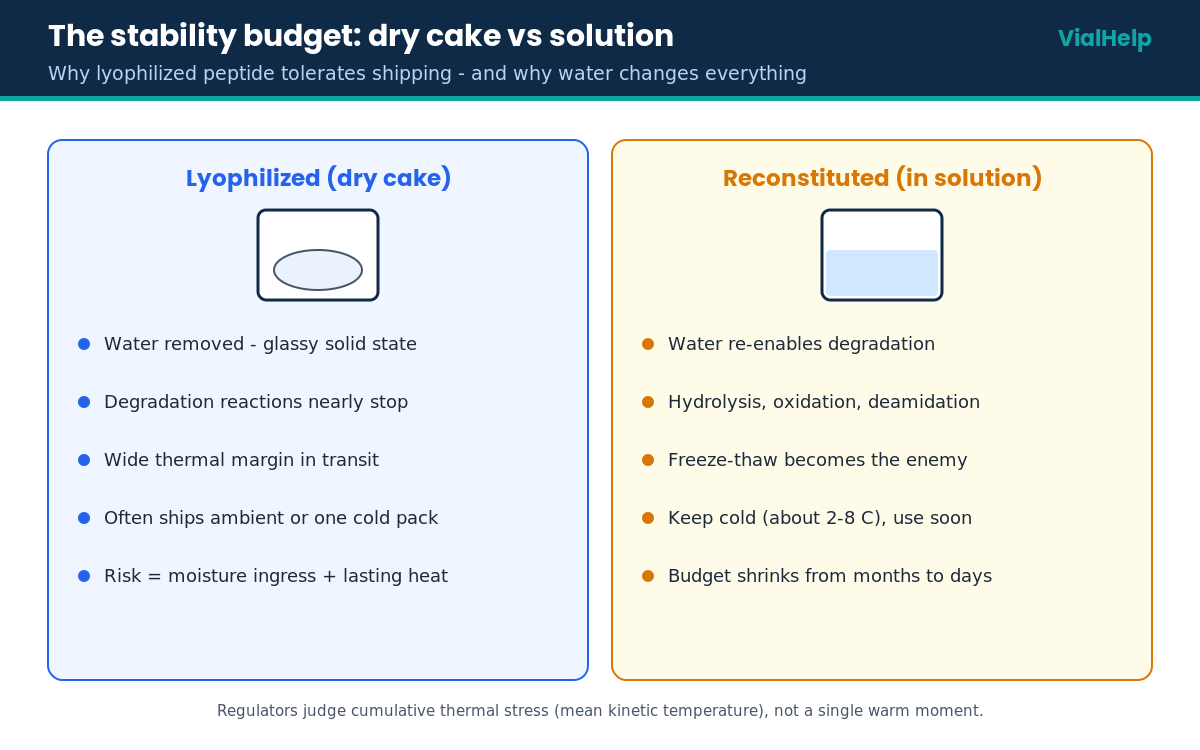
Freeze-drying removes water and locks the peptide into an amorphous, glassy solid. In that state, the water-driven reactions that degrade peptides — hydrolysis, deamidation, oxidation — slow by orders of magnitude because molecular mobility is so restricted. That is why a well-dried, well-sealed cake has a wide thermal margin and why many lyophilized peptides ship at ambient temperature or with a single cold pack as a margin of safety rather than a strict requirement.
Regulators formalize this as a stability budget. Stability data generated under ICH guidelines is explicitly used to evaluate the effect of short-term excursions outside labeled storage conditions, and mean kinetic temperature (USP General Chapter <1079.2>) is the tool used to judge whether transit temperatures were acceptable. The practical takeaway: a brief warm window is not automatically disqualifying — what matters is cumulative thermal stress, not a single warm moment.
Where shipping actually goes wrong
The real degradation risks are not “a few warm days.” They are prolonged heat (every reaction speeds up with temperature) and, for anything in solution, freeze–thaw cycling. Repeated freezing and thawing is widely cited as more damaging than a steady, moderate temperature, because ice formation and re-warming stress the molecule and accelerate oxidation and aggregation. So a parcel that stayed uniformly warm is generally less concerning than a liquid that froze and thawed in transit. Dry ice (about -78 °C) is usually reserved for pre-mixed liquids or the most heat-sensitive items — not routine lyophilized powder.
What a Certificate of Analysis does and does not tell you
A Certificate of Analysis (COA) is lot-specific, point-in-time evidence of identity, purity, and assay at the time of testing — typically identity by spectroscopy and purity by reversed-phase HPLC. It documents what was in the vial at release and may list recommended storage. What it does not do is certify what happened to your specific parcel in transit; it is not a real-time temperature record. To know what actually happened, you need a temperature logger, not the COA.
What to check when your vials arrive
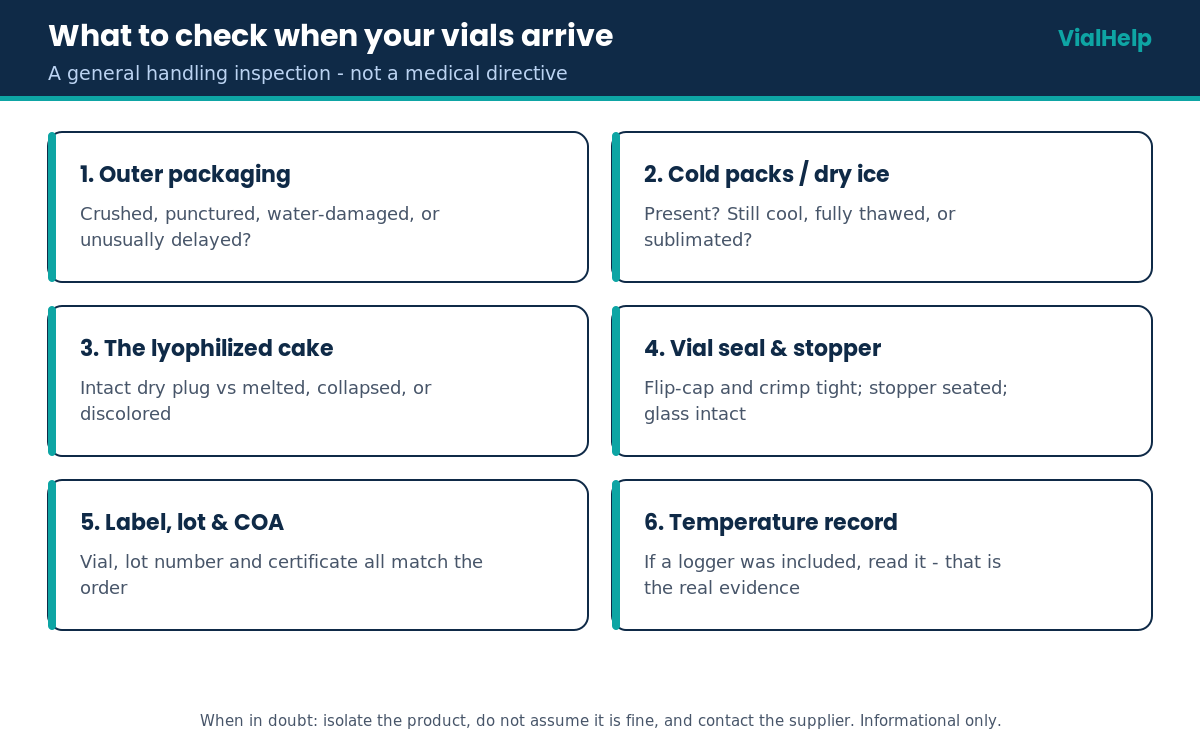
- Outer packaging: crushed, punctured, water-damaged, or unusually delayed shipments raise the odds of broken seals or longer thermal exposure.
- Cold packs / dry ice: note whether they were included and whether they are still cool, fully thawed, or fully sublimated. A warm pack matters more for a strictly-cold or pre-mixed product than for a dry cake.
- The lyophilized cake: it should be an intact, dry, white-to-off-white plug. A melted, collapsed, shrunken, “glassy/puddled,” or discolored cake can indicate heat or moisture exposure. (Minor powdering from vibration is cosmetic.)
- Vial seal and stopper: flip-cap intact, crimp tight, stopper seated, glass uncracked. A compromised seal means moisture and oxygen may have reached the cake.
- Label, lot and COA: confirm the vial label, lot number, and certificate all match each other and the order.
- Temperature record: if a logger or indicator was included, read it — that, not the COA, is the actual transit evidence.
How this connects to storage after arrival
Once received, a dry lyophilized peptide is stable short-term at room temperature, better refrigerated (2–8 °C) for months, and best frozen (around -20 °C, protected from light and moisture) for long-term — keep it dry. A reconstituted vial is fragile: refrigerate it and use within the relevant short window, and do not freeze it casually, since thaw cycling drives degradation. For the full picture, see our peptide storage & stability guide, and use the reconstitution calculator once you are ready to mix.
Frequently asked questions
My peptide arrived warm — is it ruined?
Not necessarily. A short warm window on a sealed, dry vial is usually within its stability budget, since regulators judge cumulative thermal stress (mean kinetic temperature), not a momentary spike. The bigger concerns are a collapsed or discolored cake, a broken seal, or prolonged/repeated heat.
Why did my vial ship without ice?
Because freeze-drying removes the water that drives most degradation, many lyophilized peptides are “excursion-tolerant” and ship at ambient or with one cold pack as a buffer, while still recommending cold storage on arrival. Ice and dry ice are reserved mainly for liquids and the most heat-sensitive items.
Does freeze–thaw during shipping matter?
For reconstituted (in-solution) product, yes — freeze–thaw cycling is a real degradation driver and is generally worse than a steady moderate temperature. A dry cake tolerates cold far better, but a liquid that froze and thawed in transit is a genuine red flag.
How cold does shipping need to be?
There is no single number — it depends on the product’s own validated stability data and its excursion budget. As a general principle, dry lyophilized peptide tolerates near-ambient transit, while anything already in solution should be kept cold (about 2–8 °C) and not frozen.
References
- FDA / ICH Q5C — Stability Testing of Biotechnological/Biological Products. fda.gov
- FDA / ICH Q1A(R2) — Stability Testing of New Drug Substances and Products. fda.gov (PDF)
- USP General Chapter <1079.2> — Mean Kinetic Temperature in the Evaluation of Temperature Excursions. usp.org (PDF)
- CDC — Vaccine Storage and Handling (Pink Book, Chapter 5). cdc.gov
- Strategies for overcoming protein and peptide instability (solid-state stabilization). PMC10526705
Informational only — not medical advice; consult a qualified professional for medical questions. Intended for an audience 21+.