
Why Peptides Are Freeze-Dried: Lyophilization Explained
Peptide handling · Storage science
Open a research peptide vial and you may find what looks like an almost-empty container — a thin film or a few flakes at the bottom. That is the result of lyophilization, or freeze-drying, the process used to turn a peptide solution into a stable dry powder.
Understanding why peptides are freeze-dried explains how to store and handle them, why the powder sometimes looks like almost nothing, and why a reconstituted solution has a much shorter shelf life than the sealed vial.
What lyophilization is
Lyophilization removes water from a frozen product by sublimation — ice turning directly into vapor — under vacuum, rather than by boiling it off. Because the material never warms appreciably and never passes through a destructive liquid-evaporation step, fragile molecules like peptides survive far better than they would with ordinary drying. It runs in three stages:
- Freezing: the solution is cooled until the water solidifies into ice, concentrating the dissolved solids between the ice crystals.
- Primary drying: a deep vacuum is drawn and gentle heat applied, so the ice sublimes directly to vapor and is captured on a cold condenser. This removes the bulk of the water.
- Secondary drying: the temperature is raised (vacuum maintained) to desorb the water still clinging to the solid, down to a low residual level.
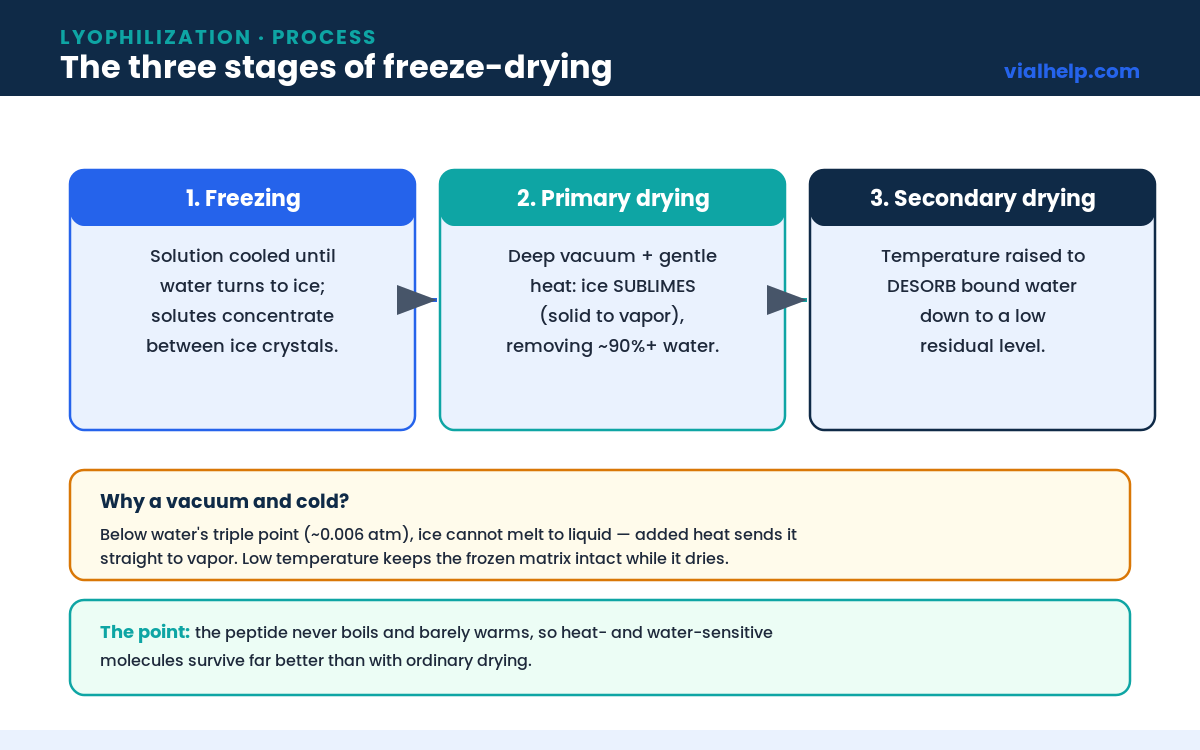
The vacuum and cold are not incidental. Below water’s triple point (about 0.006 atm), ice cannot melt into liquid — add heat and it goes straight to vapor. Low temperature keeps the frozen matrix structurally intact while it dries.
Why peptides specifically are freeze-dried
The short version: water is the enemy of peptide stability. Almost every pathway that degrades a peptide needs liquid water as a reaction medium or reactant. Remove the water and you slow them all down dramatically. The main routes suppressed by the dry state include:
- Hydrolysis — cleavage of the peptide bond, which requires water.
- Deamidation — water-mediated conversion of asparagine/glutamine side chains.
- Oxidation — of methionine, cysteine, tryptophan and histidine, worse in solution.
- Aggregation — a solution-phase clumping of peptide chains.
- Microbial growth — which needs available water; a dry cake denies it.
The payoff is stability and shippability. A sealed lyophilized vial typically holds activity for long periods when kept cold, whereas a reconstituted solution is good only days to a few weeks refrigerated. Removing the water is also what makes ambient or refrigerated shipping practical. (These shelf-life ranges are general guidance and depend on the specific sequence.)
Reading the cake
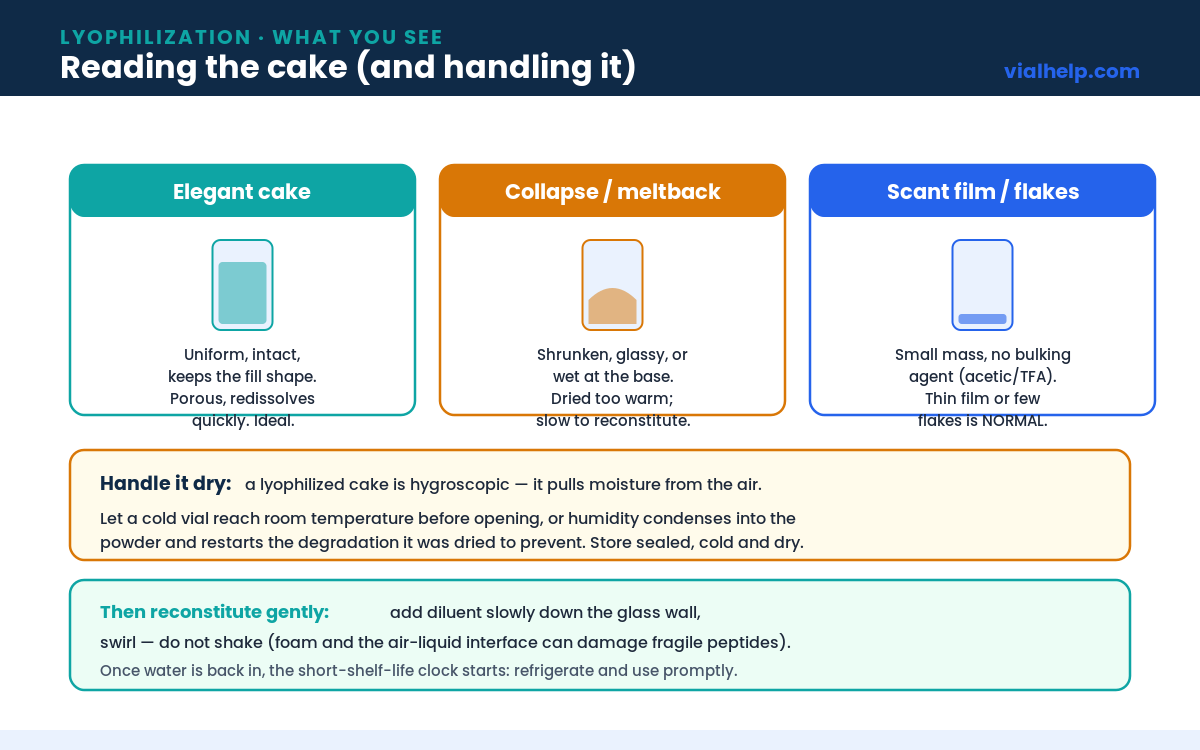
A high-quality lyophilized product forms a cake — ideally uniform, intact, and holding the shape of the original frozen fill. It is porous, which is exactly what lets it redissolve quickly. Two kinds of imperfection are worth recognizing, plus one appearance that looks wrong but is normal:
- Collapse or meltback: a shrunken, glassy, or wet-looking cake, usually from drying too warm. It can reconstitute slowly.
- Scant film or flakes: many research peptides are lyophilized from acetic-acid or TFA solutions with little or no bulking agent. When the peptide mass is small, there may be no visible cake at all — just a thin film or a few flakes. This is normal, not a missing or defective product.
Handling implications
A lyophilized cake is hygroscopic — it readily pulls moisture from the air. If you open a cold vial straight from the freezer, humidity condenses onto and into the cold powder, prematurely reintroducing the very water lyophilization removed and restarting degradation.
- Warm the vial first: let a sealed vial reach room temperature before breaking the seal, so no condensation forms.
- Store sealed, cold and dry: commonly −20 °C (colder for long-term), protected from light and moisture; minimize open-close and freeze–thaw cycles.
Reconstitution: gentle is the rule
When you add diluent such as bacteriostatic water, aim the stream down the inside glass wall so it runs onto the cake rather than blasting the powder; this prevents foaming. Then swirl, do not shake — vigorous shaking creates foam and an air–liquid interface that can denature or aggregate fragile peptides. Once water is back in, the short-shelf-life clock starts, so refrigerate and use promptly. Our reconstitution guide walks through the full technique, and the reconstitution calculator handles the mg/mL math.
Frequently asked questions
Why does my peptide vial look empty?
Because a small mass of peptide lyophilized without a bulking agent leaves only a thin film or a few flakes. That scant appearance is normal; the peptide is there.
Is freeze-dried peptide more stable than peptide in solution?
Yes. Removing water suppresses hydrolysis, deamidation, oxidation, aggregation and microbial growth, so the dry cake is far more stable than the same peptide reconstituted.
Why warm the vial before opening?
A cold, hygroscopic cake will pull condensation from room air the moment the seal is broken, adding moisture and seeding degradation. Letting it reach room temperature first avoids that.
Related reading
- U.S. FDA. Guide to Inspections of Lyophilization of Parenterals (7/93). fda.gov
- Manning MC, et al. Stability of Protein Pharmaceuticals: An Update. Pharm Res 2010;27(4):544-575. springer.com
- Lai MC, Topp EM. Solid-State Chemical Stability of Proteins and Peptides. J Pharm Sci 1999;88(5):489-500. wiley.com
- Patel SM, et al. Lyophilized Drug Product Cake Appearance: What Is Acceptable? J Pharm Sci 2017;106(7):1706-1721. sciencedirect.com