
Peptide Salt Forms: Acetate vs TFA (and Your Concentration Math)
Synthetic research peptides almost never come as pure peptide. They arrive as a salt — usually a trifluoroacetate (TFA) or acetate salt — and the salt form quietly changes how much actual peptide sits in the vial. Knowing your peptide salt forms is the difference between a concentration you can trust and one that is off by 20–30%.
Why peptides come as salts at all
Most peptides carry basic groups — the guanidino group of arginine, the amino group of lysine, the free N-terminus, the imidazole of histidine — that pair with an acid to form a salt. On top of that, the way peptides are made bakes in a counter-ion: solid-phase peptide synthesis (SPPS) uses trifluoroacetic acid during cleavage from the resin, and reversed-phase HPLC purification uses TFA as the standard mobile-phase additive. The finished peptide therefore ends up paired with trifluoroacetate ions. Unless a supplier says otherwise, the default is a TFA salt; any other form takes an extra step.
The TFA (trifluoroacetate) salt
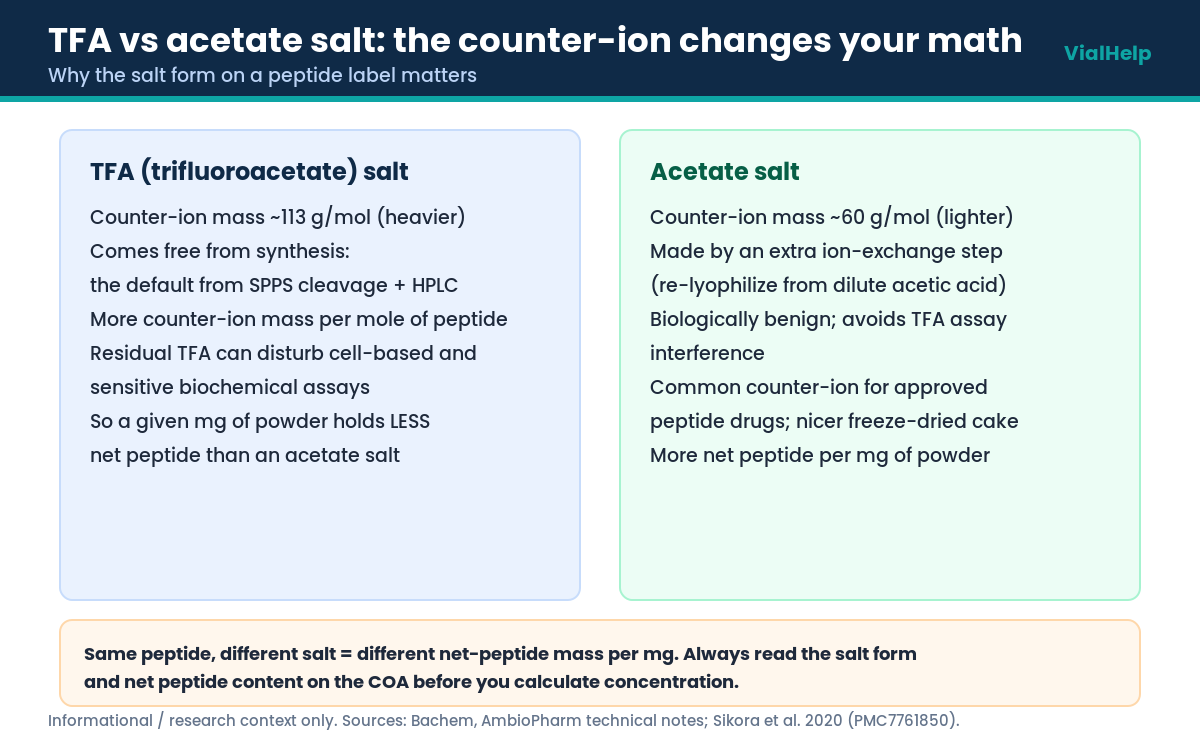
The TFA salt is what you get “for free” from synthesis and purification. Its counter-ion (trifluoroacetate, roughly 113 g/mol as the acid) is relatively heavy, so a given mass of TFA-salt powder carries more counter-ion mass — and therefore less peptide — per milligram than the same peptide as a lighter salt. Residual TFA also has a documented history of interfering with sensitive cell-based and biochemical assays (for example, inhibiting proliferation of osteoblasts and chondrocytes), which is why labs doing delicate work sometimes ask for it to be removed.
The acetate salt, and why it is often preferred
Converting a TFA salt to an acetate salt is a deliberate ion-exchange step — commonly repeated lyophilization from dilute acetic acid, or chromatography using acetate as the counter-ion. Acetate (about 60 g/mol) is lighter and biologically benign, it avoids TFA’s assay interference, and it tends to produce a nicer freeze-dried cake. Acetate is also the counter-ion of choice for many approved peptide drugs. The trade-off is simply an extra manufacturing step.
Net peptide content: the powder is not all peptide
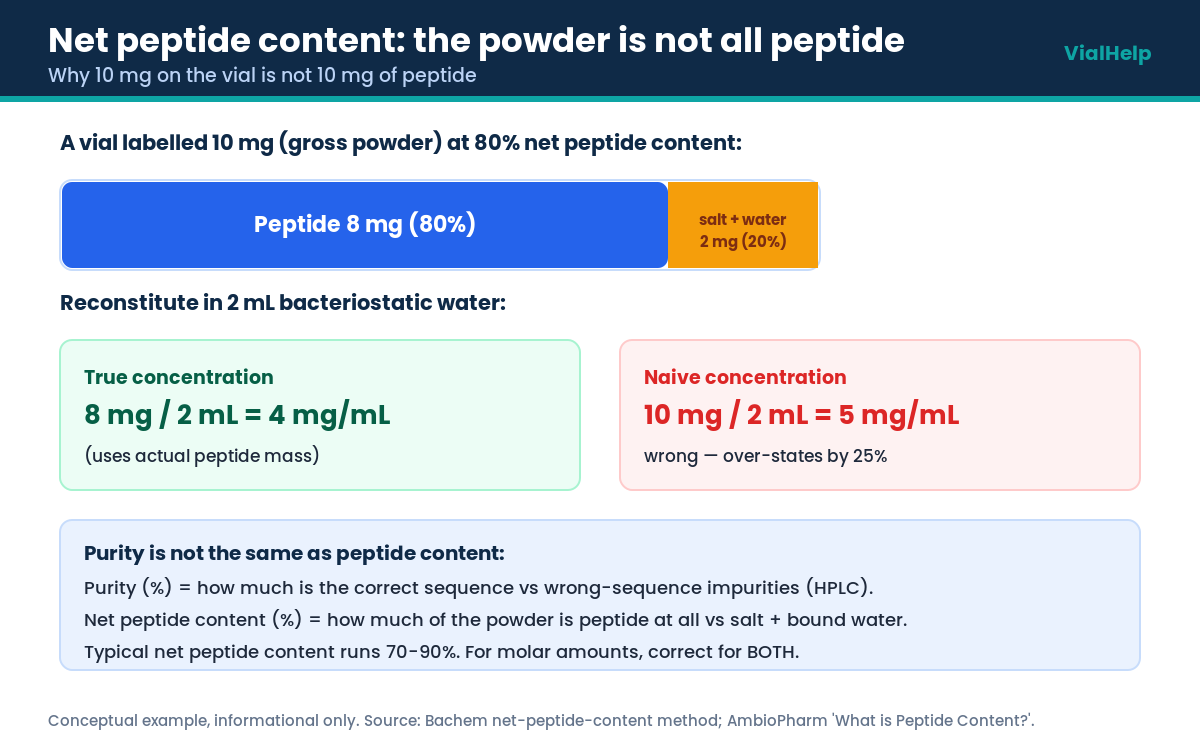
Here is the part that actually changes your math. The gross weight of a lyophilized peptide is peptide + counter-ions + bound water. The fraction that is truly peptide is the net peptide content, and it typically runs 70–90%. Crucially, net peptide content is not the same as purity: purity (from HPLC) tells you how much of the material is the correct sequence versus wrong-sequence impurities, while net peptide content tells you how much of the powder is peptide at all versus salt and water.
How a certificate of analysis reports it
A good certificate of analysis (COA) will state the salt form (often right in the product name, e.g. “… acetate salt”), the HPLC purity, the net peptide content (sometimes called “assay”), the counter-ion identity and content, and the water content by Karl Fischer. A useful sanity check: peptide content + counter-ion content + water content should add up to roughly 100%. If the sum falls well short, something undocumented is in the powder.
What it means for your reconstitution math
Frequently asked questions
Is a TFA salt bad?
Not inherently — a couple of approved peptide drugs are marketed as TFA salts. But residual TFA can confound sensitive cell and biochemical assays, and it adds heavier counter-ion mass, so acetate is often preferred for research and later-stage development.
Does the salt form change the molecular weight of the peptide?
No. The peptide molecule is identical; only the counter-ion paired with it differs. What changes is how much of a given powder mass is peptide versus salt.
Is 98% purity the same as 98% peptide?
No. Purity is about correct sequence versus impurities; peptide content is about peptide versus salt and water. A 98%-pure peptide can still be only ~80% peptide by mass.
References
- Sikora et al. 2020 — The Role of Counter-Ions in Peptides (Pharmaceuticals, PMC7761850)
- AmbioPharm — What is Peptide Content?
- AmbioPharm — Which salt form should I choose for my peptide?
- Bachem — Frequently Asked Questions (net peptide content)
- Cornish et al. 1999 — Trifluoroacetate inhibits osteoblast/chondrocyte proliferation (PMID 10567002)
Informational only — not medical advice · research/lab context · 21+. This article covers laboratory measurement, not personal dosing.