
Bacteriostatic Water vs Sterile Water vs SWFI: Which Diluent?
Handling & basics
Bacteriostatic water and sterile water look almost identical on the shelf, but the choice of bacteriostatic water vs sterile water comes down to one thing: whether the vial contains a preservative. That single difference decides whether you can re-enter the vial over days, or must use it once and throw it away.
Bacteriostatic water vs sterile water: the one difference that matters
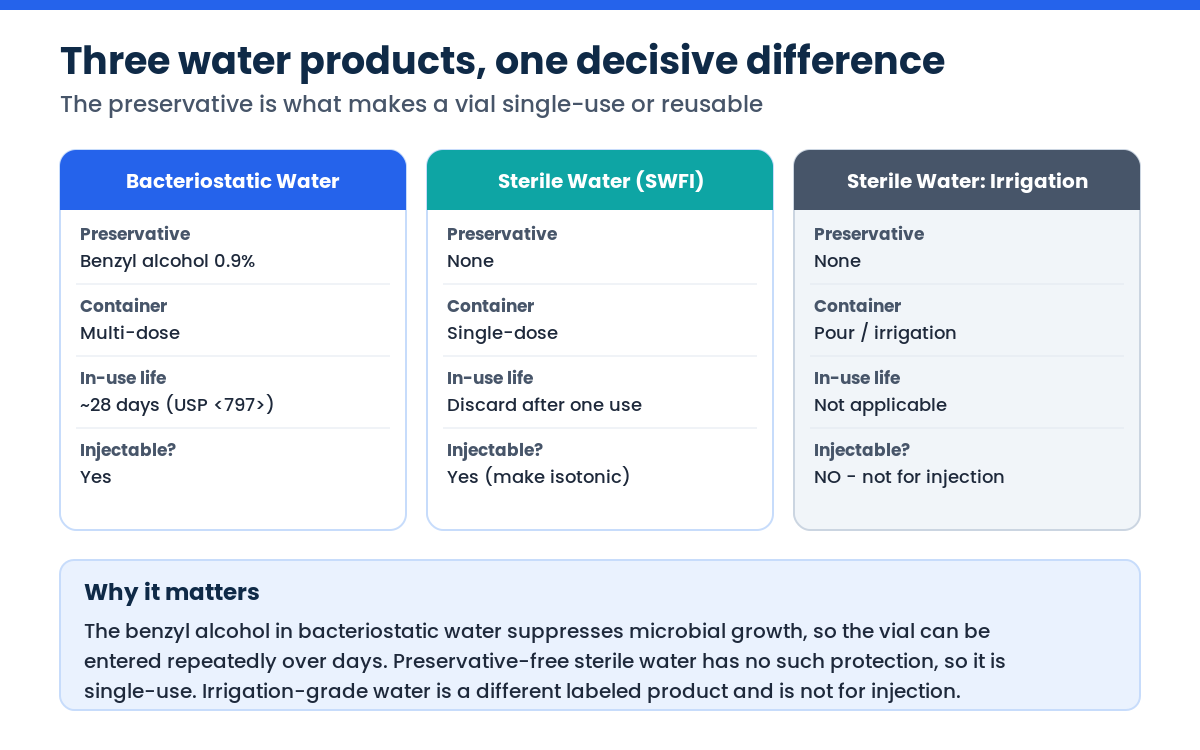
Three products get mixed up because their names overlap — Bacteriostatic Water for Injection (BWFI), Sterile Water for Injection (SWFI), and Sterile Water for Irrigation. All three are purified water. Only one contains a preservative, and that is what makes it reusable.
Bacteriostatic Water for Injection (BWFI)
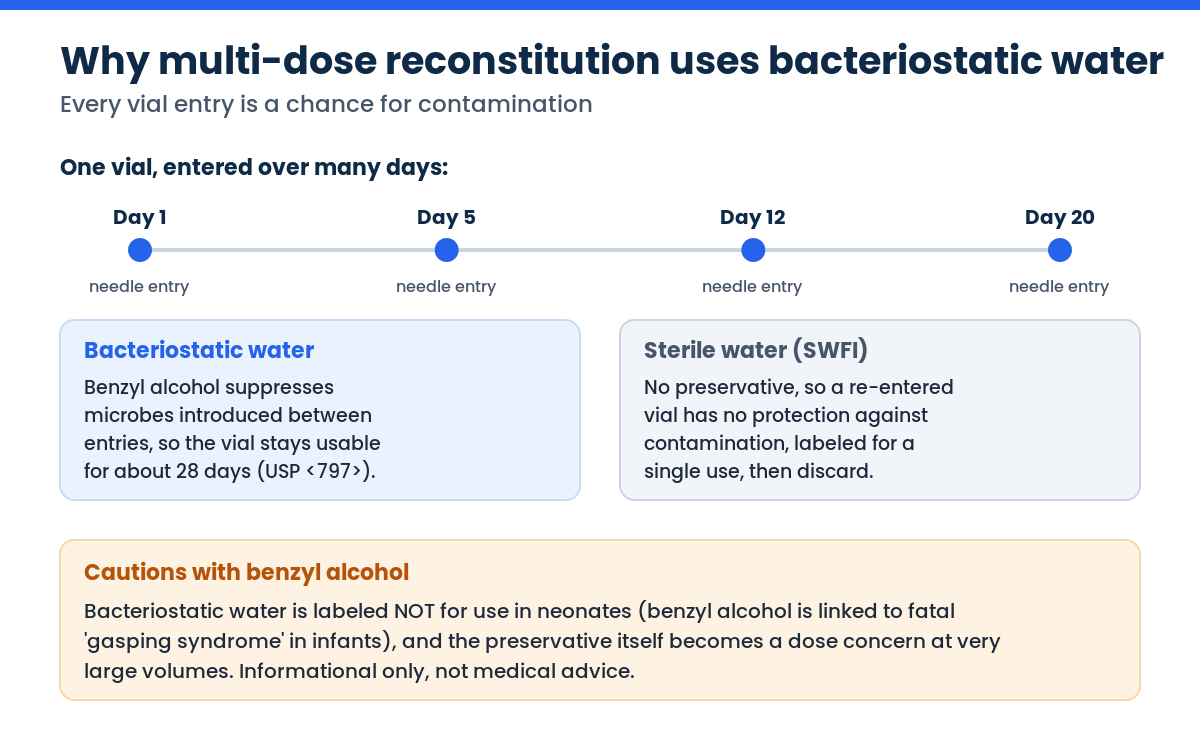
According to the manufacturer’s package insert, bacteriostatic water is sterile water with 0.9% (9 mg/mL) benzyl alcohol added as a bacteriostatic preservative, supplied in a multiple-dose container from which repeated withdrawals may be made. “Bacteriostatic” means the benzyl alcohol slows or stops microbial growth — it does not sterilize an already-contaminated solution. Because the preservative limits growth of organisms introduced between needle entries, a preserved multi-dose vial carries a beyond-use date of 28 days after first entry under USP <797> (unless the manufacturer states otherwise).
Sterile Water for Injection (SWFI)
SWFI is, per its label, a sterile, nonpyrogenic preparation that contains no bacteriostat, antimicrobial agent, or added buffer, and is supplied only in single-dose containers. With no preservative, the label directs you to discard the unused portion and not reuse the vial. SWFI is also hypotonic: injected in volume without a solute it can cause hemolysis (rupture of red blood cells), so it must be made approximately isotonic before intravenous use.
“Sterile water” for irrigation is not for injection
A third product, Sterile Water for Irrigation, is the same pure water but a different labeled product intended for irrigating wounds, catheters, or surgical fields. Its label explicitly states “Not for injection.” Similar name, different intended use — it is not manufactured, tested, or labeled to the injectable standard, so it should never be used to reconstitute an injectable.
Why multi-dose reconstitution uses bacteriostatic water
Reconstituted material is usually drawn from the same vial repeatedly over many days, and every needle entry is an opportunity for contamination. That is exactly the scenario bacteriostatic water is designed for: a multi-dose vial whose benzyl alcohol suppresses microbial growth between entries. Preservative-free sterile water offers no such protection, which is why it is labeled single-use — the core reason bacteriostatic water is the usual choice when a vial will be entered more than once.
When sterile water is the better choice
- Genuinely single-use reconstitution, where the whole amount is used at once and no preservative is needed.
- Benzyl-alcohol sensitivity, where the preservative must be avoided.
- Very large volumes, where the amount of benzyl alcohol itself becomes a concern.
Practical handling notes
- Store water vials at controlled room temperature, out of light; refrigerate reconstituted material per the compound’s own guidance.
- Label the first-entry date on a bacteriostatic (multi-dose) vial and track the ~28-day window; discard on schedule regardless of remaining volume.
- Use aseptic technique on every entry: wipe the stopper, use a fresh sterile needle.
- Never substitute tap, distilled, spring, or bottled drinking water — none are sterile, pyrogen-free, or made to injectable standards.
- Do not use irrigation-grade water for injection.
Frequently asked questions
Can I use sterile water instead of bacteriostatic water?
For a single use, yes — but discard the vial afterward, because it has no preservative. For a vial you will enter over several days, bacteriostatic water is the product designed for that.
How long is bacteriostatic water good after opening?
Under USP <797>, a preserved multi-dose vial carries a 28-day beyond-use date after first entry unless the manufacturer specifies otherwise. Label the date you first entered it.
What is the preservative in bacteriostatic water?
Benzyl alcohol, typically at 0.9% (9 mg/mL). It slows microbial growth but does not sterilize a contaminated solution.
Is bottled or distilled water an alternative?
No. Bottled, distilled, and tap water are not sterile, pyrogen-free, or manufactured to injectable standards and should never be used.
References
- Bacteriostatic Water for Injection, USP — Package Insert (Hospira/Pfizer). labeling.pfizer.com
- Bacteriostatic Water for Injection — DailyMed label. dailymed.nlm.nih.gov
- Sterile Water for Injection, USP — Single-Dose Vial PI (DailyMed). dailymed.nlm.nih.gov
- Sterile Water for Irrigation, USP — PI, “Not for injection” (B. Braun). dailymed.nlm.nih.gov
- USP General Chapter <797> Pharmaceutical Compounding — Sterile Preparations. uspnf.com
- Benzyl alcohol and neonatal “gasping syndrome” (PMC6105181). ncbi.nlm.nih.gov
Informational only — not medical advice · 21+. This article summarizes publicly available regulatory and manufacturer labeling; it does not endorse any use or provide dosing guidance.