
What DAC Means on a Peptide: Drug Affinity Complex Explained
Peptide science · informational
“DAC” on a peptide stands for Drug Affinity Complex — a small chemical handle that lets a short-lived peptide latch onto your own blood albumin and last for days instead of minutes. It is the single feature that separates CJC-1295 with DAC from its much shorter-acting cousin.
What does DAC mean on a peptide?
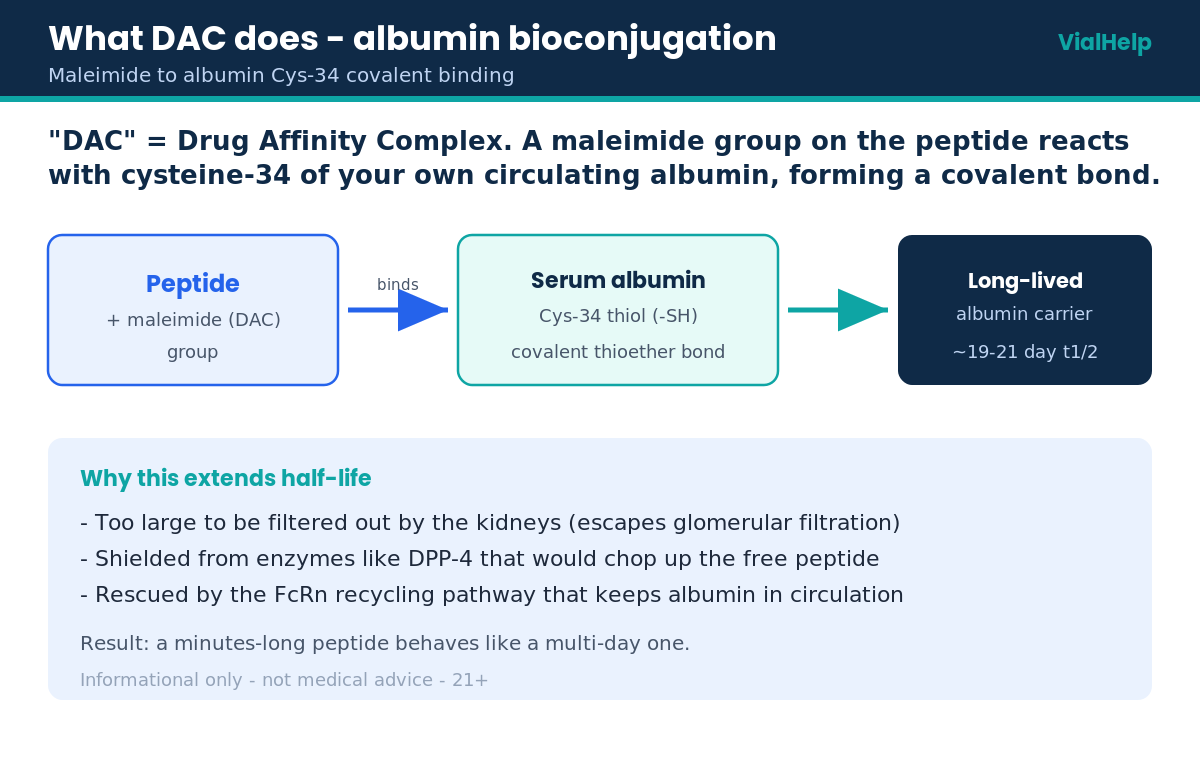
DAC is short for Drug Affinity Complex, a half-life-extension technology. Chemically, the DAC group is a reactive maleimido-propionyl (maleimide) handle attached to the peptide. After injection, that maleimide quietly reacts with a free sulfur atom on cysteine-34 of circulating serum albumin, forming a stable covalent bond. In other words, the peptide hitchhikes onto one of the most abundant, longest-lived carrier proteins in the blood.
Because the peptide is now riding on albumin, two things change dramatically: it becomes too large to be filtered out by the kidneys, and it is shielded from the enzymes that would normally chop it up within minutes. The result is a peptide that behaves like a multi-day drug.
CJC-1295: the classic DAC example
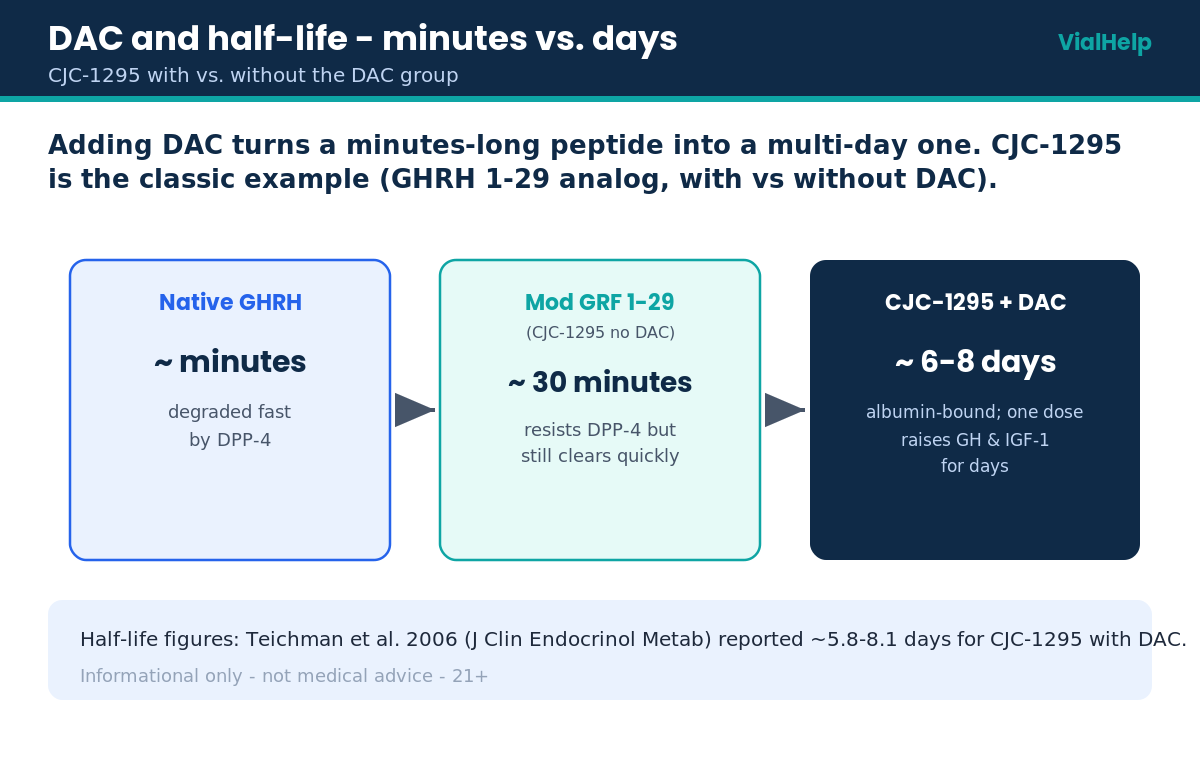
CJC-1295 is a modified analog of GHRH (1-29), the growth-hormone-releasing hormone fragment also found in sermorelin. It carries amino-acid substitutions that resist enzymatic breakdown, plus the DAC group. The DAC-versus-no-DAC distinction is the key teaching point:
In the foundational human study, a single subcutaneous injection of CJC-1295 with DAC raised mean growth hormone 2- to 10-fold for six days or more, and IGF-1 1.5- to 3-fold for 9–11 days. With repeated weekly dosing, IGF-1 stayed elevated for up to 28 days. That sustained response is the practical signature of albumin-bound, long-circulating exposure.
How albumin binding stretches half-life
Albumin is unusually long-lived for a blood protein, with a half-life of about 19–21 days. Two features explain its longevity, and a DAC-tagged peptide borrows both:
- Size: at roughly 66 kDa, albumin sits above the kidney’s filtration threshold, so it is not lost in urine the way small peptides are.
- FcRn recycling: the neonatal Fc receptor captures albumin inside cells at acidic pH and ships it back out to the bloodstream, rescuing it from breakdown.
DAC is not the only albumin trick
Binding to albumin is a broad strategy, but the method matters. DAC forms a covalent bond to albumin’s cysteine-34. A related but distinct approach is fatty-acid acylation, used in the GLP-1 drugs semaglutide and liraglutide: a lipid tail binds albumin reversibly, without a permanent chemical bond. Both extend half-life by leaning on albumin, but one is a covalent conjugate and the other is a reversible association — a distinction worth keeping straight.
Frequently asked questions
Is CJC-1295 with DAC the same as Modified GRF (1-29)?
No. Modified GRF (1-29) is the version without the DAC group and clears in about 30 minutes. “CJC-1295” properly refers to the DAC-bearing, multi-day version.
Does DAC make a peptide stronger?
Not more potent per molecule — it makes the effect last much longer by keeping the peptide in circulation, which is a different thing from raw potency.
Is the DAC bond permanent?
It is a stable covalent bond to albumin, so it persists until the albumin itself is recycled or cleared. That is why the effect is measured in days.
Is CJC-1295 an approved drug?
No. It reached early clinical research and was not approved. This article is informational and educational only.
- Teichman SL, et al. Prolonged stimulation of GH and IGF-1 secretion by CJC-1295. J Clin Endocrinol Metab 2006 (PMID 16352683). link
- Jetté L, et al. hGRF(1-29)-albumin bioconjugates — identification of CJC-1295. Endocrinology 2005 (PMID 15817669). link
- CJC-1295 — Wikipedia (DAC mechanism, nomenclature, half-life). link
- Sand KMK, et al. Unraveling the interaction between FcRn and albumin. 2014 (PMID 24652290). link
- Zorzi A, et al. Chemical strategies for half-life extension: lipidation and alternatives. (PMC6047018). link
- Knudsen LB, Lau J. The discovery and development of liraglutide and semaglutide. (PMC6474072). link
Informational only. This guide is for educational and laboratory/measurement purposes and is not medical advice. It does not recommend or instruct personal human use. Consult a qualified healthcare professional for any health decision. Content is intended for adults 21+. Verify scientific details against the primary sources cited.