
Agonists vs Antagonists: How Peptides Talk to Receptors
Peptide science
Agonists and antagonists are the two words that decide what a peptide actually does once it reaches its target — and almost every peptide you will read about is described using them. A compound is not “strong” or “weak” in the abstract. It binds a receptor, and what happens next depends on two separate properties: how tightly it holds on, and what it tells the receptor to do. Those two things are independent, and confusing them is the single most common mistake in peptide writing.
What a receptor actually is
A receptor is a protein that reads a chemical message. Signal transduction begins when a messenger acts as a ligand and binds a specific receptor; that binding forces a shape change in the receptor, which activates it and starts a chain of events inside the cell.
Peptides are water-loving molecules. They cannot slip through the fatty cell membrane the way a steroid can, so they act on receptors sitting on the cell surface. This is why testosterone and a peptide like ipamorelin work so differently: one walks into the cell and talks to DNA, the other knocks on the door from outside.
Many peptide receptors are G protein-coupled receptors, or GPCRs — a seven-pass membrane protein that, once activated, swaps GDP for GTP on an attached G protein and sets off a cascade. GPCRs are the largest family of proteins targeted by approved drugs; a dedicated 2018 analysis in Molecular Pharmacology put roughly 35% of approved drugs at GPCR targets, while other sources commonly cite around 30%. The exact figure is genuinely contested, which is worth knowing when you see it quoted as gospel.

Full agonist: binds and fully activates
A full agonist produces the maximal biological response the system can give. In the language of pharmacology it has maximal positive intrinsic activity — it occupies the receptor and turns it all the way on.
Semaglutide is a clean example. Its FDA label describes it as a GLP-1 analogue with 94% sequence homology to human GLP-1 that “selectively binds to and activates the GLP-1 receptor, the target for native GLP-1.” It does what the natural hormone does, just for far longer. If you want the underlying biology, see our explainer on what GLP-1 actually is.
Partial agonist: activates, but only so far
A partial agonist binds and activates, but produces a submaximal response even when every receptor is occupied. Adding more will not get you to the ceiling — the ceiling itself is lower.
This produces a genuinely counterintuitive consequence. In a system already flooded with a full agonist, a partial agonist behaves as a functional antagonist: while it is sitting on the receptor, the full agonist cannot bind, so the overall response goes down. The same molecule can raise activity in a quiet system and lower it in a loud one.
Why would anyone want less activation? Because, as the University of Minnesota’s pharmacology text puts it, a full agonist “may cause too much activation resulting in toxicity or receptor adaptation on prolonged use (desensitization, downregulation). The lower efficacy of partial agonists minimizes these complications.” Hold onto that idea — it returns below.
Antagonist: binds and does nothing
An antagonist has affinity but no intrinsic activity. It occupies the receptor and blocks the agonist, without sending a signal itself. That is not the same as having no effect on the body — blocking a busy receptor changes plenty.
- Competitive (surmountable). Binds the same site, reversibly. Enough agonist will outcompete it. It shifts the dose-response curve right without lowering the maximum.
- Non-competitive (insurmountable). Either binds covalently and irreversibly, or binds a different allosteric site. Piling on more agonist does not displace it, and the maximum response itself falls.
- The spare-receptor wrinkle. Many tissues have more receptors than they need. An irreversible antagonist can knock some out with no drop in maximum response at all — until the spares run out.
Inverse agonist: the one everyone gets wrong
Here is the assumption worth discarding: that a receptor sits inert until a ligand arrives. Many receptors have constitutive activity — they signal on their own, with nothing bound.
The ghrelin receptor is the textbook case, and it happens to be the receptor that ipamorelin and MK-677 target. According to the IUPHAR/BPS Guide to Pharmacology, “in the absence of any ligand, the ghrelinR signals with almost 50 percent constitutive activity.” Half on, with nothing bound. This is an intrinsic property of the receptor itself, not an artefact.
Once a receptor has a baseline, a fourth option opens up. An inverse agonist has negative intrinsic activity: it binds and pushes signalling below the resting level. An antagonist at a constitutively active receptor holds the baseline where it is. An inverse agonist drags it down. Those are different drugs with different consequences, and this is why “blocker” is a lazy word.
Affinity, efficacy and potency are three different things
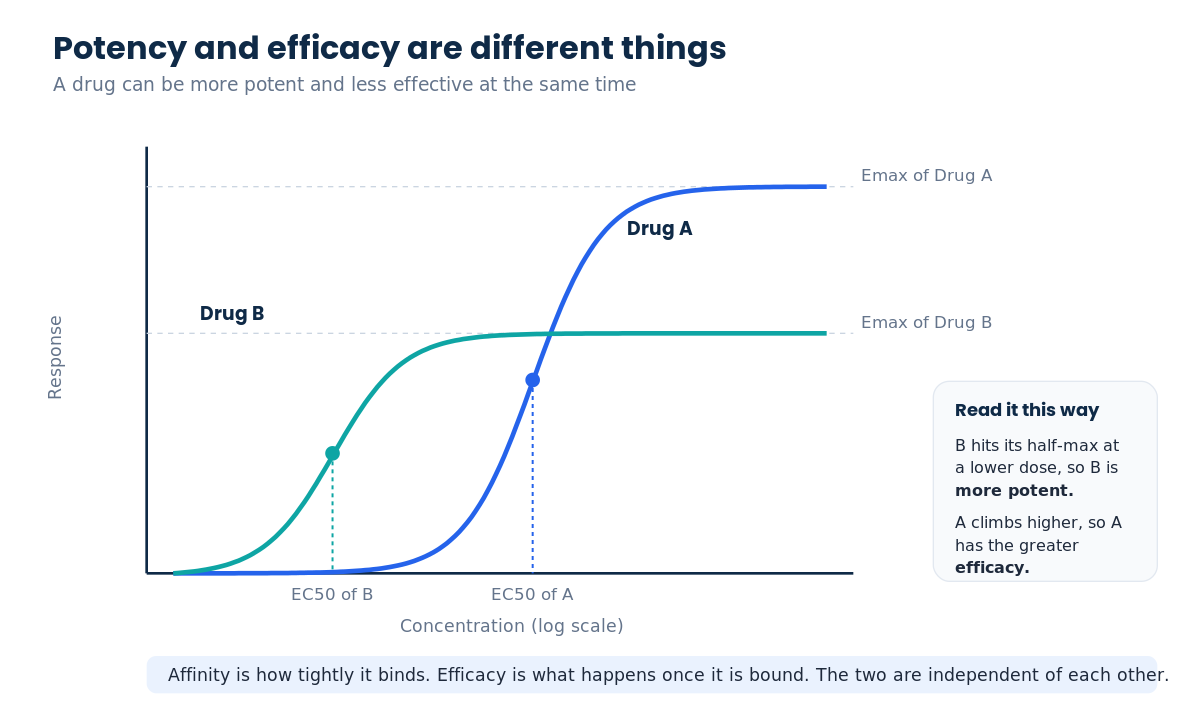
- Affinity — how tightly the ligand binds, expressed as KD. Lower KD means higher affinity. It is a function of both how fast the ligand binds and how fast it lets go.
- Efficacy — what happens once it is bound: the maximal response achievable, Emax. On a simple scale, a full agonist has an efficacy of one and an antagonist zero.
- Potency — the concentration producing 50% of the maximal response, EC50. Lower EC50 means more potent.
Potency and efficacy are independent. IUPHAR’s own teaching figure makes the point bluntly: the drug with the highest potency has the lowest efficacy, and vice versa. Potency differences can be erased by giving more drug; an efficacy ceiling cannot. “More potent” is not a synonym for “better.”
Biased agonism: same receptor, different downstream
A receptor is not a single switch. A GPCR can signal through G proteins and, separately, recruit beta-arrestin. A biased agonist favours one route over the other, which raises an appealing idea: engineer a ligand that keeps the benefit and drops the side effects.
Tirzepatide is the real, current example. As Jones’s 2022 review in the British Journal of Pharmacology documents, tirzepatide is “a biased GLP-1 agonist with very low efficacy for recruitment of beta-arrestin, whilst acting as an unbiased GIP agonist.”
Why continuous stimulation can invert the effect
Receptors adapt. Give a drug continuously and the response fades — fast fading is tachyphylaxis, slow fading over days or weeks is tolerance, and the slow kind usually involves the cell physically reducing receptor numbers.
The cleanest demonstration in all of endocrinology is from 1978. Belchetz and colleagues worked with monkeys made GnRH-deficient by a hypothalamic lesion. Continuous GnRH infusion, across four different doses over ten days, failed every single time to sustain gonadotropin secretion. The same animals, given one six-minute pulse per hour, restored it easily. As co-author Tony Plant later wrote, “the pattern of GnRH stimulation rather than the total mass of the peptide delivered to the pituitary was critical.”
Same molecule. Same total dose. Opposite outcome — and reversible in both directions.
That finding is not a curiosity; it is the basis of a drug class. Leuprolide is a GnRH agonist, yet it is used to suppress the reproductive axis. Its label describes an initial rise in LH, FSH and gonadal steroids, followed by the real effect: “continuous administration of leuprolide acetate results in decreased levels of LH and FSH. In males, testosterone is reduced to castrate levels.” An agonist, used to shut the system down, purely by never letting up.
Frequently asked questions
Is an antagonist just a drug that does nothing?
No. It has affinity but no efficacy — it binds without signalling. At a receptor with a busy endogenous ligand, blocking it produces a large effect. And at a constitutively active receptor like the ghrelin receptor, holding the baseline is itself a meaningful action.
Does “more potent” mean “stronger”?
No, and this is the most useful thing on this page. Potency is about the dose needed to reach half-maximal effect. Efficacy is about the ceiling. A very potent drug with a low ceiling will be beaten, at higher doses, by a less potent drug with a high one.
Why do some peptides get described as “selective”?
Because most receptors have relatives. Ipamorelin’s claim to selectivity comes from Raun’s 1998 work: unlike GHRP-6 and GHRP-2, it did not raise ACTH or cortisol above what GHRH produced, even at doses more than 200-fold above its ED50 for GH release. Worth noting that this was in conscious swine, not humans — the selectivity claim rests on animal data. See GHRH analogues vs GHRPs for how these classes differ.
Can one compound be an agonist at one receptor and an antagonist at another?
Yes, routinely. Bremelanotide (PT-141) is a useful caution here: its FDA label describes it as a nonselective melanocortin receptor agonist with potency in the order MC1R, MC4R, MC3R, MC5R, MC2R. It is frequently called “the MC4R agonist,” but MC1R comes first on its own label — and that label also states plainly that the mechanism behind its approved effect is unknown.
References
- Sriram K, Insel PA. G Protein-Coupled Receptors as Targets for Approved Drugs: How Many Targets and How Many Drugs? Mol Pharmacol. 2018;93(4):251-258. escholarship.org/uc/item/8kq945z6
- Khalil H, Miller M, Lappin SL. Physiology, Cellular Receptors. StatPearls, NCBI Bookshelf. ncbi.nlm.nih.gov/books/NBK554403
- Two Main Classes of Receptor Ligands: Agonists and Antagonists. Principles of Pharmacology Study Guide, University of Minnesota. open.lib.umn.edu
- Ghrelin receptor — Introduction. IUPHAR/BPS Guide to PHARMACOLOGY. guidetopharmacology.org
- Jones B. The therapeutic potential of GLP-1 receptor biased agonism. Br J Pharmacol. 2022;179(4):492-510. PMC8820210
- Plant TM. Recognition that sustained pituitary gonadotropin secretion requires pulsatile GnRH stimulation. F&S Reports (first-hand account of Belchetz et al., Science 1978;202:631-633). fertstertreports.org
- Raun K, et al. Ipamorelin, the first selective growth hormone secretagogue. Eur J Endocrinol. 1998;139(5):552-561. PMID 9849822
- VYLEESI (bremelanotide) FDA Prescribing Information. accessdata.fda.gov
Informational only — not medical advice · 21+. VialHelp does not sell or recommend peptides. Consult a qualified healthcare professional for any medical decision.