
Injection Site Rotation & Lipohypertrophy: What the Evidence Says
HANDLING & TECHNIQUE
Injection site rotation is the advice everyone hears and almost nobody gets right — because the usual version of it (“move it around a bit”) is not what the evidence actually says. The research on lipohypertrophy is large, specific and quantified, and it turns on two details most people miss: how big the area you rotate within is, and the fact that the damaged spot often feels better to inject.
What lipohypertrophy actually is
Lipohypertrophy is a firm, rubbery thickening of the fatty tissue under the skin at a repeatedly used injection site. Biopsies show enlarged fat cells alongside fibrous scar tissue, inflammatory cells, multinucleated giant cells and areas of fat necrosis. The lesions are avascular and non-capsulated — and in one study, insulin recovered from inside the nodules sat at 6 to 12 times the level in blood. The drug physically pools there.
The mechanism is genuinely debated — don’t trust anyone who states it flatly. Two things are proposed: repeated mechanical trauma from injecting the same spot, and the local anabolic, fat-building action of insulin itself. One large study found needle reuse was not associated with lipohypertrophy and that more frequent injections were actually protective — concluding it is driven by insulin’s lipogenic action rather than trauma. The relative contribution is still unsettled.
It is worth distinguishing two lookalikes. Lipoatrophy is the opposite — an immune-mediated loss of fat leaving a dent rather than a lump, now rare since recombinant human insulin. And localized insulin-derived amyloidosis (“insulin ball”) is a separate biopsy-confirmed entity that also impairs absorption and, per the researchers who study it, cannot be told apart from lipohypertrophy by look or feel alone.
How common it is — and why it matters
Among people injecting insulin, prevalence runs at roughly 37% to 64%. The range is wide because detection method matters enormously: ultrasound finds more than palpation, and trained hands find more than untrained ones. In one series, nearly 43% of affected patients had flat, invisible lesions detectable only by pinching the skin or by ultrasound.
The consequences are not cosmetic. Pooled across 37 studies, injecting into lipohypertrophic tissue was associated with:
- Unexplained hypoglycemia: odds ratio 6.98 (95% CI 3.30–14.77)
- Glycemic variability: odds ratio 5.24 (95% CI 2.68–10.23)
- HbA1c: 0.55 percentage points higher (95% CI 0.23–0.87)
- Total daily insulin: 7.68 more units per day (95% CI 5.31–10.06)
The mechanism behind those numbers was demonstrated directly in a clamp study: insulin absorbed from lipohypertrophic tissue was blunted, delayed and considerably more variable. Two caveats in fairness: nearly all the contributing studies were cross-sectional, so causality is not nailed down, and much of this literature is funded by pen-needle manufacturers.
The finding almost nobody acts on: rotation area
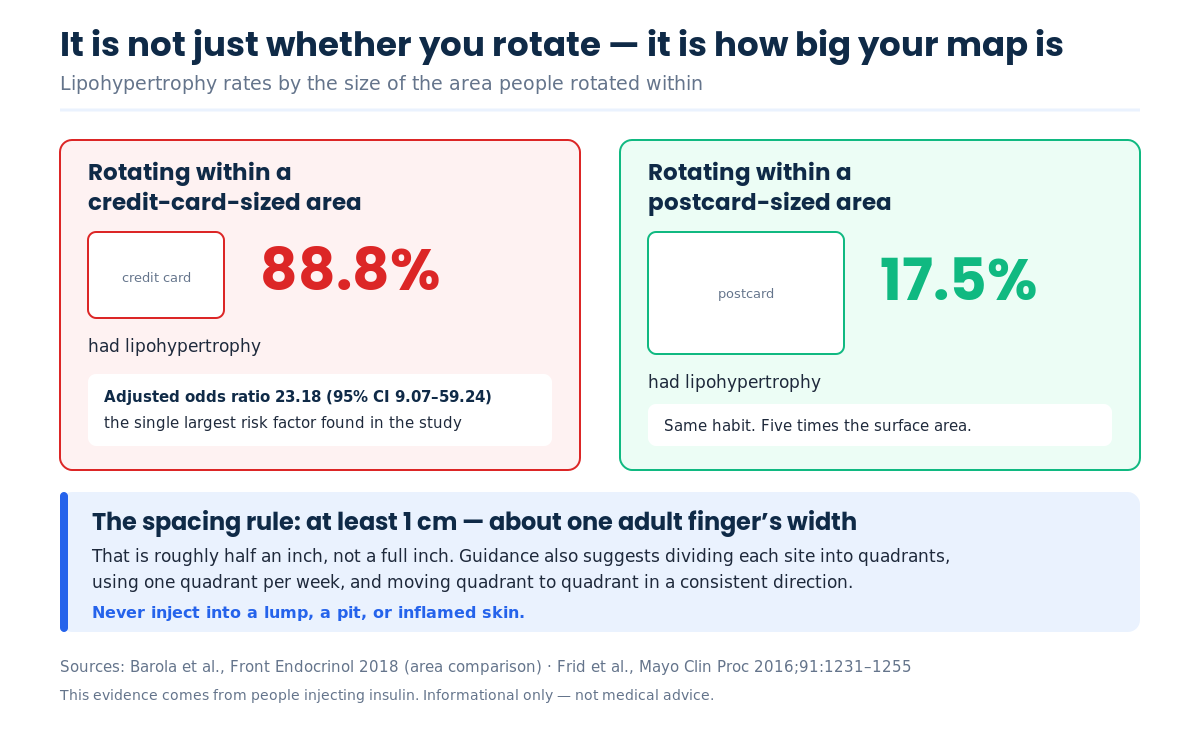
This is the most underrated result in the field. People who rotated within an area the size of a credit card had lipohypertrophy 88.8% of the time. People rotating within a postcard-sized area: 17.5%. Adjusted odds ratio 23.18 — larger than any other risk factor measured, including whether people rotated at all.
Both groups were “rotating.” The difference was the size of the map. And the spacing rule that goes with it is more specific than folklore suggests: at least 1 cm — roughly one adult finger’s width, or about half an inch. Not a full inch, which is the version that circulates online.
What the guidance actually recommends
- Systematic rotation, at least 1 cm apart. One evidence-based scheme: divide each site into quadrants (or halves for thighs and buttocks), use one quadrant per week, and move quadrant to quadrant in a consistent direction — clockwise, for example.
- Never inject into affected tissue — lipohypertrophy, inflammation, swelling, ulceration or infection.
- Inspect and palpate sites regularly. It is often easier to feel lipohypertrophy than to see it. Simply asking whether someone rotates has been shown to be insufficient.
- Single-use needles, and avoid injecting cold liquid straight from the fridge, which is painful and may contribute.
The trap: the damaged spot often feels better. Injecting into lipohypertrophic tissue can be painless — which quietly trains people to keep choosing the worst possible site. If one spot has become your favourite because it never stings, that is a reason to check it, not to keep using it.
The genuinely important caution
This is the part that belongs with a clinician, not an article. Moving injections off lipohypertrophic tissue and onto healthy tissue means the drug is suddenly absorbed properly again — which for insulin means the same dose now does more. Current guidance is explicit that there is a hypoglycemia risk when someone starts injecting into other skin areas, that glucose should be monitored closely after changing technique, and that clinicians should adjust the dose. Older guidance quantified the typical reduction as often exceeding 20%.
In other words: fixing your technique is a change that needs medical supervision. It is not a small adjustment.
Does any of this apply to GLP-1s or research peptides?

Here is where most content on this topic overreaches. Lipohypertrophy is not documented for GLP-1 receptor agonists, and that is a positive finding rather than a gap in searching: the 2024 meta-analysis states outright that despite a comprehensive literature review it found no scientific evidence linking lipohypertrophy and glycemic control in patients on GLP-1 analogs, and that this is a significant evidence gap.
The labels reflect it. None of the major GLP-1 labels use the word “lipohypertrophy” anywhere. They do tell you to rotate — but they also state that the injection site does not meaningfully change drug exposure. So the labels’ reason for rotating is dermatologic, not pharmacokinetic, which is a real and interesting difference from insulin. The one label passage that comes closest appears in a vial instruction sheet, warning about pits, thickened skin and skin lumps.
What GLP-1s do have is injection-site nodules — a different thing. This is mostly an extended-release exenatide story, tied to the microsphere formulation rather than to fat remodelling. And a widely cited semaglutide nodule case is routinely miscited as lipohypertrophy: it was a single unbiopsied patient whose nodules appeared within minutes, itched, resolved in days, and recurred at a correctly rotated fresh site. That is an acute hypersensitivity pattern, not lipohypertrophy.
For research peptides generally, there is no direct evidence at all. The honest framing: insulin’s lipohypertrophy is driven substantially by insulin’s own effect on fat cells — that is drug-specific pharmacology, not a generic consequence of putting liquid under skin. What is generic is mechanical trauma and local inflammatory responses. Guidance says to follow the insulin rotation recommendations for other injectables pending further studies — a precaution in the absence of data, not a finding. The habit costs nothing; the confident claims beyond it are extrapolation.
Some good news: lipohypertrophy tends to shrink once injection technique is corrected and the affected sites are left alone. It is not necessarily permanent.
Frequently asked questions
How far apart should injections be?
At least 1 cm — about one adult finger’s width, or roughly half an inch. The commonly repeated “one inch” overstates it.
I rotate already. Why would I still get lipohypertrophy?
Most likely because the area is too small. Rotating within a credit-card-sized patch was associated with lipohypertrophy 88.8% of the time versus 17.5% for a postcard-sized area. Rotation without area is not rotation.
Is needle reuse a definite cause?
No — it is associated but unproven, and guidance has softened. One study found no association at all, and 2025 recommendations note reuse may be preferable to skipping an injection. Single use is still the recommendation; just don’t treat it as the whole story.
Do GLP-1 users need to worry about lipohypertrophy?
There is no evidence it happens with GLP-1s, and the labels never mention it. Firm nodules have been reported, mostly with weekly exenatide. Rotating is still sensible and costs nothing.
Related reading
References
- Frid AH, et al. New Insulin Delivery Recommendations. Mayo Clin Proc. 2016;91(9):1231–1255. PMID 27594187. mayoclinicproceedings.org
- Klonoff DC, et al. Advance Insulin Injection Technique and Education With FITTER Forward Expert Recommendations. Mayo Clin Proc. 2025;100(4):682–699. PMID 40180487. mayoclinicproceedings.org
- Mader JK, et al. Relationship Between Lipohypertrophy, Glycemic Control, and Insulin Dosing: A Systematic Meta-Analysis. Diabetes Technol Ther. 2024;26(5). PMID 38215209. liebertpub.com
- Famulla S, et al. Insulin Injection Into Lipohypertrophic Tissue: Blunted and More Variable Insulin Absorption and Action and Impaired Postprandial Glucose Control. Diabetes Care. 2016;39(9):1486–1492. PMID 27411698. diabetesjournals.org
- Gentile S, et al. Insulin-Related Skin Lipohypertrophy in Type Two Diabetes: A Clinical Study of a Case Series, with Ultrasonographic and Histopathologic Implications. Diabetology. 2024;5(7):725–742. mdpi.com
- Blanco M, et al. Prevalence and risk factors of lipohypertrophy in insulin-injecting patients with diabetes. Diabetes Metab. 2013;39(5):445–453. PMID 23886784. pubmed.ncbi.nlm.nih.gov
Informational only — not medical advice · 21+. Changing injection technique can change how a medicine is absorbed. Talk to a qualified healthcare professional before altering anything about an injection routine.