Why Peptides Aren’t Pills: Oral Bioavailability Explained
PEPTIDE BASICS
Every peptide vial raises the same obvious question: why does this have to be an injection? If we can swallow antibiotics, hormones and painkillers, why do peptides need a needle? The answer is that oral peptide bioavailability is one of the hardest problems in pharmaceutics — and the one peptide that solved it did so at a cost that makes the point better than any explanation could.
Your digestive system is a protein-destroying machine
This is the part that gets lost. Your gut is not a neutral pipe that drugs pass through. It is a system evolved specifically to dismantle proteins and peptides into amino acids — because that is what food is. A therapeutic peptide swallowed as a pill is not an exception to that process. It is lunch.
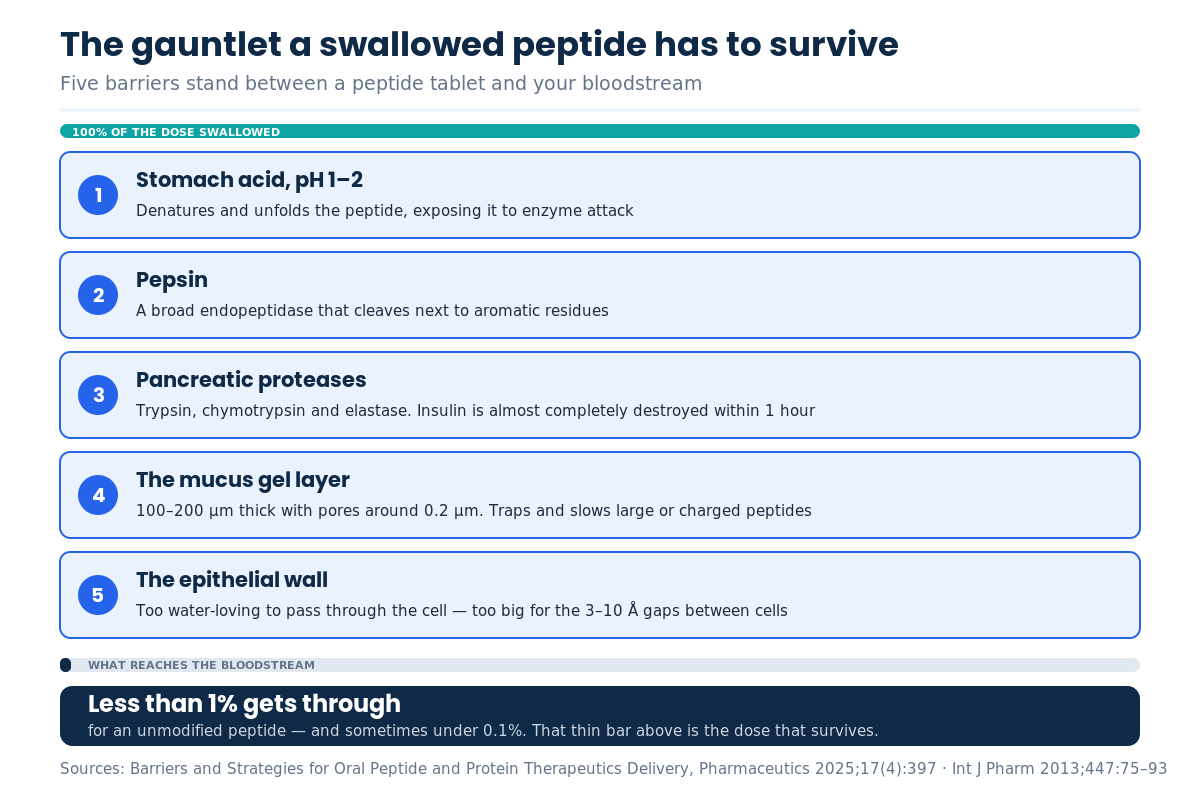
The five barriers, in order
- Stomach acid (pH 1–2). Peptides are only stable across a narrow pH range near their isoelectric point. Outside it they unfold and denature — which does not destroy them outright, but exposes their structure to what comes next.
- Pepsin. A broad endopeptidase that works best in that same acid, cleaving peptide bonds next to aromatic residues — phenylalanine, tryptophan, tyrosine. Its job is to chop things into smaller pieces so the next stage can finish them.
- Pancreatic proteases. Trypsin, chymotrypsin, elastase and the carboxypeptidases. The benchmark number: under physiological conditions, insulin is almost completely degraded within one hour.
- The mucus gel layer. A 100–200 µm barrier with pores around 0.2 µm. Anything much above ~12 kDa barely permeates it at all, and negatively charged mucins physically trap positively charged peptides.
- The epithelial wall. Even a peptide that survives everything else meets a double bind, described below.
The double bind that makes this so hard
There are only two ways across the gut wall: through the cells, or between them. Peptides are bad at both, for opposite reasons.
Through the cell means crossing a lipid membrane. Peptides are strongly hydrophilic — typically with log P values below zero — and a hydrophilic molecule has to break its hydrogen bonds with water to enter a fatty membrane. It would rather stay in the water.
Between the cells means squeezing through tight junctions built from occludin, claudins and related proteins. That gap is roughly 3–10 Å wide, and the whole paracellular route accounts for less than 1% of the mucosal surface area. Molecules under about 500 Da diffuse across gut membranes reasonably well; peptides in the 1–100 kDa range largely do not.
The result: typical oral bioavailability for an unmodified peptide is under 1%, sometimes under 0.1%. Swallow 100 units of a peptide and fewer than one reaches your bloodstream intact — and you cannot predict which day you get the one.
The exception that proves the rule: oral semaglutide
Oral semaglutide is a genuine achievement. It is also the best available illustration of how brutal this problem is, because you can read what it cost directly off the label.
It works by co-formulating semaglutide with SNAC, an absorption enhancer that does three things: it acts as a local buffer neutralising the pH right around the dissolving tablet, it reduces the peptide clumping together, and it fluidises the cell membrane to let semaglutide pass through the cells. Notably, absorption happens in the stomach, not the intestine — confirmed by gamma scintigraphy.
Here is the catch. The enhancer only works if the peptide is released immediately next to it, and its membrane effect is temporary — permeability starts returning to baseline from about 30 minutes. That fragility is why the label reads the way it does.
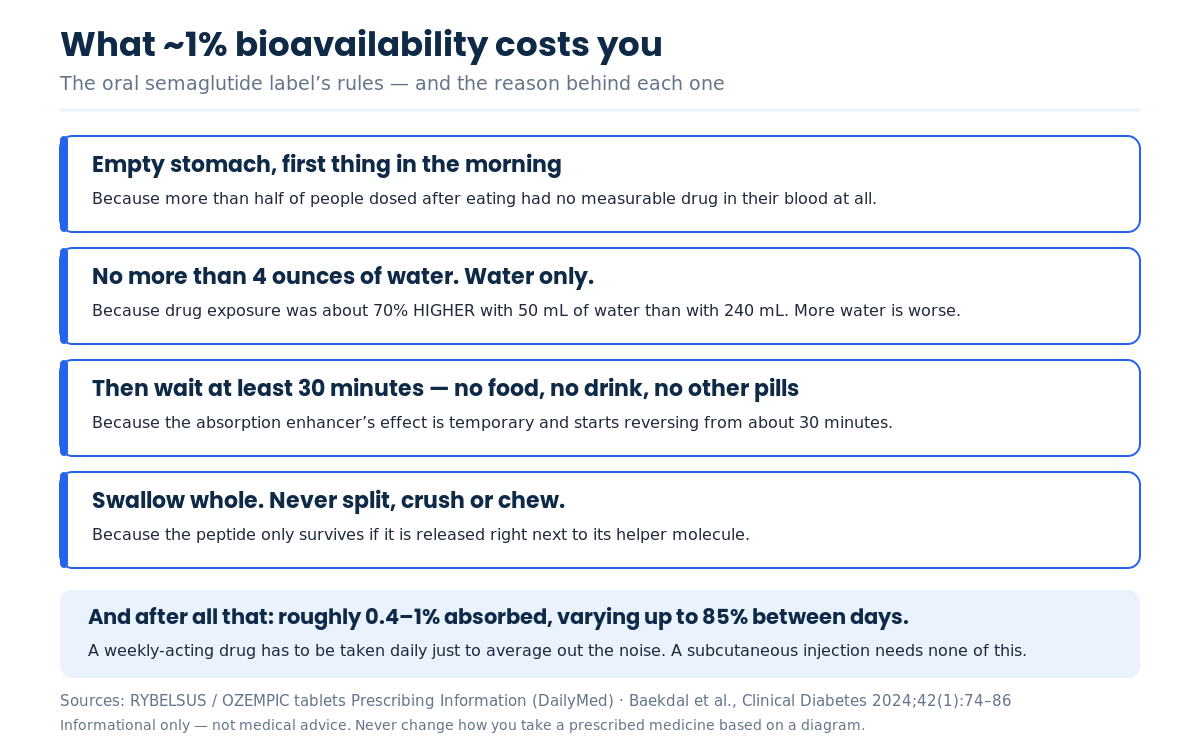
Read those rules again, because the third one is genuinely counterintuitive: drug exposure was about 70% higher with 50 mL of water than with 240 mL. More water dilutes the enhancer and the peptide, and the concentration gradient that drives absorption never forms. This is a pill that works worse if you drink a normal glass of water with it — the opposite of essentially every other oral medication.
And the payoff for all that engineering and discipline? Absolute bioavailability of 0.4% to 1%. Day-to-day variability of 20–35% within the same person, with total variability up to 85%. In one trial, some participants had no measurable drug in their plasma at all after a single dose. Semaglutide has a half-life of about a week, yet the oral form must be taken daily — not for pharmacology, but simply to average out the absorption noise.
The technology is not a universal key. Novo Nordisk tried the same SNAC approach with liraglutide. It did not work well enough and was not pursued further. Same enhancer, same company, similar peptide — different answer.
What about the oral peptides that do work?
A handful of peptides are taken orally, and it is worth separating two very different categories.
Peptides that never need to be absorbed. Linaclotide is the clearest example: it acts locally on the surface of the intestinal lining and is essentially not absorbed at all — plasma levels sit below measurable limits at therapeutic doses. It “works orally” precisely because it never has to cross anything. Several peptide antibiotics work the same way.
Peptides engineered into systemic absorption. This list is short. Oral octreotide (Mycapssa) uses a permeation-enhancer technology and lands around 0.7% bioavailability — requiring doses over 200 times higher than the injection. Desmopressin tablets reach roughly 5% of the intranasal exposure and about 0.16% of intravenous. Cyclosporine, a lipophilic cyclic peptide, needs a self-emulsifying formulation to work orally.
The chemistry strategies behind these are real but constrained: cyclisation removes the exposed N- and C-termini that enzymes attack first; lipidation improves membrane permeability but creates a legally distinct new drug entity; protease inhibitors were tried and largely abandoned because chronically inhibiting your own digestive enzymes is a bad idea. And permeation enhancers carry an inherent tension — you are deliberately loosening a barrier that exists to keep things out.
Which is why the vial exists
A subcutaneous injection skips every barrier above. No acid, no proteases, no mucus, no epithelium to cross — the peptide is placed directly into tissue where it can reach circulation. That is not a limitation of peptide science; it is the sensible engineering answer. The lyophilized powder in the vial exists for the same reason: peptides degrade in water over time, so they are dried for storage and reconstituted only when needed.
The practical upshot: if you see a peptide marketed as an oral capsule with no absorption-enhancer technology behind it, the pharmacology above is the reason to be sceptical. Getting ~1% required a billion-dollar formulation program and a four-ounce water limit.
Frequently asked questions
Why can’t you just put a peptide in a capsule?
Because the capsule only protects it until it dissolves. After that the peptide meets stomach acid, pepsin and pancreatic proteases — the exact machinery that exists to break peptides down — and then has to cross a gut wall it is chemically unsuited to cross.
Why does oral semaglutide need an empty stomach?
Because food defeats it. In trials, more than half of people dosed in the fed state had no measurable drug exposure at all, while everyone dosed fasting did.
Is oral bioavailability the same as potency?
No. Bioavailability is the fraction of a dose that reaches circulation intact. A peptide can be extremely potent and still nearly useless orally — which is why oral octreotide needs over 200 times the injected dose.
Does this apply to nasal sprays too?
Partly. Nasal delivery avoids the stomach and pancreatic proteases, which is why it works better than oral for some peptides — desmopressin tablets reach only about 5% of the intranasal exposure. But it still faces enzymes and a membrane, and it is not a general solution.
Related reading
References
- RYBELSUS (semaglutide) tablets / OZEMPIC (semaglutide) tablets — Full Prescribing Information. Novo Nordisk, DailyMed. dailymed.nlm.nih.gov
- Bækdal TA, et al. Current Understanding of Sodium N-(8-[2-Hydroxylbenzoyl] Amino) Caprylate (SNAC) as an Absorption Enhancer: The Oral Semaglutide Experience. Clinical Diabetes. 2024;42(1):74–86. diabetesjournals.org (industry-funded; label figures cited independently above)
- Barriers and Strategies for Oral Peptide and Protein Therapeutics Delivery: Update on Clinical Advances. Pharmaceutics. 2025;17(4):397. PMID 40284395. PMC12030352
- Buckley ST, et al. Transcellular stomach absorption of a derivatized glucagon-like peptide-1 receptor agonist. Science Translational Medicine. 2018;10(467):eaar7047. science.org
- Choonara BF, et al. Approaches for enhancing oral bioavailability of peptides and proteins. Int J Pharm. 2013;447(1-2):75–93. PMID 23428883. PMC3680128
- DDAVP (desmopressin acetate) Tablets — Full Prescribing Information. Ferring Pharmaceuticals, DailyMed. dailymed.nlm.nih.gov
Informational only — not medical advice · 21+. Never change how you take a prescribed medicine based on an article. Talk to a qualified healthcare professional.