
How Peptides Break Down: The Chemistry of Peptide Degradation
Peptide chemistry
Peptides break down along two broad routes: chemical degradation, where covalent bonds actually change, and physical degradation, where the molecule stays chemically intact but clumps, sticks to surfaces, or falls out of solution. Water is the master enabler of the most common chemical routes, which is exactly why a dry, freeze-dried powder is far more stable than the same peptide dissolved in liquid. Understanding these mechanisms is what makes careful handling matter — and it is why lab methods like HPLC and mass spectrometry can “see” degradation as new peaks and tiny mass shifts.
Two kinds of breakdown
It helps to split peptide degradation into two categories from the start, because they have different causes and different fixes.

Chemical degradation means covalent bonds are made or broken — the molecule is no longer the same compound. Physical degradation means the chemistry is unchanged, but the peptide has aggregated, adsorbed to a surface, or precipitated, so it is no longer usable even though every bond is intact. Real-world instability is usually a mix of both, and the two feed each other.
Chemical degradation pathways
Hydrolysis of the backbone. The peptide bond is an amide bond, and water can cleave it through acid- or base-catalyzed hydrolysis. Some sites are especially fragile — bonds involving aspartate, particularly Asp-Pro and other Asp-X sequences, are well-known hot spots because the aspartate side chain helps catalyze its own backbone cleavage.
Deamidation. One of the most common routes: the side-chain amides of asparagine (Asn) and glutamine (Gln) are lost, converting them to acids. Asn deamidation typically runs through a cyclic succinimide intermediate that then opens to a mix of aspartate and iso-aspartate. It is strongly pH- and sequence-dependent, and it is fastest when the neighbor is glycine (an Asn-Gly sequence), because the small glycine lets the ring close easily.
Oxidation. Sulfur- and aromatic-containing residues — methionine, cysteine, tryptophan and histidine — are oxidation targets. Oxygen, light, peroxide contaminants and trace metal ions all drive it. Methionine oxidizing to its sulfoxide adds 16 mass units and is effectively irreversible in practice.
Disulfide scrambling. In peptides with cysteines, existing S-S bonds can reshuffle into the wrong pairings (“scrambling”), especially at alkaline pH, and related beta-elimination reactions can destroy disulfides outright and spawn reactive free thiols.
Isomerization and racemization. The same succinimide chemistry that drives deamidation also converts aspartate to iso-aspartate and can create D-amino-acid isomers — changes that alter shape and activity without changing overall mass much.
Diketopiperazine formation. At the N-terminus, the free amino group can cyclize and snip off the first two residues as a small cyclic diketopiperazine. It is favored when glycine or proline sits near the start of the sequence.
Physical degradation pathways
Aggregation. Peptides can self-associate into clumps, driven by partial unfolding, exposure to air-liquid and container interfaces, high concentration, and freeze-thaw stress. Aggregation is often the first visible sign of trouble — haze or particulates in a once-clear solution.
Adsorption. Peptides stick to glass and plastic surfaces. At low concentrations, a surprisingly large fraction can simply disappear onto the walls of a vial or syringe. This is why research protocols sometimes add a carrier protein or use low-binding plastics.
Precipitation and fibrillation. Loss of solubility can cause the peptide to precipitate, and some peptides form ordered amyloid-type fibrils — both remove active material from solution.
Denaturation. Structured peptides can unfold from heat, shaking, air exposure and freeze-thaw, which then feeds aggregation. (Very small linear peptides have little fixed structure to lose, so denaturation matters most for larger, folded ones.)
What speeds the clock up
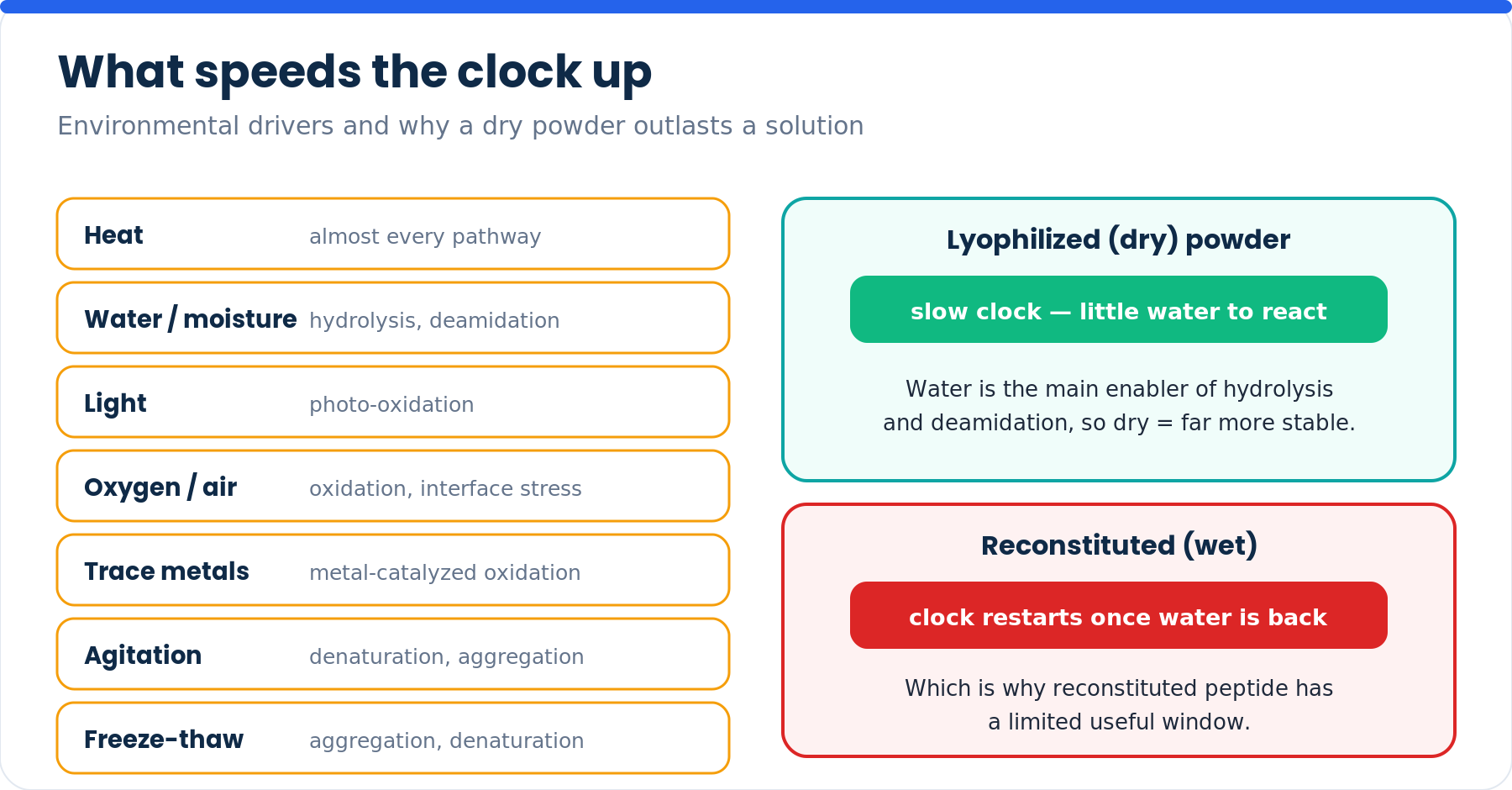
Each environmental stress accelerates specific pathways — which is the whole reason handling conditions matter.
Why a dry powder outlasts a solution
The two most common chemical routes — hydrolysis and deamidation — need water as a reactant, and molecules barely move in a dry, glassy solid. Remove the water, and you remove the main enabler of those reactions, which is why a properly freeze-dried (lyophilized) powder is chemically far more stable than the dissolved peptide. Once it is reconstituted, water is back and the hydrolysis, deamidation and oxidation clocks effectively restart — which is the underlying reason reconstituted peptide has only a limited useful window. (Residual moisture left in an imperfectly dried cake still permits slow solid-state degradation.)
How labs “see” degradation

Degradation is not invisible. On HPLC, it shows up as new or shifted peaks and a drop in main-peak purity — that purity percentage is exactly what a Certificate of Analysis reports. Mass spectrometry reads the fingerprints directly: roughly +16 Da flags oxidation (an added oxygen), about +1 Da flags deamidation (an amide becoming an acid), and the loss of two N-terminal residues points to diketopiperazine formation. Cloudiness or new high-mass species point to aggregation. Together, the purity number and the mass-spec identity check on a COA are what tell you whether a peptide is intact.
Frequently asked questions
What is the most common way peptides degrade?
In solution, hydrolysis of the backbone and deamidation of asparagine/glutamine are among the most common chemical routes; both are driven by water. Oxidation and aggregation are also frequent.
Why is freeze-dried peptide more stable than a solution?
Because water enables the main chemical breakdown routes. A dry powder has little water and very low molecular mobility, so those reactions slow dramatically; reconstituting restarts the clock.
Can you tell if a peptide has degraded just by looking?
Sometimes — cloudiness, particulates or a color change suggest aggregation or precipitation — but many chemical changes are invisible and only show up on HPLC or mass spectrometry.
What does a +16 mass shift mean?
An added oxygen atom, typically from oxidation of methionine to its sulfoxide. A shift of about +1 mass unit usually indicates deamidation.
References
- Manning MC, et al. Stability of Protein Pharmaceuticals: An Update. Pharm Res 2010;27(4):544–575. pubmed
- Wang W. Instability, stabilization, and formulation of liquid protein pharmaceuticals. Int J Pharm 1999;185(2):129–188. pubmed
- Robinson NE, Robinson AB. Molecular clocks (deamidation). PNAS 2001;98(3):944–949. pnas.org
- Torosantucci R, et al. Oxidation of Therapeutic Proteins and Peptides. Pharm Res 2014;31(3):541–553. springer.com
- Goolcharran C, et al. Deamidation, diketopiperazine formation, and oxidation in rhVEGF and model peptides. AAPS PharmSci 2000;2(1):article 5. pubmed
- Lai MC, Topp EM. Solid-state chemical stability of proteins and peptides. J Pharm Sci 1999;88(5):489–500. wiley.com
Informational only — not medical advice · 21+. This article explains degradation chemistry and does not provide storage protocols or dosing guidance.