
What Are Receptor Tyrosine Kinases (RTKs)? The Peptide Receptors That Aren’t GPCRs
Receptor pharmacology
Receptor tyrosine kinases (RTKs) are the family of cell-surface receptors that many peptide and protein hormones use instead of a GPCR. If you have read our explainer on G-protein-coupled receptors, this is the other half of the story: insulin, IGF-1 and the classic growth factors do not work through GPCRs at all. They work through receptors that carry their own built-in enzyme.
What is a receptor tyrosine kinase?
A receptor tyrosine kinase is a single-pass transmembrane receptor. It has three parts: an extracellular domain that binds the ligand, a single membrane-spanning helix, and an intracellular tyrosine kinase domain — an enzyme that attaches phosphate groups to tyrosine amino acids. Humans have about 58 receptor tyrosine kinases sorted into roughly 20 families, a count established in Lemmon and Schlessinger’s landmark 2010 review.
The name tells you the mechanism. Unlike a GPCR, which has no enzyme of its own and must borrow a G protein, an RTK is a kinase. When it is switched on, it starts phosphorylating — and that single act sets off the rest of the cascade.
How receptor tyrosine kinases fire
The classic activation sequence has four steps, and it is different from the shape-change-and-G-protein story of a GPCR.
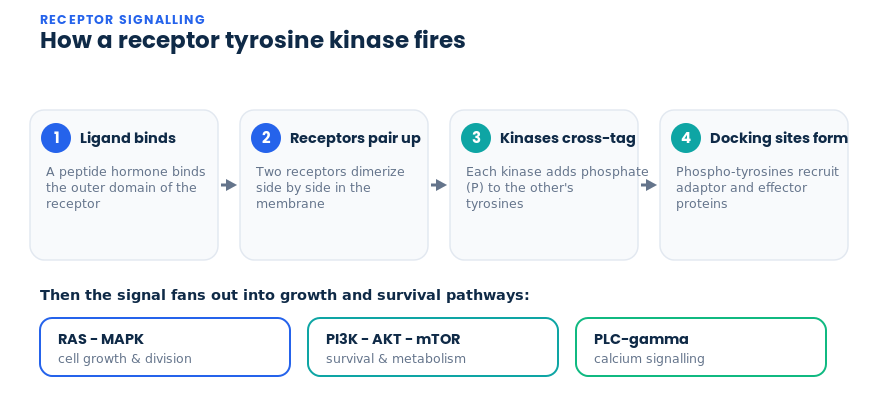
A ligand binds the outer domain, which brings two receptors together (dimerization). The paired kinase domains then cross-phosphorylate each other — each one tags the other’s tyrosines with phosphate. Those phospho-tyrosines become docking sites that recruit adaptor and effector proteins, and the signal fans out into three well-known pathways: RAS–MAPK (growth and division), PI3K–AKT–mTOR (survival and metabolism), and PLC-gamma (calcium signalling). The theme is growth, metabolism and survival rather than the fast neurotransmission a GPCR often drives.
Insulin and IGF-1 receptors are an unusual twist: they are already permanently paired as disulfide-linked dimers even before ligand binds, so the hormone triggers a conformational change that switches on kinases that were pre-assembled rather than pulling two separate receptors together.
Receptor tyrosine kinases vs GPCRs
Both are cell-surface receptors, but they pass the message along in completely different ways.
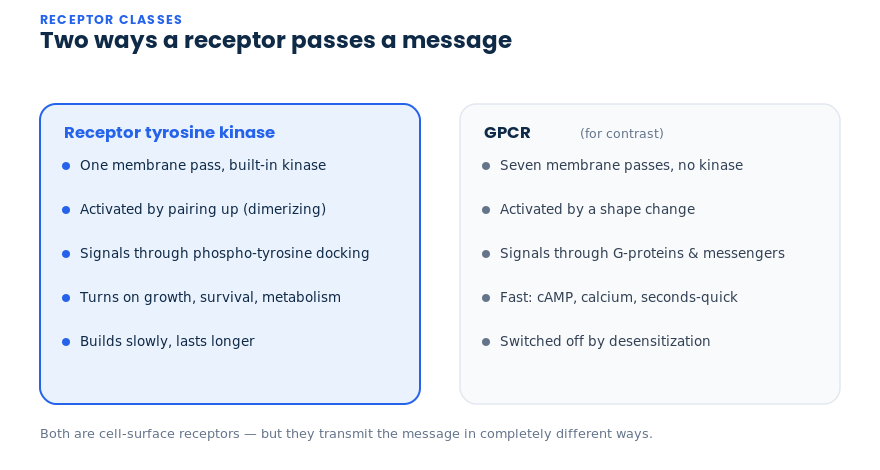
A GPCR threads through the membrane seven times, has no kinase, and signals through G proteins and second messengers such as cAMP and calcium — often within seconds, and it is switched off by desensitization. An RTK crosses once, brings its own kinase, signals through phospho-tyrosine docking sites, and drives slower, longer-lasting programs of growth and metabolism. This is why the two classes suit such different jobs.
Which receptor does a peptide hormone actually use?
Here is the practical map for anyone reading about research peptides. Receptor class is not a footnote — it explains why compounds behave so differently.
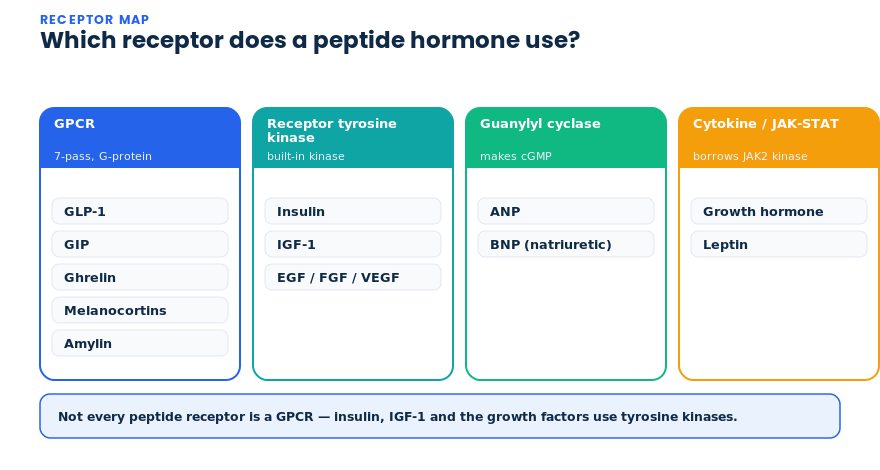
The GPCRs handle GLP-1, GIP, ghrelin, the melanocortins and amylin. The receptor tyrosine kinases handle insulin, IGF-1 and the growth factors (EGF, FGF, VEGF). Two more classes round it out: natriuretic peptides (ANP, BNP) act on guanylyl cyclase receptors that make cGMP, and — a point that trips up almost everyone — growth hormone and leptin act on cytokine receptors that have no kinase of their own and borrow the separate enzyme JAK2 to run a JAK–STAT cascade.
Why this matters for the peptide-research community
Insulin, IGF-1 and IGF-1 analogs marketed in the research space (such as IGF-1 LR3) all cluster around the insulin/IGF-1 receptor tyrosine kinase axis. Because RTK signalling is fundamentally about growth, proliferation and survival — the same PI3K–AKT and RAS–MAPK pathways that are validated targets in oncology — compounds that push this axis carry theoretical proliferative concerns that GPCR-acting peptides do not. That is context, not a clinical claim, and it is one reason the documented side-effect discussion around IGF-1 reads so differently from, say, a melanocortin peptide. The recombinant IGF-1 drug mecasermin (Increlex) is approved precisely because it feeds this axis to treat severe IGF-1 deficiency.
It also reframes a common oversimplification: it is simply not true that “peptide hormones all work through GPCRs.” Knowing whether a molecule talks to a GPCR, an RTK, a guanylyl cyclase or a JAK-STAT receptor tells you far more about its biology than its molecular weight does. For more on how peptides differ from ordinary drugs, see peptides vs small-molecule drugs.
Frequently asked questions
Are all peptide hormone receptors GPCRs?
No. Many are — GLP-1, GIP, ghrelin, melanocortins and amylin all use GPCRs — but insulin, IGF-1 and the growth factors use receptor tyrosine kinases, natriuretic peptides use guanylyl cyclase receptors, and growth hormone and leptin use JAK-STAT cytokine receptors.
What is the difference between an RTK and a tyrosine kinase inhibitor?
The RTK is the receptor; a tyrosine kinase inhibitor (TKI) is a drug that blocks kinase activity. Anti-RTK cancer drugs include EGFR inhibitors and HER2 antibodies. Note that the famous drug imatinib mainly targets a non-receptor kinase, so it is not the cleanest example of an anti-RTK agent.
Is the insulin receptor a receptor tyrosine kinase?
Yes. The insulin receptor and the IGF-1 receptor are receptor tyrosine kinases, with the unusual feature that they exist as permanently paired, disulfide-linked dimers even before the hormone binds.
Why does receptor class matter for research peptides?
Because it predicts behaviour. RTK signalling drives growth and metabolism over longer timescales, which is why the insulin/IGF-1 axis carries different considerations than fast, desensitizing GPCR pathways.
References
- Lemmon MA, Schlessinger J. Cell Signaling by Receptor Tyrosine Kinases. Cell 2010. pubmed.ncbi.nlm.nih.gov/20602996
- Physiology, Tyrosine Kinase Receptors. StatPearls (NCBI Bookshelf). ncbi.nlm.nih.gov/books/NBK538532
- Cabail MZ et al. The insulin and IGF1 receptor kinase domains are functional dimers in the activated state. Nat Commun 2015. nature.com/articles/ncomms7406
- Brooks AJ, Waters MJ. The Growth Hormone Receptor: Mechanism of Activation and Signaling. PMC5816795. ncbi.nlm.nih.gov/pmc/articles/PMC5816795
- Receptor Tyrosine Kinase-Targeted Cancer Therapy. PMC6274851. ncbi.nlm.nih.gov/pmc/articles/PMC6274851
- INCRELEX (mecasermin) Prescribing Information, U.S. FDA. accessdata.fda.gov
Informational only — not medical advice. For research and educational use by adults 21+. Receptor classifications summarize published pharmacology and may be refined by ongoing research.