Peptides vs Small-Molecule Drugs: What’s Actually Different
Peptides vs small molecules is one of the most useful distinctions to understand before reading anything about research compounds. “Peptide” is not a marketing word or a safety category — it describes a size and chemistry class of molecule, and that class behaves very differently from the small-molecule pills most people are used to. Once you see where peptides sit, a lot of otherwise puzzling details (why they come in vials, why they are injected, why they have short shelf lives) suddenly make sense.
Three sizes of medicine
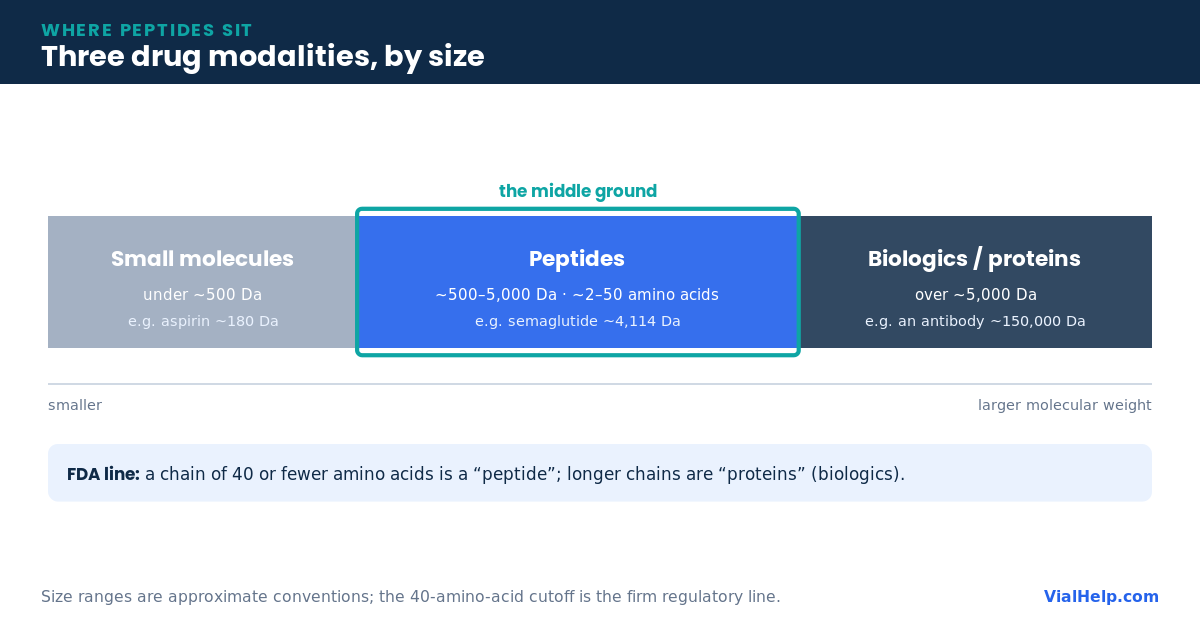
It helps to picture drugs on a size axis. At the small end are small molecules — things like aspirin (about 180 daltons) or most tablets in a pharmacy, typically under roughly 500 daltons. At the large end are biologics — proteins and antibodies weighing tens of thousands of daltons (a typical antibody is around 150,000). Peptides sit in between, usually in the range of about 500 to 5,000 daltons, made of roughly 2 to 50 amino acids strung together. They are the middle ground: bigger and more specific than a small molecule, smaller and simpler than a full protein.
Size and the 40-amino-acid line
Those size ranges are useful conventions rather than hard laws, but there is one firm regulatory line. The FDA defines a peptide as a chain of 40 or fewer amino acids; a chain longer than 40 is treated as a protein, and proteins are generally regulated as biologics. The 500-dalton small-molecule threshold, meanwhile, traces to Lipinski’s well-known “rule of five” for orally active drugs. So the tidy picture is: under ~500 Da behaves like a classic pill; 40 amino acids marks the peptide/protein boundary.
Specificity: a big handshake vs a small key
Because a peptide is larger, it binds its target across a bigger surface — more like a two-handed handshake than a small key in a lock. That large interface tends to make peptides highly selective, hitting one intended target with fewer off-target effects. Small molecules, being tiny, more often fit into several different binding pockets around the body, which is one reason they can carry a wider range of side effects. This is a general tendency, not an absolute rule, but it is a big part of why peptides are attractive as drugs.
Why peptides usually can’t be pills
Here is the practical heart of it. Your digestive system is built to break peptides and proteins down — that is what it does to the protein in food. Swallow a peptide drug and stomach acid, digestive proteases, and a poorly permeable gut wall destroy most of it before it can reach the bloodstream. Oral bioavailability for an unmodified peptide is often below 1–2%. That is why peptides are typically injected, and why they arrive as a powder in a vial to be reconstituted rather than as a tablet.
Half-life and metabolism
Native peptides also tend to be cleared quickly — many have half-lives measured in minutes to a few hours — because the body degrades them rapidly. Drug developers extend that with tricks like attaching a fatty acid so the peptide clings to albumin, adding PEG chains, or using non-natural amino acids; that is how a peptide like semaglutide reaches a roughly week-long half-life. The way they are broken down differs too: small molecules are largely processed by liver CYP450 enzymes (sometimes producing reactive metabolites), whereas peptides are chopped back into ordinary amino acids — generally a cleaner metabolic exit.
Immunogenicity
One trade-off for being bigger and more protein-like: peptides and biologics can be immunogenic, meaning the immune system can raise anti-drug antibodies against them. (The tesamorelin label, for instance, reports antibodies in about half of patients.) Small molecules are generally too small to trigger that kind of immune response. The FDA specifically asks manufacturers of synthetic peptides to assess the immunogenic risk of impurities — a concern that simply does not arise for a typical small-molecule tablet.
How each is made
Manufacturing differs as well. Small molecules are built by classical chemical synthesis. Peptides are made either by solid-phase peptide synthesis (SPPS) — the technique R. Bruce Merrifield invented, which won the 1984 Nobel Prize in Chemistry — or by recombinant expression in cells. Assembling a defined chain of amino acids is more involved than many small-molecule syntheses, which feeds into cost, purity considerations, and why a certificate of analysis matters.
Side by side
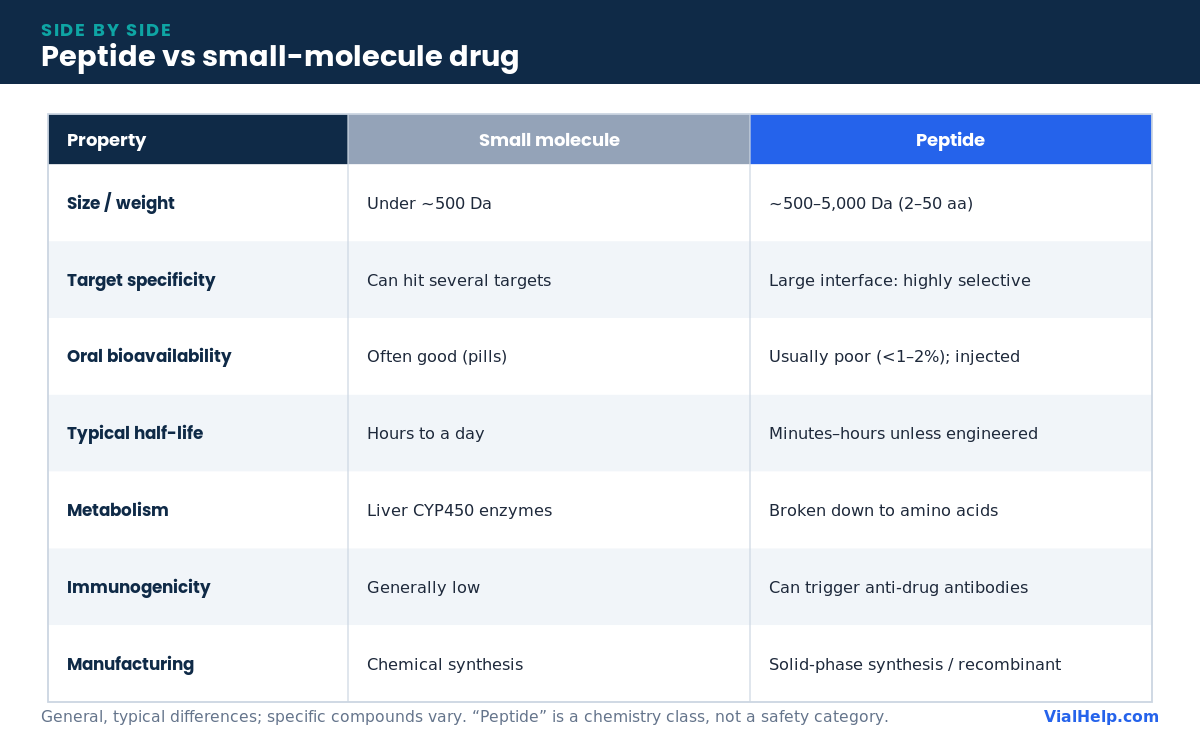
Put together, peptides occupy a genuine middle modality between small molecules and large biologics — and, for context, there are already more than 80 approved peptide drugs (as of a 2021 Nature Reviews Drug Discovery review), with the number still growing.
The takeaway
Two ideas are worth carrying away. First, the vial-and-needle format isn’t arbitrary: it is a direct consequence of peptide chemistry — too fragile for the gut, too short-lived and specific to behave like a small-molecule pill. Second, and just as important, “peptide” describes chemistry, not safety. Being a peptide says nothing about whether a given compound is well-studied, pure, or safe; that depends entirely on the specific molecule, its dose, its manufacturing, and the evidence behind it.
Frequently asked questions
Is a peptide the same as a protein?
They are made of the same building blocks — amino acids — but differ in size. By the FDA’s definition, 40 or fewer amino acids is a peptide; longer chains are proteins and are regulated as biologics.
Why can’t you just take peptides as a pill?
The digestive system breaks peptides down and the gut wall absorbs them poorly, so very little survives to reach the bloodstream. That is why most peptides are injected; the handful of oral ones rely on special absorption-enhancing formulations.
Are peptides safer than small-molecule drugs?
Not inherently. Peptides tend to be more selective and are metabolized to amino acids, but they can be immunogenic and their risks depend entirely on the specific compound and its purity. “Peptide” is a chemistry class, not a safety guarantee.
Why do peptides have such short shelf lives?
Their amino-acid chains are chemically and physically fragile — prone to breakdown and aggregation — which is why they are freeze-dried for storage and reconstituted just before use, and why handling and temperature matter so much.
- Muttenthaler M, et al. Trends in peptide drug discovery. Nat Rev Drug Discov. 2021;20(4):309–325. https://pubmed.ncbi.nlm.nih.gov/33536635/
- FDA Final Rule — Definition of the Term “Biological Product” (40-amino-acid cutoff). https://www.federalregister.gov/documents/2018/12/12/2018-26840/definition-of-the-term-biological-product
- Lipinski CA, et al. Experimental and computational approaches to estimate solubility and permeability (Rule of Five). Adv Drug Deliv Rev. 1997. https://www.sciencedirect.com/topics/pharmacology-toxicology-and-pharmaceutical-science/lipinskis-rule-of-five
- FDA Guidance — Immunogenicity testing of therapeutic protein products. https://www.fda.gov/regulatory-information/search-fda-guidance-documents/immunogenicity-testing-therapeutic-protein-products-developing-and-validating-assays-anti-drug
- The Nobel Prize in Chemistry 1984 — R. Bruce Merrifield (solid-phase peptide synthesis). https://www.nobelprize.org/prizes/chemistry/1984/press-release/
- SNAC as an absorption enhancer: the oral semaglutide experience. Clin Diabetes. 2024;42(1):74. https://diabetesjournals.org/clinical/article/42/1/74/153538/
Informational only — not medical advice. VialHelp is an educational resource and does not sell or recommend peptides. 21+.