
What Is Leptin? The Satiety Hormone That Reports Your Fat Stores
Hormone biology
Leptin is the hormone your fat tissue uses to tell your brain how much energy you have in storage. Discovered in 1994, leptin is often called the “satiety hormone,” but its real job is subtler: it is a long-term fuel gauge — the mirror image of the short-term hunger hormone ghrelin.
What leptin is
Leptin is a protein hormone of 167 amino acids (about 16 kilodaltons in its mature form), built in the shape of a four-helix bundle that places it in the class-I cytokine family. It is the product of the LEP gene — historically the “ob” (obese) gene — and it was identified in a landmark 1994 study by Zhang, Friedman and colleagues, who cloned the mouse ob gene and proposed that its product signals from fat tissue to regulate the size of the body’s fat stores. Because leptin is made mainly by white adipose tissue, the amount in your blood roughly tracks how much body fat you carry, which is what makes it an “adiposity signal.”
What leptin does: the brain’s fuel gauge
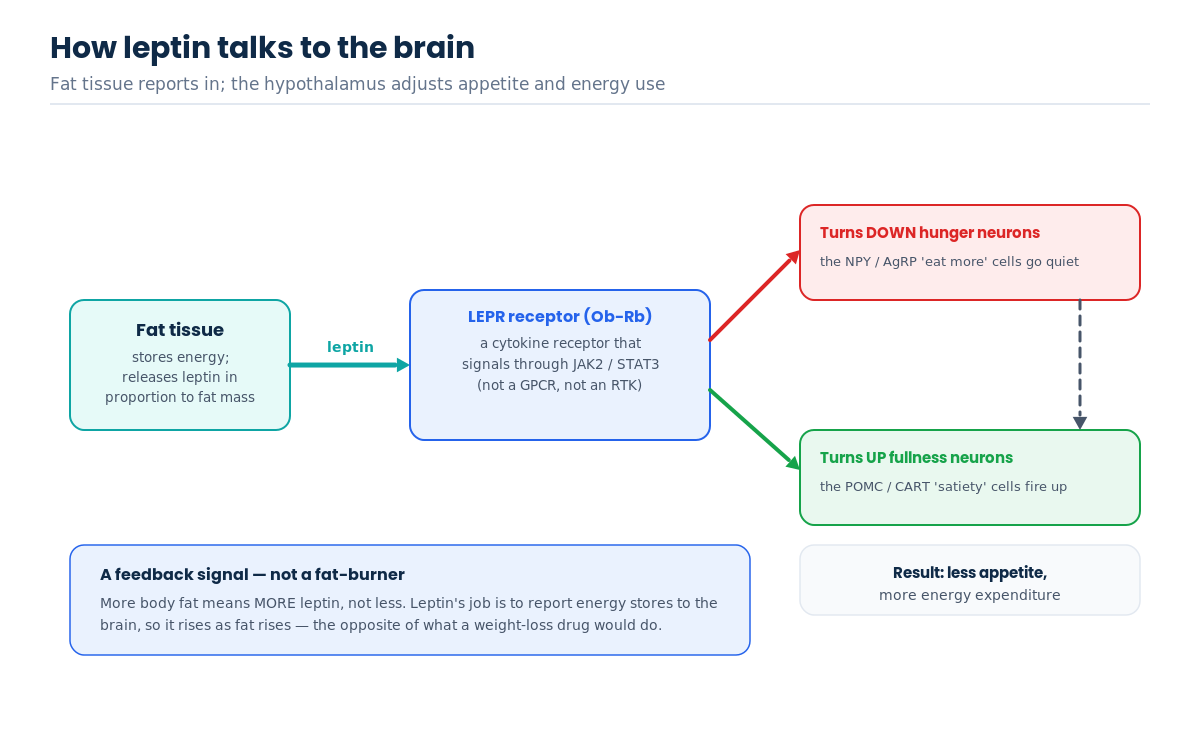
Leptin acts on the hypothalamus, in a region called the arcuate nucleus. There it quiets the “eat more” neurons (the NPY/AgRP cells) and activates the “I’m satisfied” neurons (the POMC/CART cells), the net effect being reduced appetite and increased energy expenditure. It does this through its receptor, LEPR (Ob-R) — specifically the long isoform Ob-Rb concentrated in the hypothalamus. Like the growth-hormone receptor, LEPR is a class-I cytokine receptor with no built-in kinase of its own: it signals through an associated JAK2 enzyme and STAT3. In other words, it is neither a GPCR nor a receptor tyrosine kinase — a useful thing to know when comparing how different hormones talk to cells.
Leptin vs ghrelin: two opposite signals
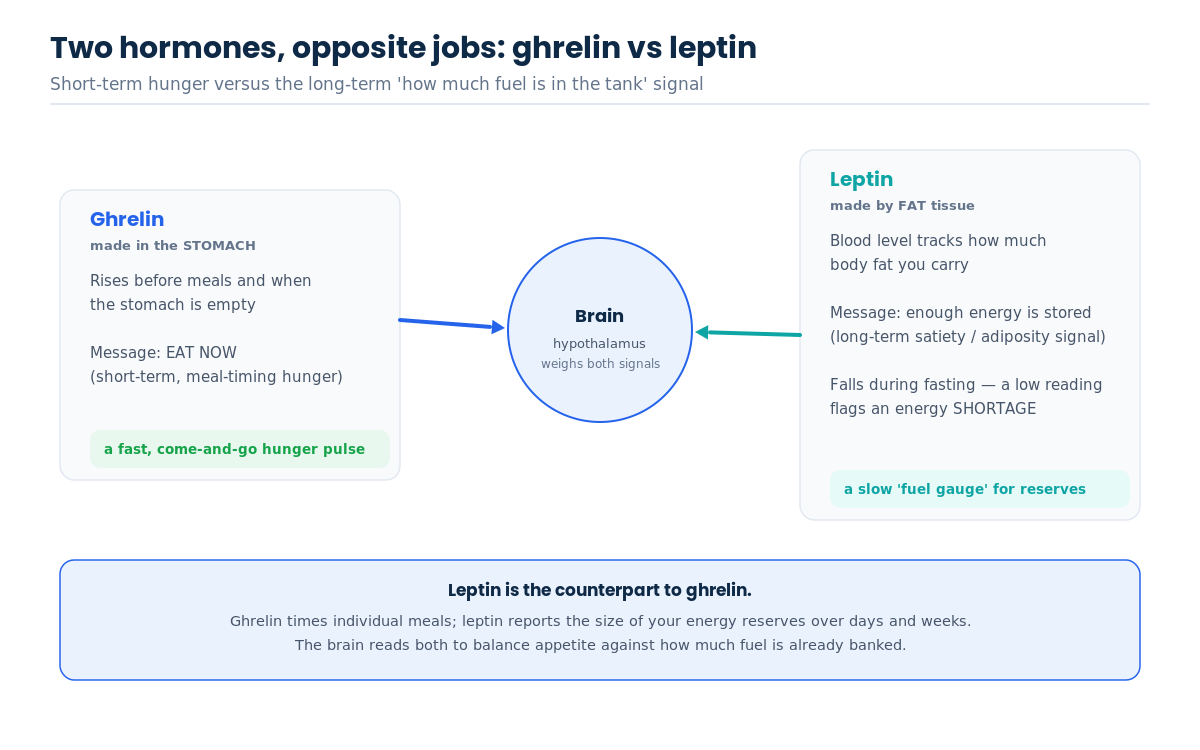
Leptin and ghrelin are best understood as a pair. Ghrelin rises before meals and when the stomach is empty; it is the short-term, meal-timing hunger signal. Leptin works on a longer timescale, reporting the size of your energy reserves over days and weeks. Interestingly, leptin’s most important role may be signaling deficiency rather than plenty: leptin falls sharply during fasting, and that drop — shown in classic work by Ahima and colleagues in 1996 — triggers the body’s starvation response, including changes to the reproductive, thyroid and stress axes. This is also why adequate leptin is permissive for puberty and reproduction: it tells the body there is enough stored energy to spare.
The leptin paradox: why more leptin doesn’t mean less weight
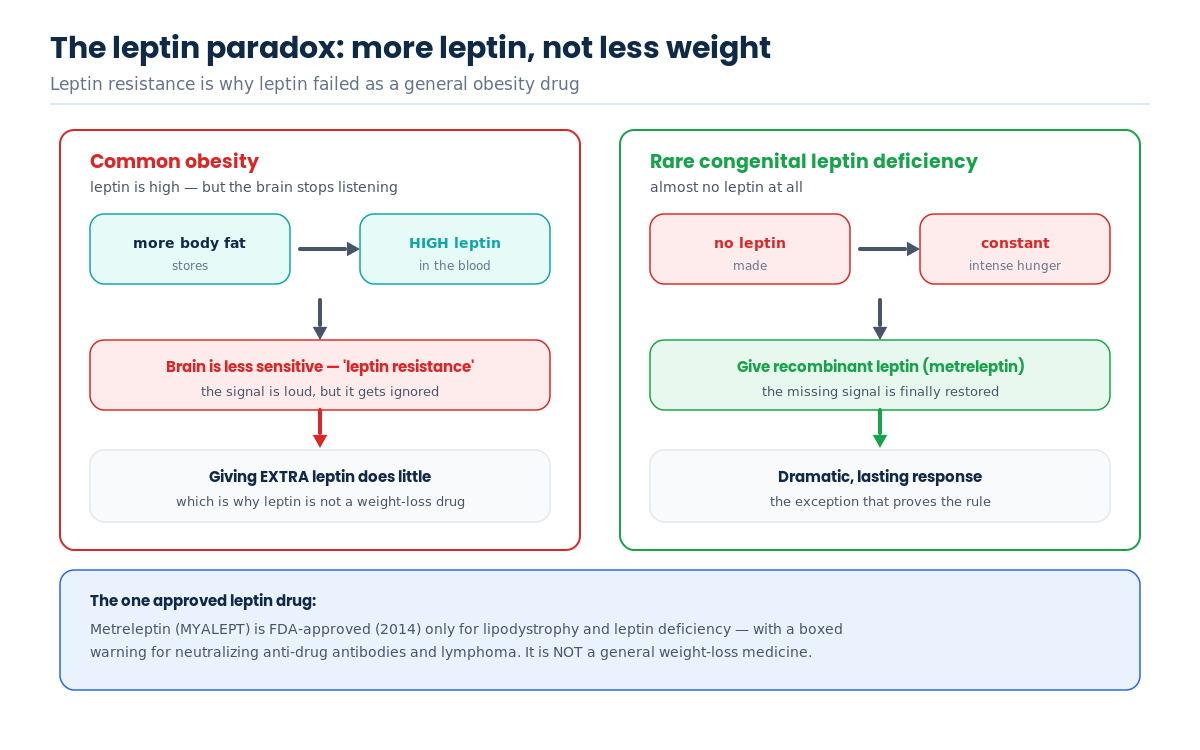
Here is the twist that surprised researchers. If leptin curbs appetite, you might expect people with obesity to be low in it — but the opposite is true. Because leptin tracks fat mass, most people with obesity have high leptin, yet their brains respond to it weakly. This reduced sensitivity is called leptin resistance, and it is why giving extra leptin does little for common obesity: the signal is already loud and is being ignored. That failure is the reason leptin never became the general weight-loss drug it was once hoped to be. The exception proves the rule — in the rare condition of congenital leptin deficiency, where the body makes almost none, recombinant leptin produces a dramatic, lasting response, as Farooqi and colleagues reported in a much-cited 1999 case.
The one approved leptin drug
Metreleptin (MYALEPT) is a recombinant leptin analog, FDA-approved in 2014. Its approved use is narrow: as replacement therapy for the complications of leptin deficiency in generalized lipodystrophy (and congenital leptin deficiency) — not general obesity, for which it is actually contraindicated. It carries a boxed warning covering two serious risks: neutralizing anti-metreleptin antibodies (which can blunt the body’s own leptin as well as the drug) and lymphoma, with several cases of T-cell lymphoma reported in the treatment program. It is available only through a restricted (REMS) program. The takeaway: leptin biology is fascinating, but the one approved leptin medicine is a specialist drug for a rare disease, not an appetite pill.
Does leptin belong in the research-peptide conversation?
Only loosely. Leptin is a large protein hormone, not a small research peptide, and it is not a mainstream research injectable. It occasionally comes up alongside metabolic hormones like GLP-1 and amylin, but the genuinely interesting story is the biology — how fat tissue signals the brain, and why that signal stops working in obesity — rather than any physique or performance use.
Frequently asked questions
Is leptin a hunger hormone or a fullness hormone?
Neither exactly. Leptin is a long-term “how much energy is stored” signal from body fat. It is the counterpart to ghrelin, the short-term hunger hormone from the stomach.
If leptin reduces appetite, why can’t people with obesity just take it?
Because they usually already have high leptin. In common obesity the brain becomes less sensitive to the signal — “leptin resistance” — so adding more leptin does little.
Is leptin a peptide like the research peptides?
It is a large protein hormone (about 16 kDa), not a small synthetic peptide. That size is part of why it behaves differently from typical research peptides.
What is metreleptin approved for?
Metreleptin (MYALEPT) is FDA-approved only for leptin deficiency in generalized lipodystrophy, not for general weight loss, and it carries a boxed warning for neutralizing antibodies and lymphoma.
References
- Zhang Y, et al. Positional cloning of the mouse obese gene and its human homologue. Nature 1994 (PMID 7984236)
- UniProt P41159 — Leptin (LEP), Homo sapiens
- Leptin signalling pathways in hypothalamic neurons (LEPR / JAK2-STAT3 review, PMC11108307)
- Leptin, Obesity, and Leptin Resistance: Where Are We 25 Years Later? (PMC6893721)
- MYALEPT (metreleptin) — FDA Prescribing Information (2014)
- Farooqi IS, et al. Effects of recombinant leptin therapy in a child with congenital leptin deficiency. NEJM 1999 (PMID 10486419)
Informational only — not medical advice. Content is for education about leptin biology and is intended for adults 21+. Consult a qualified healthcare professional for any medical decision.