
What Is Nesfatin-1? The NUCB2-Derived Appetite Peptide
Neuropeptides
Nesfatin-1 is a peptide fragment of the protein nucleobindin-2 (NUCB2) that was reported in 2006 to reduce food intake in rats. It is an appetite-related signal found in the brain, stomach and pancreas, but much about it is still unsettled, including its receptor and whether it forms as a mature peptide in tissues.
What is nesfatin-1?
The human gene NUCB2 encodes nucleobindin-2, a calcium-binding protein that UniProt also lists under the alternative name prepronesfatin. After a 24-residue signal peptide is removed, the mature chain spans residues 25 to 420, and UniProt annotates nesfatin-1 as residues 25 to 106 of the precursor and as a secreted product. Papers usually number from the mature chain instead, which is why the same fragment is described as nesfatin-1 (1-82).
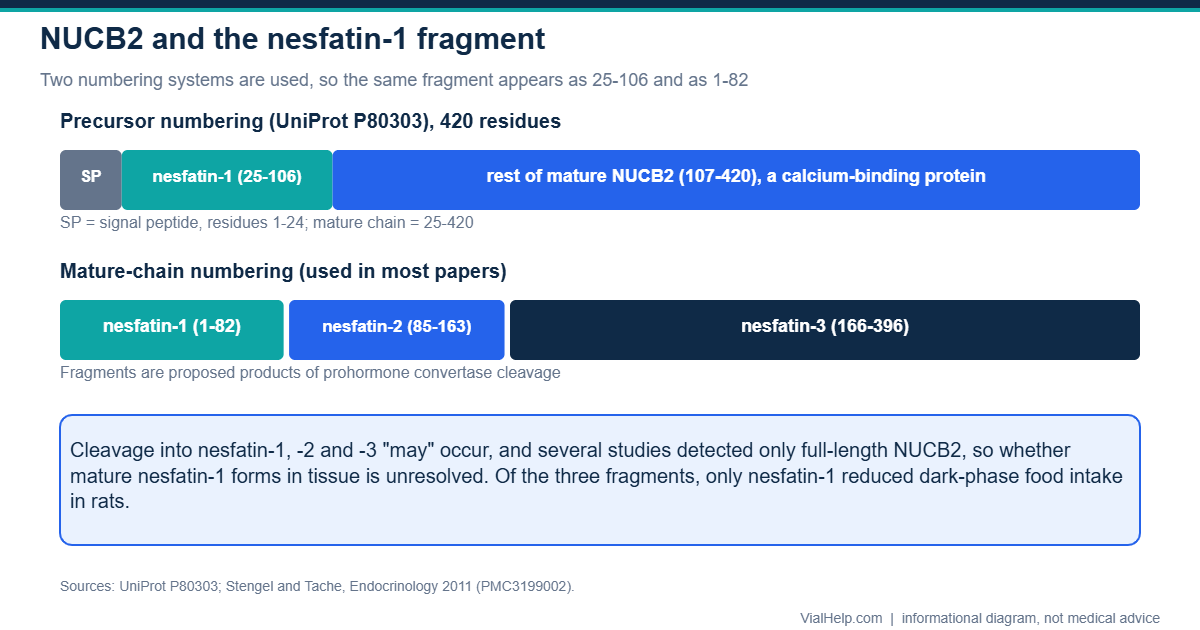
Prohormone convertases are proposed to cut NUCB2 into three pieces, nesfatin-1 (1-82), nesfatin-2 (85-163) and nesfatin-3 (166-396). In a 2011 review, Stengel and Taché describe this cleavage as something that may occur, note that only nesfatin-1 reduced dark-phase food intake, and point out that several studies detected only full-length NUCB2 by Western blot. Whether mature nesfatin-1 forms in tissue, or whether the intact precursor is the active molecule, remains unresolved.
How nesfatin-1 was discovered
In 2006 Oh-I and colleagues, writing in Nature, identified nesfatin-1 in the hypothalamus as a satiety molecule. In rats, injecting it into the brain reduced food intake and body weight, and blocking it increased eating. UniProt’s function summary states that nesfatin-1 appears to regulate food intake and energy balance independently of leptin, which is why it attracted attention as a separate appetite pathway. Compare it with leptin and ghrelin.
Where nesfatin-1 is found and what it is reported to do
Reviews report NUCB2 and nesfatin-1 in several hypothalamic nuclei and the brainstem, in the stomach’s oxyntic mucosa within ghrelin-containing X/A-like cells, in insulin-producing beta cells of the pancreatic islets, and in adipose tissue. Stomach NUCB2 expression has been reported at higher levels than brain, but the size of the difference varies between papers, so no figure is given here.
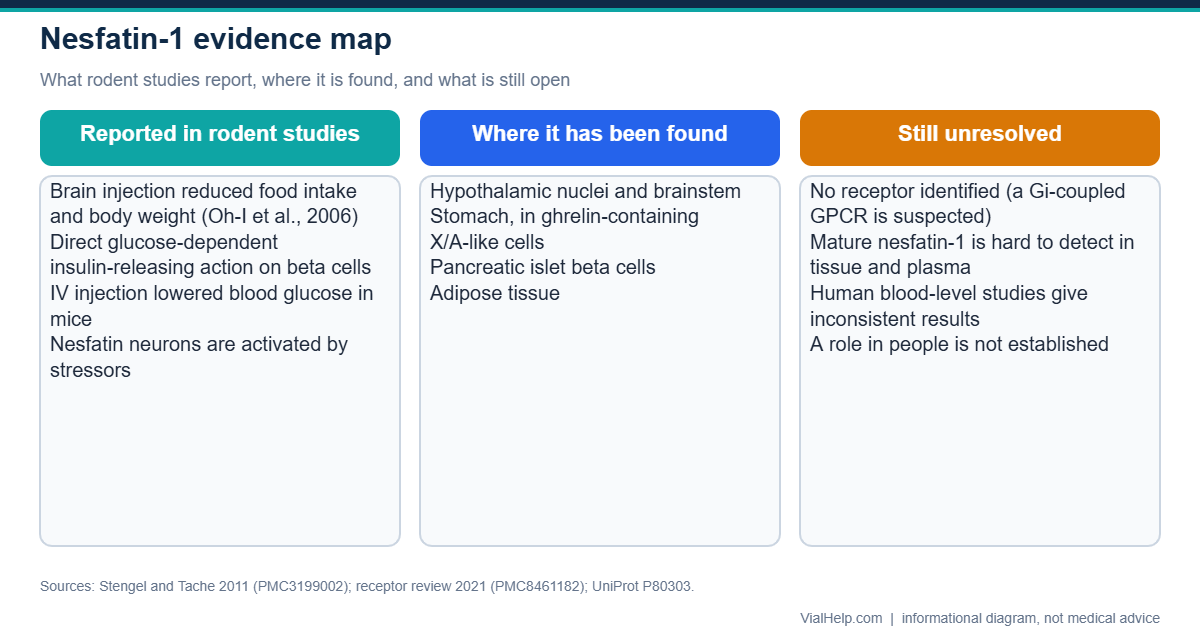
According to the Stengel and Taché review, rodent studies reported a direct glucose-dependent insulin-releasing action on beta cells, lower blood glucose after intravenous injection in mice, and activation of nesfatin neurons by stressors, with central nesfatin-1 engaging the HPA axis. These are animal findings and are not evidence of effects in people.
What is still unresolved
A 2021 systematic review concluded that a specific nesfatin-1 receptor has not been identified. The data point toward a Gi-coupled G-protein-coupled receptor, but the evidence is indirect and mixed: one cardiac study found pertussis toxin did not block the effects. Mature nesfatin-1 is also hard to measure, and human work is mostly studies of circulating levels. A recent meta-analysis of serum nesfatin-1 in type 2 diabetes pooled eight studies with very high heterogeneity (I2 98 percent) and its own forest plot did not reach significance, so those results should be treated as preliminary.
Frequently asked questions
Is nesfatin-1 the same as NUCB2?
No. NUCB2 is the full precursor protein; nesfatin-1 is the N-terminal fragment thought to be cut from it.
Does nesfatin-1 work through leptin?
UniProt and the reviews describe its effect on food intake as independent of leptin.
Has the nesfatin-1 receptor been found?
Not yet. A Gi-coupled GPCR is suspected, but no specific receptor has been identified.
Why do blood-level studies disagree?
Measurement is difficult, assay methods differ, and pooled analyses show very high heterogeneity.
References
- Oh-I S et al. Identification of nesfatin-1 as a satiety molecule in the hypothalamus. Nature 2006
- UniProt P80303 — Nucleobindin-2 (NUCB2), human
- Stengel A, Taché Y. Minireview: Nesfatin-1, an emerging new player in the brain-gut, endocrine, and metabolic axis. Endocrinology 2011
- Stengel A et al. Nesfatin-1: a novel inhibitory regulator of food intake and body weight. Obes Rev 2011
- Nesfatin-1 receptor: distribution, signaling and increasing evidence for a GPCR, a systematic review. Front Endocrinol 2021
- Meta-analysis of serum nesfatin-1 in type 2 diabetes (methodological caveats apply)
Informational only — not medical advice. This article is for educational purposes. It does not recommend, sell or instruct personal human use of any compound. Consult a qualified healthcare professional for any health decision. Content is intended for adults 21+. Verify scientific details against the primary sources cited.