
What Is Pancreatic Polypeptide? Structure, Release and Research
Gut and pancreatic hormones
Pancreatic polypeptide (PP) is a 36-amino-acid hormone made by specialised cells in the pancreatic islets and released into the blood after eating. It is less famous than insulin or glucagon, but it belongs to the same family as neuropeptide Y, and one small human study has made it a recurring topic in appetite research.
What is pancreatic polypeptide?
In humans, pancreatic polypeptide is encoded by the PPY gene. UniProt (entry P01298) lists a 95-residue precursor called “pancreatic polypeptide prohormone”. The mature hormone is residues 30–65 — 36 amino acids — and a separate 20-residue fragment, the “pancreatic icosapeptide”, is cut from the same precursor at positions 69–88. UniProt classes it in the neuropeptide Y (NPY) family. Its tissue pattern is described as enriched in the pancreas, and it is “released in circulation upon food intake”.
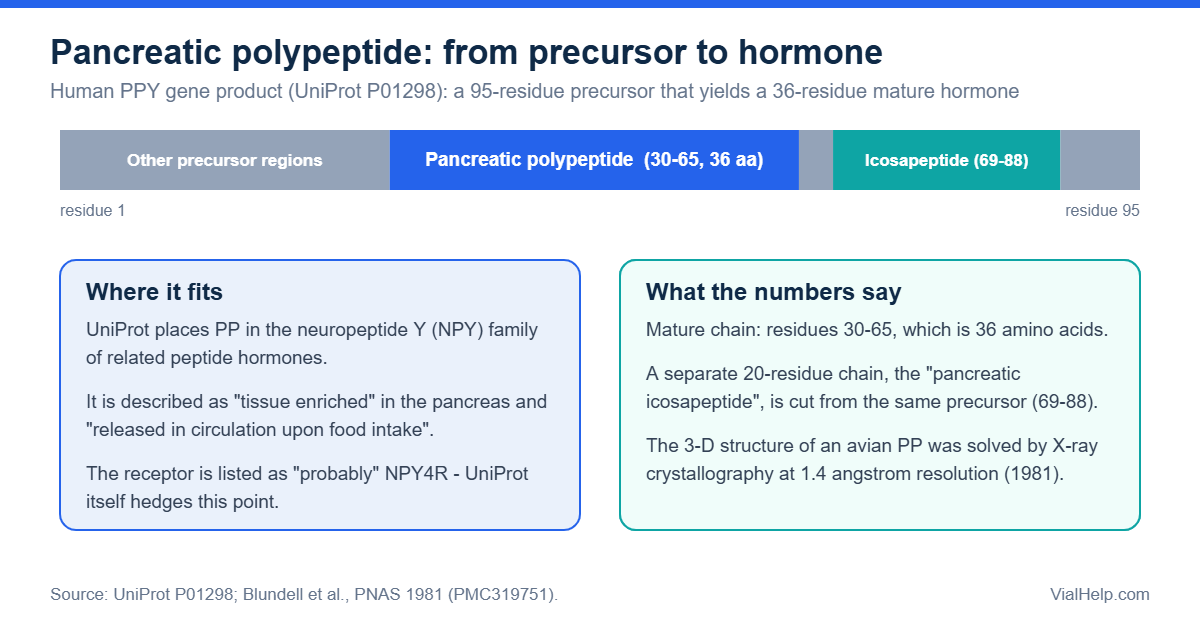
The structure of an avian PP was solved by X-ray crystallography at 1.4 Å resolution in 1981 (Blundell and colleagues, PNAS), one of the early detailed looks at a small peptide hormone.
How pancreatic polypeptide is studied to work
UniProt describes PP as a regulator of pancreatic and gastrointestinal functions and says it probably signals through the receptor NPY4R. That hedge matters: the entry itself does not state receptor pharmacology as settled fact, so this article does not either.
Secondary sources such as Wikipedia describe PP cells as concentrated mainly in the head of the pancreas and report that release is driven by vagal stimulation, with gastrin, secretin and cholecystokinin also stimulating it, and that atropine or vagotomy blunts the response to a meal. These descriptions are consistent with PP being a marker of a meal-linked, nerve-dependent pathway, but they come from a general reference rather than a primary study, so treat the details as background.

Reported effects in the research literature
The most-cited human experiment is Batterham and colleagues, Journal of Clinical Endocrinology & Metabolism 2003. Their introduction notes that plasma PP is reduced in conditions associated with increased food intake and elevated in anorexia nervosa, and that peripheral PP lowers food intake in rodents. They then ran a randomised, double-blind, placebo-controlled crossover study in ten healthy volunteers, infusing PP intravenously at 10 pmol/kg/min. PP reduced appetite and cut energy intake at a buffet lunch two hours later by 21.8% (± 5.7), and the reduction persisted: cumulative 24-hour energy intake was down by 25.3% (± 5.8). A 1999 study by Ueno and colleagues, titled “Decreased food intake and body weight in pancreatic polypeptide-overexpressing mice”, points the same way in animals.
What the human evidence shows
Human data are thin. The Batterham study is small and short, and this review of primary literature did not verify further controlled human trials, so claims about PP as a therapy, a diagnostic marker or a long-term appetite regulator should be treated as unestablished here. What is reasonably supported is that PP rises after food and that infusing it changed appetite and intake in that one experiment.
Cautions and considerations
- PP is not a consumer product and this page does not suggest any personal use.
- Any numbers here describe a study average in a small, healthy group; individual physiology differs.
- Receptor assignments and several effects (gastric emptying, gallbladder, vagal-function testing) were not verified against primary sources for this article and are deliberately left out.
Frequently asked questions
Is pancreatic polypeptide the same as PYY?
No. They are separate hormones from separate genes; PP comes from PPY (UniProt P01298). They are related members of the NPY family, and we cover PYY separately.
Which cells make it?
PP cells of the pancreatic islets, sometimes called gamma or F cells in general references.
Does it rise after a meal?
Yes — UniProt describes it as released into the circulation upon food intake, and the vagal dependence of that response is described in secondary sources.
Is pancreatic polypeptide approved as a drug?
This article does not describe any approved or recommended use. The infusion work was a research experiment.
References
- UniProt P01298 — Pancreatic polypeptide prohormone (PPY), human
- Batterham RL et al. Pancreatic polypeptide reduces appetite and food intake in humans. J Clin Endocrinol Metab 2003;88:3989–3992 (PMID 12915697)
- Ueno N et al. Decreased food intake and body weight in pancreatic polypeptide-overexpressing mice. Gastroenterology 1999 (PMID 10579984)
- Blundell TL et al. X-ray analysis (1.4-Å resolution) of avian pancreatic polypeptide. PNAS 1981;78:4175–4179 (PMC319751)
- Wikipedia — Pancreatic polypeptide (secondary source for background on cell location and release)
Informational only — not medical advice. This article is for educational purposes. It does not recommend, sell or instruct personal human use of any compound. Consult a qualified healthcare professional for any health decision. Content is intended for adults 21+. Verify scientific details against the primary sources cited.