
What Is Gastrin? The Hormone Behind Stomach Acid
Digestive hormones
Gastrin is the hormone that tells your stomach to make acid. Released by specialized G cells when a meal arrives, it turns a resting stomach into an acidic, protein-digesting environment — and it is switched off just as carefully as it is switched on.
What is gastrin?
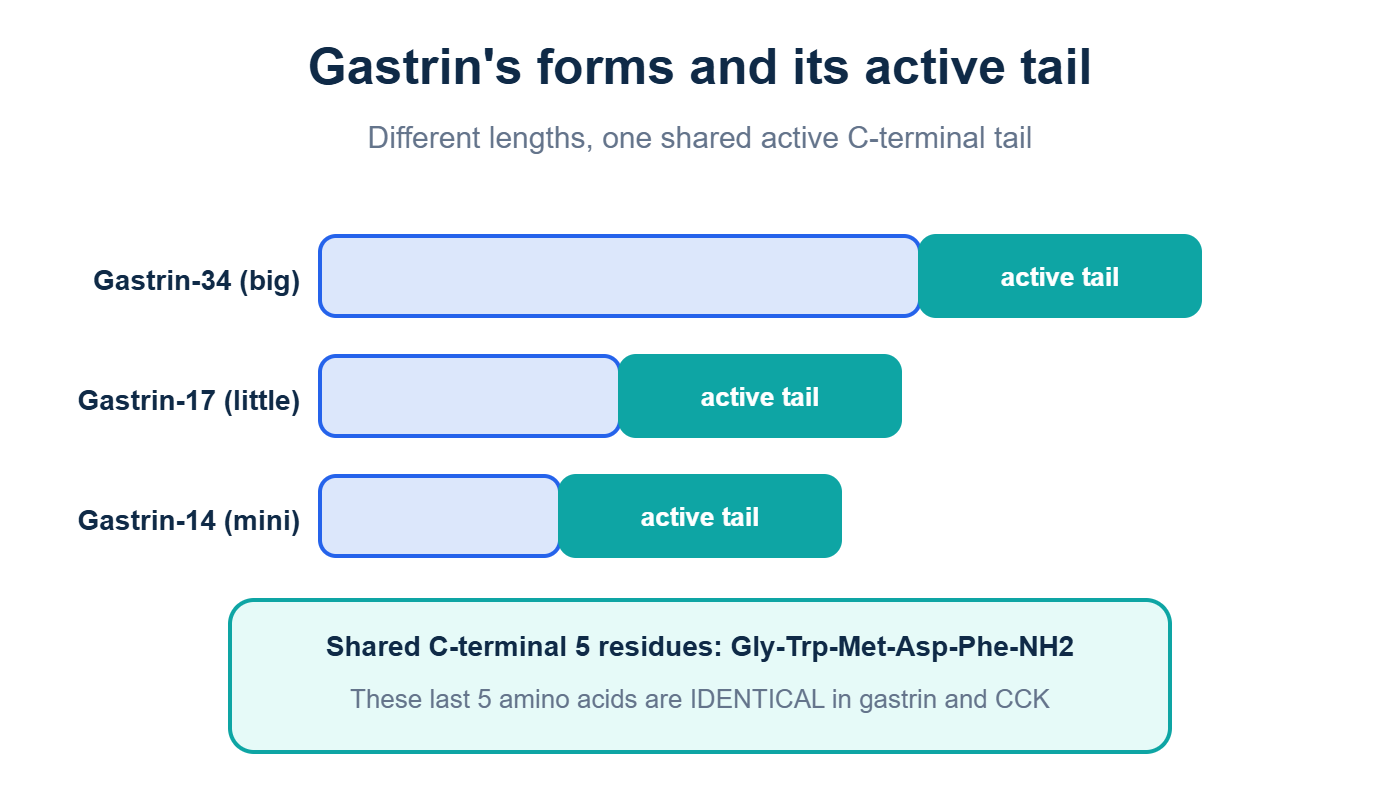
Gastrin is a peptide hormone produced mainly by G cells in the antrum (the lower part) of the stomach, with smaller amounts made in the duodenum. It is one of the classic gut hormones, first described in the early twentieth century as the chemical signal that links the arrival of a meal to the secretion of stomach acid. Gastrin circulates in several forms of different lengths — the most studied are gastrin-17 (“little gastrin”), gastrin-34 (“big gastrin”) and gastrin-14 (“minigastrin”) — all cut from a larger precursor called progastrin. Gastrin-17 dominates the antral response to a meal, while the longer gastrin-34 lingers in the blood between meals because it is cleared more slowly.
Whatever the length, the business end of every gastrin molecule is the same: a short C-terminal sequence. The final five residues (Gly-Trp-Met-Asp-Phe-NH2) are identical to those of cholecystokinin (CCK), a related gut hormone — which is why gastrin and CCK can both act on some of the same receptors.
How gastrin is studied to work
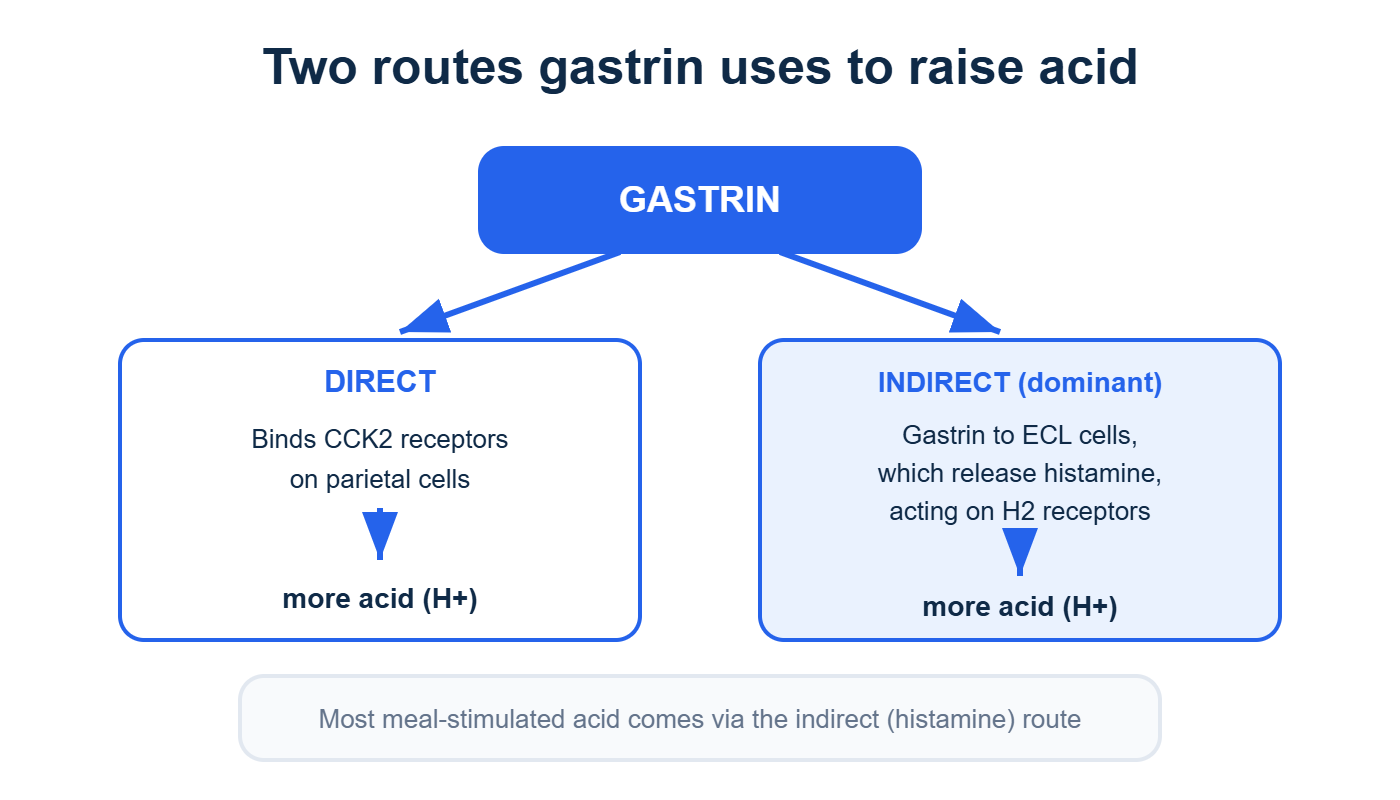
Gastrin acts through the CCK-B receptor (also called CCK2), a G-protein-coupled receptor found on cells of the stomach lining. Once gastrin binds, it raises stomach acid in two ways:
- Directly, gastrin binds CCK2 receptors on acid-producing parietal cells and stimulates their proton pumps.
- Indirectly — and this is the dominant route — gastrin stimulates enterochromaffin-like (ECL) cells to release histamine, which then acts on H2 receptors on the parietal cells.
That indirect, histamine-driven route is why H2-blocking drugs and proton-pump inhibitors are such effective acid reducers: they interrupt machinery that gastrin ultimately drives. Gastrin also has a trophic (growth-promoting) effect on the stomach lining and helps drive gastric motility.
How the acid loop is kept in balance
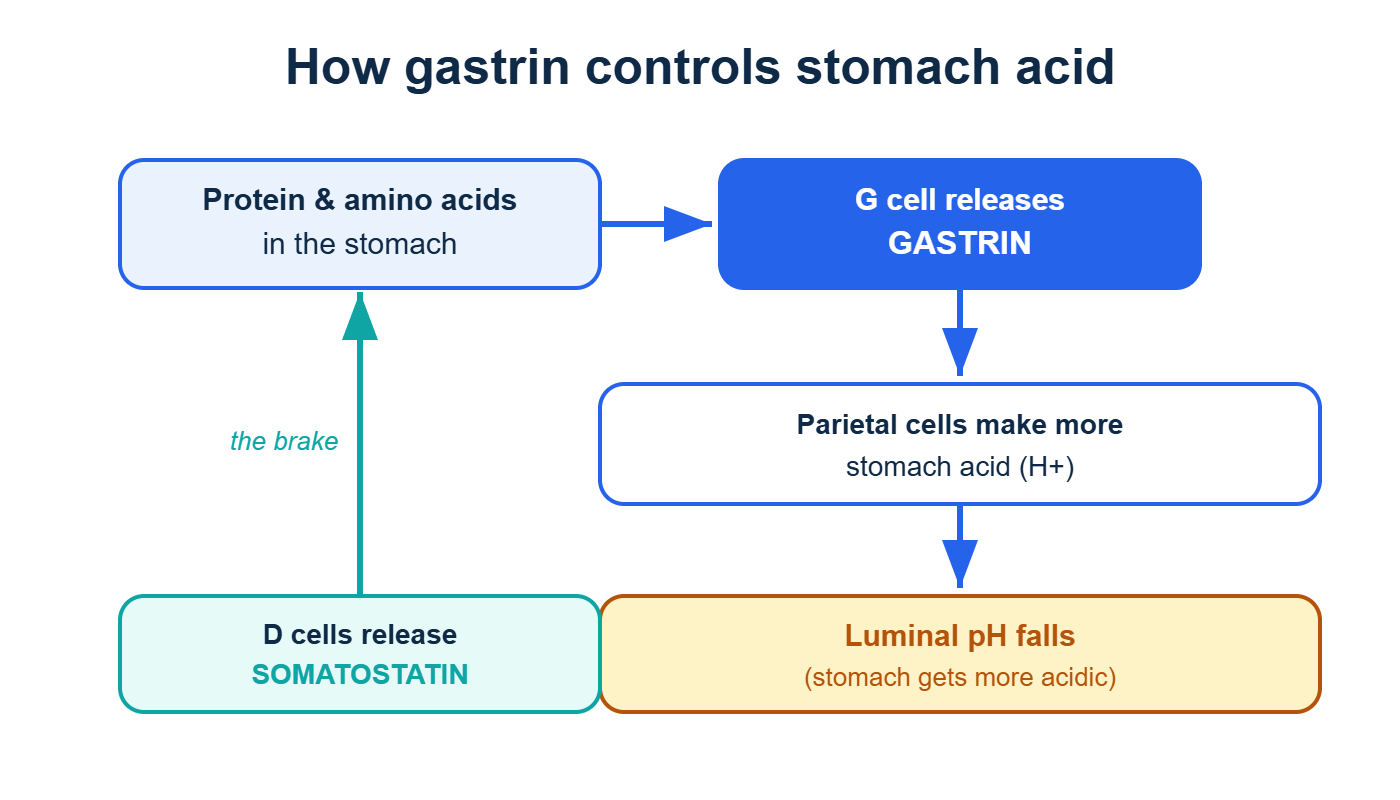
The elegant part of gastrin biology is its off-switch. A meal — especially protein and amino acids — plus stretching of the stomach and input from the vagus nerve all stimulate G cells to release gastrin. As acid accumulates and the stomach contents become more acidic, that falling pH triggers neighboring D cells to release somatostatin, which puts the brakes on the G cells. Less gastrin means less acid, and the system settles. This negative-feedback loop keeps acid production matched to need.
Gastrin in health and disease
Because gastrin and acid are so tightly linked, gastrin levels are a useful clinical clue. In Zollinger-Ellison syndrome, a gastrin-secreting tumor (a gastrinoma) pumps out gastrin without regard to the normal feedback, causing acid oversecretion and stubborn ulcers. High gastrin can also appear for the opposite reason: when acid is low, the somatostatin brake eases and gastrin rises to compensate — which is why long-term acid-suppressing therapy, atrophic gastritis, or infection with H. pylori can all raise gastrin. A synthetic fragment called pentagastrin, which contains gastrin’s active tail, is used in some diagnostic tests.
Gastrin, secretin and CCK: the digestive relay
Gastrin is best understood as the first player in a three-hormone relay that manages a meal. Gastrin readies the stomach with acid; secretin then neutralizes that acid once it reaches the small intestine; and CCK triggers the enzymes and bile that finish digestion. Seeing the family together — alongside the hormones of the endocrine pancreas — makes each one easier to remember.
Frequently asked questions
What does gastrin do?
Gastrin stimulates the stomach to secrete acid, promotes growth of the stomach lining, and increases gastric motility — linking the arrival of a meal to digestion.
Where is gastrin produced?
Mostly by G cells in the antrum of the stomach, with smaller amounts in the duodenum.
What triggers gastrin release?
Protein and amino acids in the stomach, stretching of the stomach wall, and vagus-nerve signals. It is switched off as stomach acid rises, through somatostatin from D cells.
How is gastrin related to CCK?
They share an identical five-amino-acid active tail and can both act on the CCK2 receptor. CCK, however, needs a sulfated tyrosine to strongly bind its own CCK1 receptor.
Related reading
Reconstitution calculator · Peptide library · Guides & how-tos
References
- Prosapio JG, et al. Physiology, Gastrin. StatPearls. ncbi.nlm.nih.gov/books/NBK534822
- Gastrinoma. StatPearls. ncbi.nlm.nih.gov/books/NBK441842
- GAST — Gastrin, Homo sapiens. UniProt P01350. uniprot.org/uniprotkb/P01350
- Little gastrin I (gastrin-17), PubChem CID 16132267. pubchem.ncbi.nlm.nih.gov/compound/16132267
- Gastrin C-terminal pentapeptide activating the CCK2 receptor. PMC9899899. pmc.ncbi.nlm.nih.gov/articles/PMC9899899
- Copps J, et al. Gastrin-17 in gastrointestinal cancers. PMC2872940. ncbi.nlm.nih.gov/pmc/articles/PMC2872940
Informational only — not medical advice; consult a qualified healthcare professional. 21+.