
What Is Secretin? The First Hormone Ever Discovered
Digestive hormones
Secretin holds a unique place in biology: it was the discovery that gave science the very word “hormone.” Released by the small intestine when acid arrives, its job is to protect the gut by neutralizing that acid.
What is secretin?
Secretin is a 27-amino-acid peptide hormone made by S cells in the lining of the duodenum, the first stretch of the small intestine. It is the namesake of a family of related peptides — the secretin/glucagon superfamily — that also includes glucagon, GIP and VIP. Its central job is to keep the small intestine from being damaged by the strong acid arriving from the stomach.
The discovery that created the word “hormone”
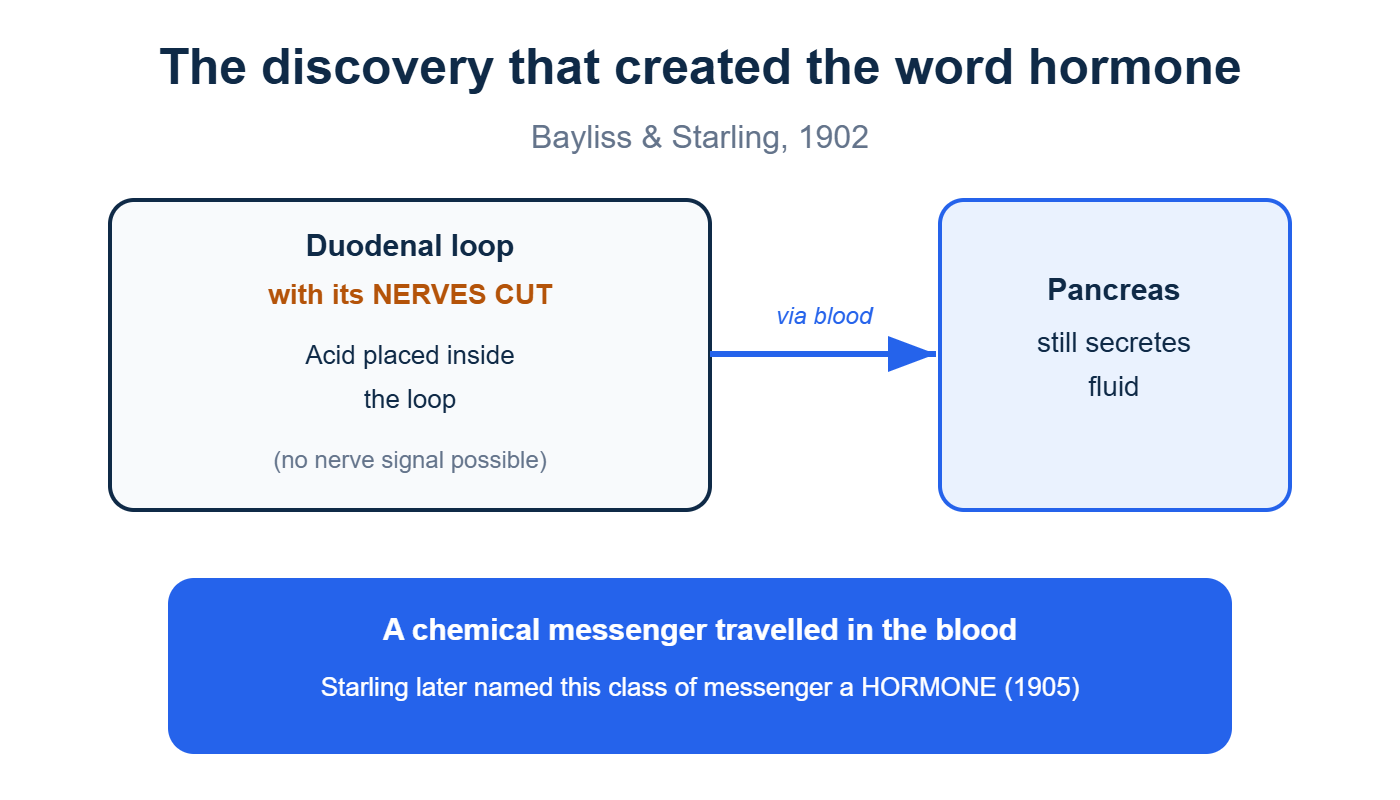
In 1902, the physiologists William Bayliss and Ernest Starling ran an experiment that changed biology. They took a loop of duodenum and cut its nerves, then introduced acid into it. Despite having no nerve connection, the pancreas still began to secrete — proving that a chemical messenger had travelled through the blood to carry the signal. That messenger was secretin. A few years later, in 1905, Starling coined the term hormone for this new class of blood-borne chemical messengers. Secretin is therefore considered the first hormone ever identified, and the founding example of endocrinology.
How secretin is studied to work
Secretin acts through the secretin receptor (SCTR), a class B G-protein-coupled receptor. Binding activates the enzyme adenylate cyclase and raises the second messenger cAMP inside the target cell. The headline action is on the pancreas: secretin stimulates the pancreatic duct cells to release a watery fluid rich in bicarbonate. Bicarbonate is alkaline, so it neutralizes the acid arriving from the stomach and raises the pH of the small intestine toward neutral. Secretin also increases bicarbonate-rich secretion from the liver’s bile ducts and, acting as a brake on the stomach, reduces gastric acid secretion and gastrin release.

The acid-neutralizing feedback loop
Secretin’s trigger is simple and precise: acid itself. When acidic chyme from the stomach enters the duodenum and the pH drops (below roughly 4.5), S cells release secretin; the resulting bicarbonate raises the pH back toward neutral, which removes the stimulus and shuts secretin off. Fatty acids in the duodenum add to the signal. The result is a self-correcting system that protects the intestinal lining and creates the near-neutral environment that pancreatic digestive enzymes need to work.
Secretin vs CCK: two jobs, one pancreas
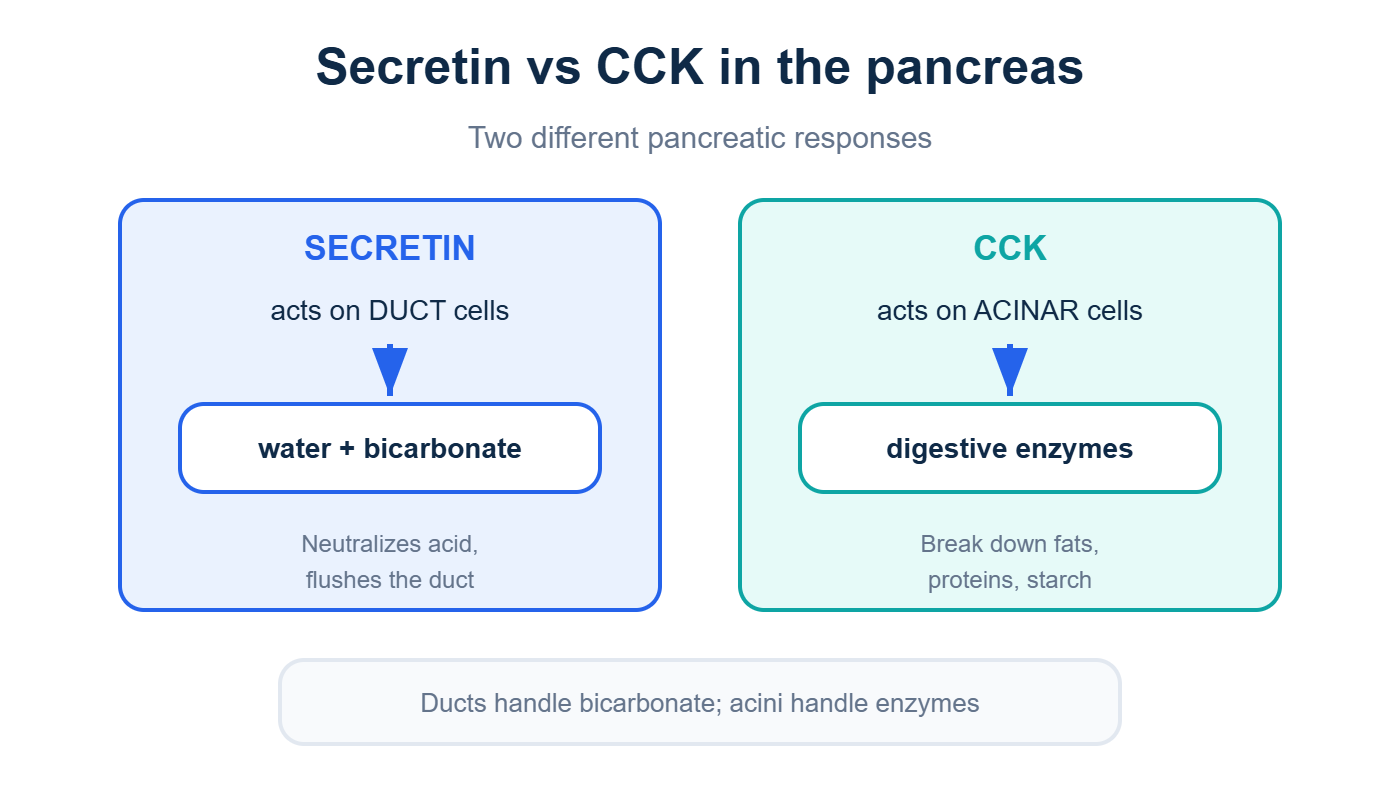
It is easy to confuse secretin with cholecystokinin (CCK), the other major small-intestine hormone, because both act on the pancreas. The clean distinction: secretin acts on the pancreatic duct cells to produce bicarbonate and fluid, while CCK acts on the acinar cells to release digestive enzymes. Secretin buffers; CCK digests.
Secretin beyond digestion
Secretin has a few other roles worth knowing. Because a gastrinoma paradoxically increases gastrin after a secretin injection, the “secretin stimulation test” is used to help diagnose that condition, and secretin is also used to enhance certain pancreatic imaging studies. One myth worth correcting: secretin was widely tried as a treatment for autism after anecdotal reports in the late 1990s, but well-designed controlled trials found no benefit, and it is not an effective treatment for autism.
Frequently asked questions
What does secretin do?
It signals the pancreas and bile ducts to release bicarbonate, neutralizing stomach acid in the small intestine, and it lightly suppresses stomach acid and gastrin.
Why is secretin historically important?
Its 1902 discovery proved that hormones exist; the word “hormone” was coined in 1905 to describe it, making secretin the founding example of endocrinology.
Where is secretin made?
By S cells in the duodenum, the first part of the small intestine.
How is secretin different from CCK?
Secretin drives bicarbonate from pancreatic duct cells; CCK drives enzymes from acinar cells. The two complement each other.
Related reading
Reconstitution calculator · Peptide library · Guides & how-tos
References
- DiGregorio N, Sharma S. Physiology, Secretin. StatPearls. ncbi.nlm.nih.gov/books/NBK537116
- Henriksen JH, de Muckadell OBS. Secretin, its discovery, and the introduction of the hormone concept. PMID 11129062. pubmed.ncbi.nlm.nih.gov/11129062
- Afroze S, et al. The physiological roles of secretin and its receptor. PMC4200670. ncbi.nlm.nih.gov/pmc/articles/PMC4200670
- SCT — Secretin, Homo sapiens. UniProt P09683. uniprot.org/uniprotkb/P09683
- Secretin (human), PubChem CID 16129665. pubchem.ncbi.nlm.nih.gov/compound/16129665
- Sandler AD, et al. Lack of benefit of secretin in autism. N Engl J Med 1999. PMID 10588965. pubmed.ncbi.nlm.nih.gov/10588965
Informational only — not medical advice; consult a qualified healthcare professional. 21+.