
What Is GDF15? The Hormone Linking Nausea, Appetite and Weight
Guides · Peptide biology
GDF15 is a stress-responsive protein hormone that acts on a small patch of the hindbrain to suppress appetite and trigger nausea. Here is what GDF15 is, how its receptor was found, and what research in pregnancy, metformin and cancer cachexia has reported — with the limits of that evidence stated plainly.
What is GDF15?
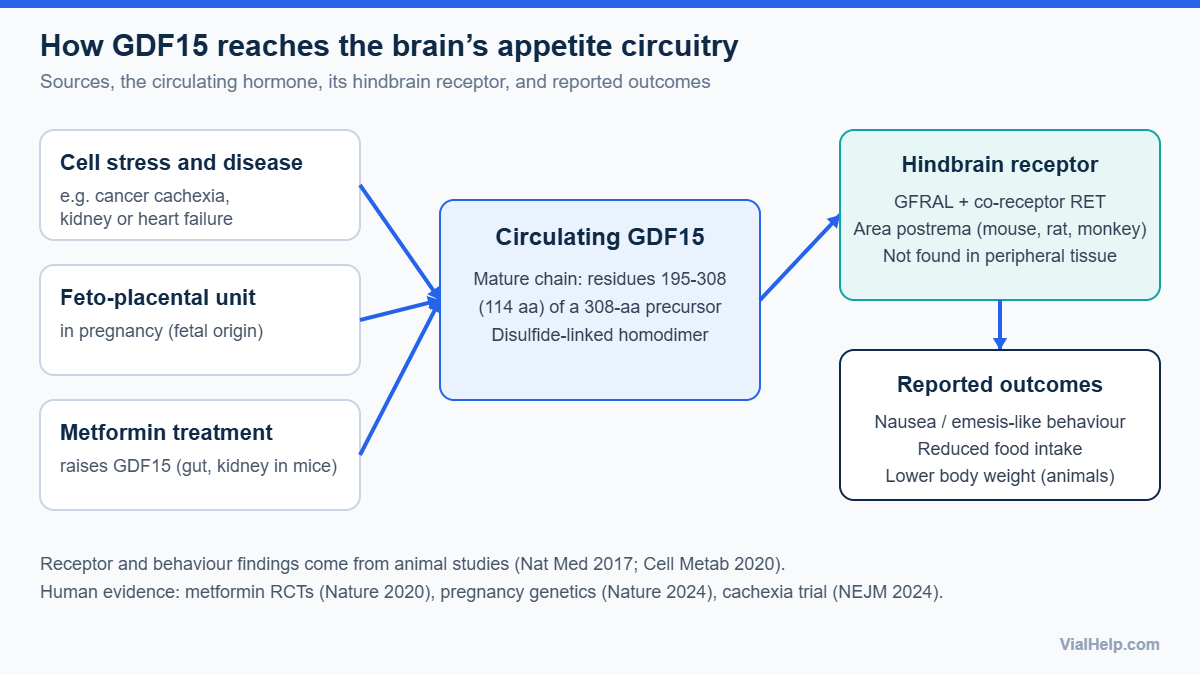
GDF15 — growth/differentiation factor 15, also known as MIC-1 — is a distant member of the transforming growth factor-beta (TGF-beta) superfamily. Published work has linked it to cancer cachexia, kidney and heart failure, atherosclerosis and metabolism. Unlike the short peptides covered elsewhere on VialHelp, it is a full secreted protein: UniProt entry Q99988 describes a 308-residue precursor with a signal peptide (residues 1–29), a propeptide (30–194) and a mature chain of residues 195–308, 114 amino acids long. The active hormone is a disulfide-linked homodimer.
That puts GDF15 in the same broad family of metabolic signalling proteins as FGF21, adiponectin and leptin. What makes it unusual is how it works: rather than acting broadly across tissues, its only known receptor sits in a very small part of the brain.
How GDF15 acts: the GFRAL–RET receptor
For years GDF15 was a hormone without a receptor. In 2017, two papers in Nature Medicine reported that GFRAL (GDNF family receptor alpha-like), an orphan member of the GFR-alpha family, is a high-affinity receptor for GDF15. To signal, GFRAL needs a co-receptor, RET; UniProt describes a 2:2:2 complex of GDF15, GFRAL and RET.
The evidence for GFRAL as the functional receptor was strong in animals. Mice lacking GFRAL did not respond to recombinant GDF15 with lower body weight or food intake, and an antibody that blocked the GDF15–GFRAL interaction prevented the metabolic effects in rats. GFRAL expression was restricted to hindbrain neurons — notably the area postrema in mouse, rat and monkey — and was not found in peripheral tissues. The area postrema is a hindbrain region tied to nausea and vomiting circuitry, which matters for the next section.
GDF15, nausea and appetite
Early obesity research treated GDF15 as an appetite-suppressing hormone. A 2020 paper in Cell Metabolism asked a sharper question: does GDF15 reduce eating because it makes animals feel unwell? The authors tested three mammalian species. GDF15 caused vomiting in musk shrews (Suncus murinus), and in species that cannot vomit, such as mice and rats, it produced anorexia and pica — behaviours used as markers of nausea or malaise. They also reported data in mice suggesting GDF15 contributes to chemotherapy-induced malaise, and concluded that GDF15 triggers anorexia through nausea and/or by engaging emetic neurocircuitry.
The abstract also notes that elevated endogenous GDF15 is associated with energy-balance disturbances, cancer progression, chemotherapy-induced anorexia and morning sickness. Those associations set up the three human settings below. For how other appetite hormones are described, see ghrelin and amylin, which also act partly in the hindbrain.
GDF15 in pregnancy, metformin and cancer cachexia
Pregnancy. A 2024 Nature study reported that fetal production of GDF15 and the mother’s sensitivity to it both contribute substantially to the risk of hyperemesis gravidarum (severe nausea and vomiting of pregnancy). Using mass spectrometry to track a naturally labelled GDF15 variant, the authors showed that most GDF15 in maternal plasma comes from the feto-placental unit. Carriers of genetic variants linked to low GDF15 outside pregnancy had a higher risk, while women with beta-thalassaemia, a condition with chronically high GDF15, reported very low nausea and vomiting of pregnancy. In mice, prior exposure changed the response to a GDF15 bolus, consistent with desensitisation.
Metformin. A 2020 Nature paper reported, in two independent randomised clinical trials, that metformin increases circulating GDF15. In mice, GDF15 expression rose mainly in the distal intestine and kidney. Metformin prevented weight gain on a high-fat diet in normal mice but not in mice lacking GDF15 or GFRAL, and a GFRAL-blocking antibody reversed its weight effects in obese mice. Glucose lowering, however, persisted without GDF15. This is a mechanism finding about an existing drug, not a reason to expect any particular outcome in an individual.
Cancer cachexia. In a phase 2, randomised, double-blind, 12-week trial in the New England Journal of Medicine, ponsegromab — a humanised monoclonal antibody that inhibits GDF15 — was given subcutaneously every 4 weeks for three doses at 100, 200 or 400 mg versus placebo. The 187 participants had cancer cachexia and serum GDF15 of at least 1500 pg/mL. At 12 weeks the median between-group difference in body weight was 1.22 kg (100 mg), 1.92 kg (200 mg) and 2.81 kg (400 mg) in favour of ponsegromab. For wider context on muscle-wasting signals, see our explainer on myostatin, activin and follistatin.

What the human evidence does and does not show
It is also worth separating cause from correlation. Higher GDF15 appears in many conditions, but the studies above are strongest where they combine human genetics or randomised data with receptor-level mechanism, as in pregnancy and cachexia. Related questions — whether weight-loss drugs in the incretin class intersect with this pathway — are not settled by the sources cited here; for what is known about those drugs’ adverse effects, see GLP-1 side effects and semaglutide vs tirzepatide.
Handling, storage and reconstitution (research context)
Recombinant GDF15 is a protein, not a short peptide, so its handling follows the manufacturer’s datasheet — the diluent, buffer, carrier protein and storage temperature are set by the supplier and can differ from the conventions used for short synthetic peptides. For general laboratory background, see the reconstitution guide, sterile technique, the reconstitution calculator and why IU and mL are not a dose. Concentration maths in these tools is laboratory arithmetic only.
Cautions and considerations
This article is educational and summarises published abstracts and database entries. Persistent nausea, vomiting or unintended weight loss have many possible causes and warrant evaluation by a qualified clinician. Nothing here is guidance for personal use of any compound.
Frequently asked questions
What does GDF15 stand for?
GDF15 stands for growth/differentiation factor 15. It is also called MIC-1 and belongs to the TGF-beta superfamily of signalling proteins.
What is the GDF15 receptor?
GDF15 binds GFRAL (GDNF family receptor alpha-like), which needs the co-receptor RET to signal. In mouse, rat and monkey, GFRAL expression was reported in the hindbrain, notably the area postrema, and not in peripheral tissues.
Does metformin raise GDF15?
A 2020 Nature paper reported that metformin raised circulating GDF15 in two randomised clinical trials, and that its weight effects in mice depended on GDF15 and GFRAL. Its glucose-lowering effect did not.
Is GDF15 linked to morning sickness?
A 2024 Nature study reported that fetal GDF15 production and maternal sensitivity to it both contribute to the risk of hyperemesis gravidarum, the severe form of nausea and vomiting in pregnancy.
References
- UniProt Q99988: Growth/differentiation factor 15 (human)
- The metabolic effects of GDF15 are mediated by the orphan receptor GFRAL. Nat Med 2017 (PMID 28846098)
- GFRAL is the receptor for GDF15 and is required for the anti-obesity effects of the ligand. Nat Med 2017 (PMID 28846099)
- GDF15 induces anorexia through nausea and emesis. Cell Metab 2020 (PMID 31928886)
- GDF15 mediates the effects of metformin on body weight and energy balance. Nature 2020 (PMID 31875646)
- GDF15 linked to maternal risk of nausea and vomiting during pregnancy. Nature 2024 (PMID 38092039)
- Ponsegromab for the treatment of cancer cachexia. N Engl J Med 2024 (PMID 39282907)
Informational only — not medical advice. This article is for education and general information. It is not a recommendation to use any substance and does not replace advice from a qualified clinician. 21+.