
What Is Thyrotropin-Releasing Hormone (TRH)? The Tripeptide That Starts the Thyroid Axis
Guides · Peptide biology
Thyrotropin-releasing hormone (TRH) is a three-amino-acid peptide made in the hypothalamus that tells the pituitary gland to release thyroid-stimulating hormone. Here is what TRH is, how a 242-residue precursor yields it, how it fits into the thyroid axis and energy balance, and what the TRH test and the analogue taltirelin show.
What is thyrotropin-releasing hormone?
Thyrotropin-releasing hormone (TRH, also called protirelin) is a tripeptide with the sequence pyroglutamyl-histidyl-prolinamide, written pGlu-His-Pro-NH2. PubChem lists its formula as C16H22N6O4 and its molecular weight as 362.38 g/mol. It is one of the smallest signalling peptides in the body, yet it sits at the top of the thyroid axis described in our HPT axis guide.
A three-residue peptide cannot be encoded directly, so the body makes it from a larger precursor. In UniProt entry P20396, human pro-TRH is 242 amino acids long, with a 24-residue signal peptide and six copies of the sequence Gln-His-Pro. In the first copy the sequence reads Gln-His-Pro-Gly-Lys-Arg: processing enzymes cut at the basic residues, the N-terminal glutamine cyclises to pyroglutamate, and the glycine supplies the amide that caps the C-terminal proline. UniProt annotates the proline amide at each copy. One precursor therefore yields up to six TRH molecules.

How TRH works in the thyroid axis
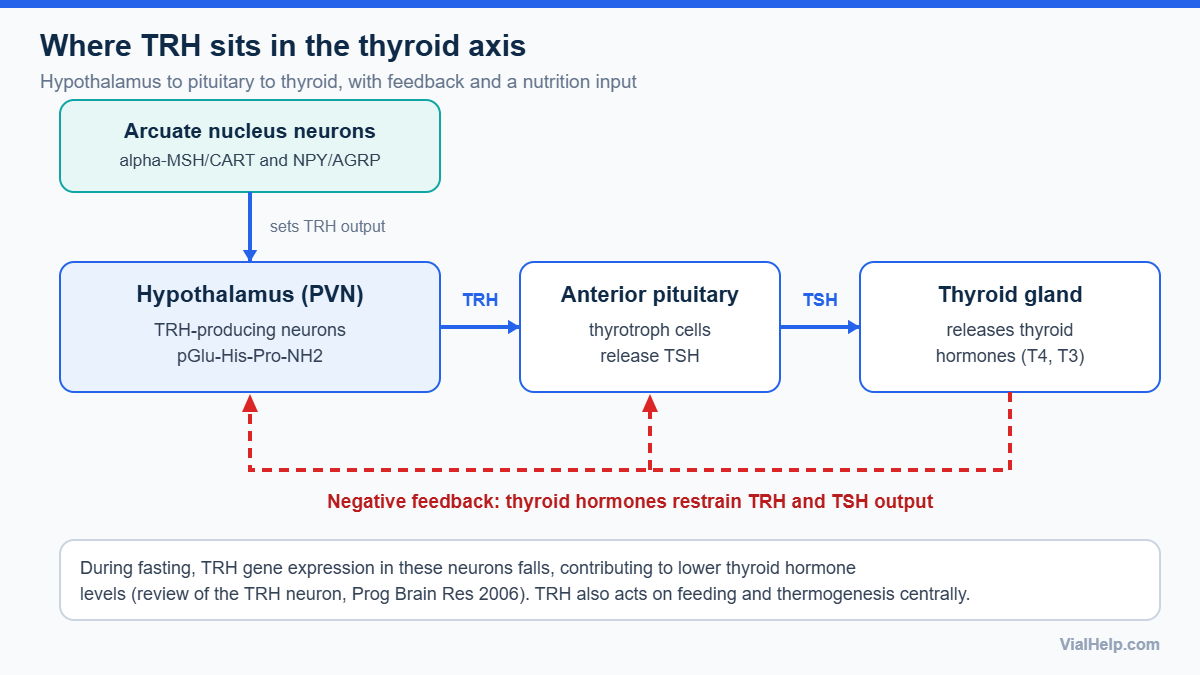
The TRH neurons that control the pituitary (hypophysiotropic neurons) sit in the medial and periventricular parvocellular parts of the paraventricular nucleus of the hypothalamus, as described in a 2006 review of the TRH neuron. TRH reaches the anterior pituitary, where it stimulates thyroid-stimulating hormone (TSH) release; TSH then drives the thyroid gland to release thyroid hormones, which feed back to restrain TRH and TSH. See the hypothalamus and pituitary gland explainers for the surrounding anatomy.
TRH acts through the TRH receptor, a 398-residue G protein-coupled receptor. According to UniProt, ligand binding activates the phosphatidylinositol (IP3)–calcium–protein kinase C pathway. For a primer on that receptor family, see what is a GPCR?.
TRH, energy balance and the brain
TRH is not just a thyroid switch. The 2006 review describes roles in feeding behaviour, thermogenesis, locomotor activation and autonomic regulation. Hypophysiotropic TRH neurons receive direct input from two leptin-responsive groups of neurons in the arcuate nucleus: one containing alpha-MSH and CART, which promote weight loss, and one containing NPY and AGRP, which promote weight gain. During fasting, TRH gene expression in these neurons falls as alpha-MSH/CART activity is suppressed and NPY/AGRP rises, contributing to the drop in circulating thyroid hormone. For the hormone that feeds this circuit, see leptin.
TRH also acts on the pituitary beyond TSH; its link to prolactin release is discussed in our prolactin explainer. In the brain, research continues on TRH-based compounds: a 2015 Neuropharmacology study of an experimental compound, JAK4D, reported nanomolar binding to TRH receptors in human hippocampal tissue and found those receptors to be pharmacologically distinct from the pituitary ones. That work is preclinical.
TRH in testing and the taltirelin story
The TRH stimulation test. Synthetic TRH has long been used as a diagnostic probe of pituitary TSH reserve. A 2024 study in the Journal of the Endocrine Society evaluated 952 people with subclinical hypothyroidism (TSH 4.01–10.00 mIU/L) using TSH response to TRH stimulation, defining an exaggerated response by the rise from baseline to peak TSH. The authors note that in the upper-normal TSH range the test has proved useful for identifying an exaggerated response.
Taltirelin. Taltirelin hydrate is a synthetic TRH analogue studied in ataxia caused by spinocerebellar degeneration. In a randomised Korean trial of 149 patients published in the Journal of Movement Disorders in 2025, taltirelin 5 mg orally twice daily was compared with a control group. At 24 weeks the change in the K-SARA ataxia score differed significantly (−0.51 ± 2.79 with taltirelin versus 0.36 ± 2.62 in controls; p = 0.0321), with lower “stance” and “speech disturbance” subscores, but other secondary measures showed no significant difference.
Handling, storage and reconstitution (research context)
Short native peptides such as TRH are often modified into analogues for stability, a theme covered in peptide half-life extension strategies. For general laboratory background, see the reconstitution guide, sterile technique, the reconstitution calculator and why IU and mL are not a dose. Concentration maths in these tools is laboratory arithmetic only.
Cautions and considerations
This article is educational and summarises published abstracts and database entries. Thyroid function tests and any TRH-based testing are interpreted by clinicians in the context of symptoms and other results. Nothing here is guidance for personal use of any compound.
Frequently asked questions
What does TRH stand for?
TRH stands for thyrotropin-releasing hormone. It is a tripeptide, pGlu-His-Pro-NH2, made in the hypothalamus.
How is TRH made from its precursor?
Human pro-TRH (UniProt P20396) is 242 amino acids and contains six Gln-His-Pro copies. Each is cut out, the N-terminal glutamine becomes pyroglutamate and the C-terminal proline is amidated, giving the mature tripeptide.
Does TRH only act on the thyroid axis?
No. TRH stimulates pituitary TSH release, but reviews also describe central roles in feeding behaviour, thermogenesis, locomotor activation and autonomic regulation.
What is taltirelin?
Taltirelin hydrate is a synthetic TRH analogue studied in ataxia due to spinocerebellar degeneration. A 2025 randomised trial of 149 patients reported a small but statistically significant K-SARA improvement at 24 weeks versus control.
References
- UniProt P20396: Pro-thyrotropin-releasing hormone (human)
- UniProt P34981: Thyrotropin-releasing hormone receptor (human)
- PubChem: Protirelin (CID 638678)
- Lechan RM, Fekete C. The TRH neuron: a hypothalamic integrator of energy metabolism. Prog Brain Res 2006 (PMID 16876577)
- Role of Thyrotropin-Releasing Hormone Stimulation Test and Autoantibody in 952 Subjects with Subclinical Hypothyroidism. J Endocr Soc 2024 (PMID 39749109)
- Efficacy and Safety of Taltirelin Hydrate in Patients With Ataxia Due to Spinocerebellar Degeneration. J Mov Disord 2025 (PMID 39428104)
- First-in-class thyrotropin-releasing hormone (TRH)-based compound binds to a pharmacologically distinct TRH receptor subtype in human brain and is effective in neurodegenerative models. Neuropharmacology 2015 (PMID 25281210)
Informational only — not medical advice. This article is for education and general information. It is not a recommendation to use any substance and does not replace advice from a qualified clinician. 21+.