
Mitochondria-Derived Peptides: Humanin, MOTS-c and the SHLPs
Mitochondrial biology
Mitochondria-derived peptides are tiny proteins encoded not in the nucleus but in the mitochondrion’s own small genome. The best known are humanin, MOTS-c and a family called the SHLPs. They have attracted attention because they appear to act as signals between mitochondria and the rest of the cell, but the evidence is still overwhelmingly from cells and animals.
What are mitochondria-derived peptides?
Mitochondria carry a small circular genome of their own. For decades its genes were thought to code only for a handful of respiratory-chain proteins, plus the transfer and ribosomal RNAs needed to make them. Mitochondria-derived peptides (MDPs) overturned part of that picture: short open reading frames hiding inside the ribosomal RNA genes turn out to encode small, biologically active peptides.
Humanin and the SHLPs come from the 16S rRNA gene (MT-RNR2), while MOTS-c is read from the 12S rRNA gene (MT-RNR1). According to UniProt, human humanin is 24 amino acids long and MOTS-c is 16.

The main mitochondria-derived peptides
Humanin
Humanin was the first MDP described. It was identified independently in the early 2000s by groups studying protection against amyloid-beta toxicity, binding to the cell-death protein BAX, and interaction with IGFBP-3. UniProt summarizes its reported functions as suppressing apoptosis by binding BAX and BID, signaling through a receptor complex and JAK-STAT3, and protecting cultured cells against amyloid-beta and familial Alzheimer’s-disease gene toxicity. A synthetic variant, HNG (S14G), is reported to be far more potent in the lab than the natural sequence, which is one reason much humanin research uses analogs.
MOTS-c
MOTS-c (“mitochondrial open reading frame of the 12S rRNA type-c”) is a 16-amino-acid peptide. UniProt describes a mechanism in which MOTS-c inhibits the folate cycle, slowing de novo purine synthesis, so the metabolite AICAR accumulates and activates AMPK, a central energy-sensing enzyme. Under metabolic stress it is also reported to move into the nucleus and influence antioxidant-response genes. In a 2021 Nature Communications study, labelled MOTS-c entered cultured muscle cells and reached the nucleus within about 30 minutes.
The SHLPs
In 2016 a team searching the humanin region in silico reported six more small ORFs, named SHLP1 to SHLP6, encoding peptides of roughly 20 to 38 amino acids. The authors’ RT-PCR work supported a mitochondrial origin for SHLP1, 4, 5 and 6, but results for SHLP2 and SHLP3 were inconclusive because nuclear copies of the sequence also amplified. In cell experiments the family had mixed effects: for example SHLP2 and SHLP3 reduced apoptosis and reactive oxygen species, while SHLP6 increased apoptosis.
Reported effects of mitochondria-derived peptides in research
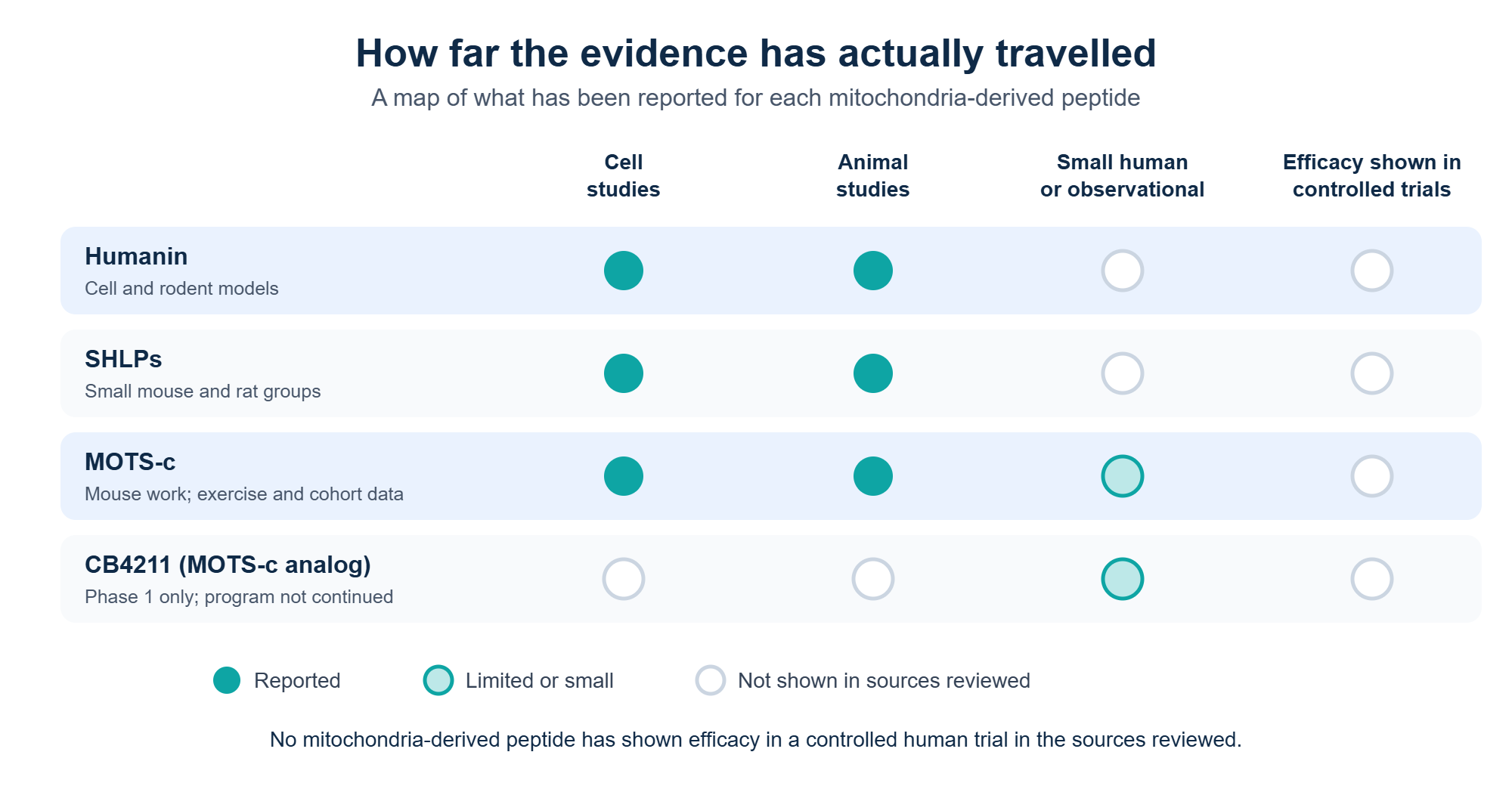
Most of what is reported comes from cultured cells and rodents. Humanin has been studied in rodent models of Alzheimer’s-type pathology, stroke and metabolic disease. For MOTS-c, UniProt’s summary notes protection against diet-induced obesity and age-related insulin resistance in mice. In the 2021 Reynolds study, MOTS-c treatment improved physical performance in young and old mice, with an exploratory trend toward longer survival that the authors themselves said needs larger cohorts to confirm.
What the human evidence shows
Human data on mitochondria-derived peptides are sparse and mostly observational.
Exercise. In the same 2021 paper, 10 young sedentary men cycled while samples were taken: muscle MOTS-c rose roughly 12-fold and circulating MOTS-c about 1.6-fold during exercise, returning to baseline after four hours of rest. A secondary analysis of a randomized exercise trial in breast-cancer survivors (Scientific Reports, 2021) found plasma MOTS-c rose after 16 weeks of training in non-Hispanic White participants but not Hispanic participants, with changes correlating with body-composition and insulin-resistance markers. These are small, associational findings.
Genetics. A variant in the MOTS-c sequence (m.1382A>C) found in Northeast Asian populations was proposed in 2015 as a possible factor in Japanese longevity, a hypothesis paper. A 2021 follow-up reported that carriers had more type 2 diabetes in Japanese men, specifically sedentary men, and that the variant peptide failed to improve glucose tolerance in high-fat-fed mice. Association studies cannot show cause.
The one drug-development program. CB4211, developed by CohBar, was described in company filings as an analog of MOTS-c, not MOTS-c itself. A company-reported Phase 1b study in 20 obese adults with fatty liver (11 treated, 9 placebo) saw no serious adverse events, mainly mild or moderate injection-site reactions, and reported larger falls in liver enzymes (ALT, AST) than placebo, but liver fat measured by MRI did not separate from placebo. The program had earlier been paused in 2018 over injection-site reactions. In 2023 CohBar’s merger filing stated that efforts to find a suitable formulation had not succeeded and that the merged company would not continue its product candidates.
Regulatory and availability context
We found no approved drug based on a mitochondria-derived peptide. MOTS-c has been promoted online as an injectable “peptide stack” ingredient, and its status under US compounding rules has been changing in 2026 (an FDA advisory committee met in July 2026, and its votes are non-binding). Check FDA’s own pages for the current position rather than relying on secondary summaries. See also our explainer on another class of naturally occurring peptides for how research candidates differ from approved drugs.
Cautions and considerations
Because research-grade peptides are not approved medicines, identity, purity and dose are not guaranteed, and nothing here is guidance for human use. Peptides also face practical hurdles: short half-lives (see peptide half-life explained) and the stability issues covered in peptide degradation. For lab-math context, the reconstitution calculator shows concentration relationships only.
Frequently asked questions
Are mitochondria-derived peptides hormones?
MOTS-c has been detected in blood and rises with exercise, and humanin is reported to act on cell-surface receptors, so both are described as signaling molecules. Whether they behave as true endocrine hormones in humans is still being worked out.
Is MOTS-c the same as CB4211?
No. CohBar’s filings describe CB4211 as a novel analog of MOTS-c, and its trial results should not be read as results for MOTS-c itself.
Why are they encoded inside rRNA genes?
The mitochondrial genome is compact and tightly packed. Short ORFs inside genes previously labelled “RNA only” were overlooked until bioinformatic and mass-spectrometry approaches began searching for them.
Do these peptides have anything to do with other “stress” signals?
Mitochondrial stress also drives circulating proteins such as GDF15, and exercise signals such as irisin, but each is a distinct molecule with its own pathway.
References
- UniProt Q8IVG9 — Humanin (MT-RNR2), human
- UniProt A0A0C5B5G6 — Mitochondrial open reading frame of the 12S rRNA-c (MOTS-c), human
- Reynolds JC et al. MOTS-c is an exercise-induced mitochondrial-encoded regulator of age-dependent physical decline and muscle homeostasis. Nat Commun 2021;12:470
- Cobb LJ et al. Naturally occurring mitochondrial-derived peptides are age-dependent regulators of apoptosis, insulin sensitivity, and inflammatory markers. Aging 2016;8(4):796-809
- Dieli-Conwright CM et al. Sci Rep 2021 — plasma MOTS-c and exercise in breast cancer survivors (secondary analysis of a randomized trial)
- Fuku N, Cohen P et al. A pro-diabetogenic mtDNA polymorphism in the mitochondrial-derived peptide, MOTS-c. Aging 2021
- CohBar Inc. — CB4211 Phase 1a/1b topline results (SEC Form 8-K exhibit 99.2, Aug 2021)
Informational only — not medical advice. This article is for educational purposes. It does not recommend, sell or instruct personal human use of any compound. Consult a qualified healthcare professional for any health decision. Content is intended for adults 21+. Verify scientific details against the primary sources cited.