
Amyloid-Beta Peptide: What It Is and How It Is Made
Guides · Peptide biology
The amyloid-beta peptide is a roughly 40-residue fragment cut from the amyloid precursor protein, and it is the building block of the plaques associated with Alzheimer’s disease. Here is how the peptide is produced, how it aggregates, and what the first anti-amyloid antibody trials actually measured.
What is the amyloid-beta peptide?
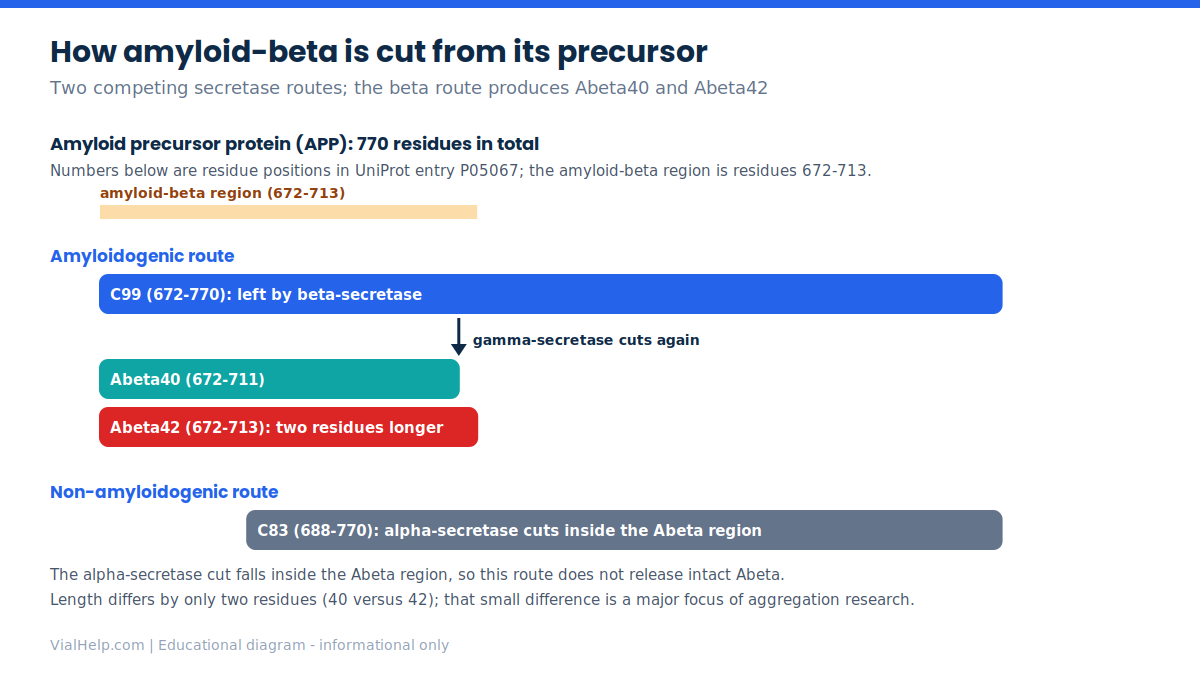
Amyloid-beta (Aβ) is not a gene product in its own right; it is a fragment cut out of a much larger membrane protein, the amyloid-beta precursor protein (APP). In the UniProt reference entry for human APP (P05067) the full precursor is 770 residues long. The amyloid-beta region sits near its C-terminal end: the 42-residue form, Aβ42, spans residues 672–713, and the 40-residue form, Aβ40, spans residues 672–711. The two differ only by the last two amino acids, yet that small difference is a central subject of aggregation research.
The same entry annotates the intermediate fragments left behind after the first cut: C99 (residues 672–770) and the shorter C83 (residues 688–770).
How amyloid-beta is released from APP
APP can be processed along two competing routes, each defined by which protease cuts first. On the amyloidogenic route, beta-secretase cuts first and leaves the 99-residue C-terminal fragment (C99). Gamma-secretase then cuts C99 again, releasing Aβ peptides of slightly different lengths, including Aβ40 and Aβ42. On the non-amyloidogenic route, alpha-secretase cuts first, inside the Aβ region (the C83 fragment begins at residue 688, within 672–713), so intact Aβ is not released.
From monomer to plaque: the amyloid hypothesis
In the classic formulation reviewed by Hardy and Selkoe in 2002, the amyloid hypothesis proposes that deposition of Aβ in plaques in brain tissue is the primary influence driving Alzheimer’s disease pathogenesis, and that the rest of the disease process — including formation of neurofibrillary tangles containing tau — follows from an imbalance between Aβ production and clearance. The review’s title itself captures the tone of the field: “progress and problems on the road to therapeutics.”
At the molecular level, the peptide’s behaviour is an aggregation story: soluble monomers can assemble into larger soluble species and ultimately into insoluble fibrils. The chemistry of that process is covered in our explainer on peptide aggregation and fibrillation, and the structural motifs involved in peptide secondary structure.
What the human evidence shows: anti-amyloid antibodies
The strongest human evidence about Aβ as a target comes from antibody trials. Lecanemab, a humanized IgG1 antibody that binds Aβ soluble protofibrils, was tested in the 18-month phase 3 Clarity AD trial (NCT03887455) in people aged 50–90 with early Alzheimer’s disease and amyloid confirmed by PET or cerebrospinal fluid. Of 1,795 participants, 898 received lecanemab (10 mg/kg intravenously every two weeks) and 897 received placebo. On the primary end point, the Clinical Dementia Rating–Sum of Boxes (CDR-SB), the adjusted mean change from baseline was 1.21 with lecanemab versus 1.66 with placebo (difference −0.45; 95% CI −0.67 to −0.23). The authors concluded that lecanemab reduced markers of amyloid and produced moderately less decline on cognition and function measures, but was associated with adverse events.
Donanemab was tested in the TRAILBLAZER-ALZ 2 trial (NCT04437511), which randomised 1,736 participants with early symptomatic disease and amyloid and tau pathology on PET to donanemab (n=860) or placebo (n=876) given every four weeks for up to 72 weeks. On the primary outcome, the integrated Alzheimer Disease Rating Scale (iADRS), the least-squares mean change at 76 weeks in the combined population was −6.02 with donanemab and −9.27 with placebo (difference 3.25; 95% CI 1.88–4.62). The authors concluded that donanemab significantly slowed clinical progression in the low/medium-tau and combined populations.
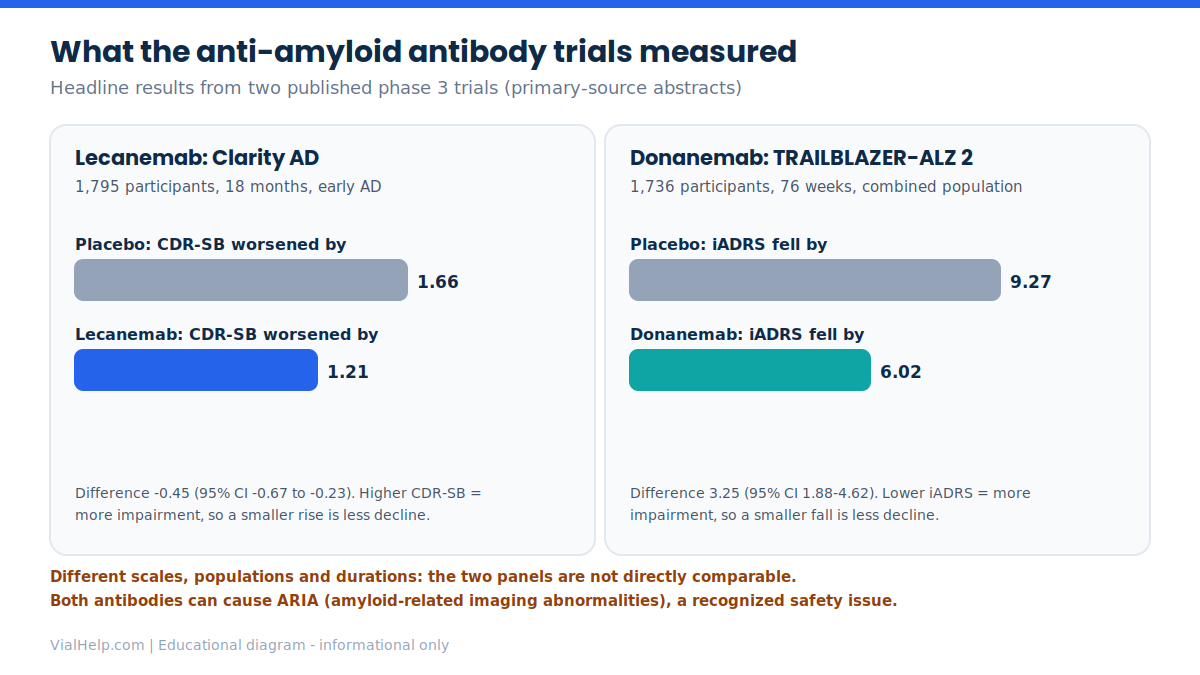
On the regulatory side, the FDA converted lecanemab (Leqembi) from accelerated to traditional approval on July 6, 2023, on the strength of the Clarity AD trial. The label carries a boxed warning for amyloid-related imaging abnormalities (ARIA), and testing for the ApoE e4 variant is recommended because homozygotes have a higher ARIA risk. The Alzheimer’s Association reports that donanemab (Kisunla) also has traditional FDA approval for early-stage disease, that both drugs can cause ARIA, and that aducanumab has been discontinued.
Biomarkers and research use
Because Aβ can be measured, it also serves as a research and diagnostic marker. The Clarity AD entry criteria themselves required evidence of amyloid by PET or by cerebrospinal fluid testing. Any specific biomarker test, cut-off value or approval status should be checked against the current regulatory and primary literature; this article does not state one.
Handling and storage considerations (research context)
From a laboratory standpoint, Aβ is a reminder that a peptide’s sequence is only part of its identity: its aggregation state also matters, and two preparations of the same sequence can behave differently. Work with aggregation-prone peptides is documented in the primary literature and should follow supplier certificates of analysis and the laboratory’s own protocols. For general lab arithmetic and technique see the reconstitution guide, sterile technique, the reconstitution calculator and why IU and mL are not a dose. For analytical background, see HPLC purity. Concentration maths here is laboratory arithmetic only.
Cautions and considerations
This article is educational and does not describe any treatment decision. The antibody drugs discussed are prescription medicines evaluated in specific trial populations; their benefits, monitoring needs and ARIA risks are for clinicians and patients to weigh, not for a general-interest article. Effect sizes quoted above come from trial abstracts and are group averages on clinical rating scales, so the small differences should not be read as individual outcomes.
Frequently asked questions
How long is the amyloid-beta peptide?
In UniProt’s annotation of human APP, Aβ42 is residues 672–713 (42 amino acids) and Aβ40 is residues 672–711 (40 amino acids).
Which enzymes release amyloid-beta?
Beta-secretase makes the first cut, leaving the C99 fragment, and gamma-secretase then cuts C99 to release Aβ. Alpha-secretase instead cuts inside the Aβ region, so it does not release intact Aβ.
What is ARIA?
ARIA stands for amyloid-related imaging abnormalities, changes seen on brain imaging that can occur with anti-amyloid antibodies. The Alzheimer’s Association describes it as a common side effect that usually causes no symptoms but can be serious, and lecanemab’s label carries a boxed warning.
Is the amyloid hypothesis proven?
It remains a hypothesis. It proposes that Aβ deposition is the primary driver of Alzheimer’s disease, and trial results with antibodies that clear amyloid show modest slowing of decline on rating scales in selected early-stage populations, not a cure.
References
- UniProt P05067: Amyloid-beta precursor protein (human) — chain and fragment annotation
- Hardy J, Selkoe DJ. The amyloid hypothesis of Alzheimer’s disease: progress and problems on the road to therapeutics. Science 2002
- van Dyck CH et al. Lecanemab in early Alzheimer’s disease (Clarity AD). N Engl J Med 2023
- Sims JR et al. Donanemab in early symptomatic Alzheimer disease: the TRAILBLAZER-ALZ 2 randomized clinical trial. JAMA 2023
- FDA: converts novel Alzheimer’s disease treatment to traditional approval (lecanemab)
- Alzheimer’s Association: medications for memory loss (lecanemab, donanemab, ARIA)
Informational only — not medical advice. This article is for educational purposes and does not recommend or instruct personal human use. Consult a qualified healthcare professional for any health decision. Content is intended for adults 21+. Verify scientific details against the primary sources cited.