
Carnosine and Anserine: The Muscle Dipeptides and What the Evidence Shows
Guides · Biochemistry
Carnosine is a dipeptide of beta-alanine and histidine, first isolated from meat extract in 1900, and it is stored at high levels in human skeletal muscle. Together with its methylated cousin anserine, it has spent a century as a molecule with a long list of proposed roles and a much shorter list of proven ones. This guide separates the chemistry, the biology and the human evidence, and shows why the beta-alanine literature is much firmer than the literature on carnosine itself.
What is carnosine?
Carnosine is beta-alanyl-L-histidine, formula C9H14N4O3, average molecular weight about 226.23, CAS 305-84-0 (Human Metabolome Database). It was reported in 1900 by Gulewitsch and Amiradžibi as a new organic base in meat extract. Anserine is the same skeleton with a methyl group on the histidine ring’s pi nitrogen (formula C10H16N4O3, CAS 584-85-0), and balenine (also called ophidine) carries the methyl on the tau nitrogen (de Jager et al., 2023). The group is often called histidine-containing dipeptides.
The unusual part is the beta-alanine: its amino group sits one carbon further along than in ordinary amino acids, so this dipeptide is not built like a typical protein fragment.
How the body makes and breaks it
Carnosine synthase (gene CARNS1, formerly ATPGD1) joins beta-alanine and histidine using ATP. Beta-alanine, not histidine, is the limiting precursor; the ISSN position stand and later reviews credit early beta-alanine dosing studies for showing that its availability limits muscle carnosine, and one review estimates only about 3 to 6 percent of ingested beta-alanine ends up in muscle carnosine (Rezende et al., 2020).

Breakdown is handled by two enzymes. CN1 (gene CNDP1) is the serum carnosinase, specific for carnosine and homocarnosine. CN2 (gene CNDP2) is a cytosolic enzyme found in most tissues with broader specificity (Rizzarelli et al., 2014). Humans have a highly active serum carnosinase that rodents lack, and after oral carnosine, plasma levels rose only slightly and only in people with low CN1 activity (de Jager et al., 2023). Human skeletal muscle, by contrast, has no carnosinase (Trexler et al., 2015). Findings in rodents therefore do not transfer cleanly to people.
Where it is found and what shapes the level
Human muscle typically holds roughly 10 to 40 mmol/kg dry muscle, averaging about 20 to 30. Levels are higher in men than women and higher in fast-twitch than slow-twitch fibers. Meat and fish supply carnosine and anserine, and in a study of 149 people vegetarians had 26 percent lower carnosine in the gastrocnemius; muscle carnosine in the soleus also fell with age, and CNDP1 genotype was not associated with muscle levels (Everaert et al., 2011). Homocarnosine is about 100-fold more concentrated than carnosine in brain, and the olfactory bulb is a major site of carnosine in mammals.
Proposed roles: what is lab chemistry and what is human evidence
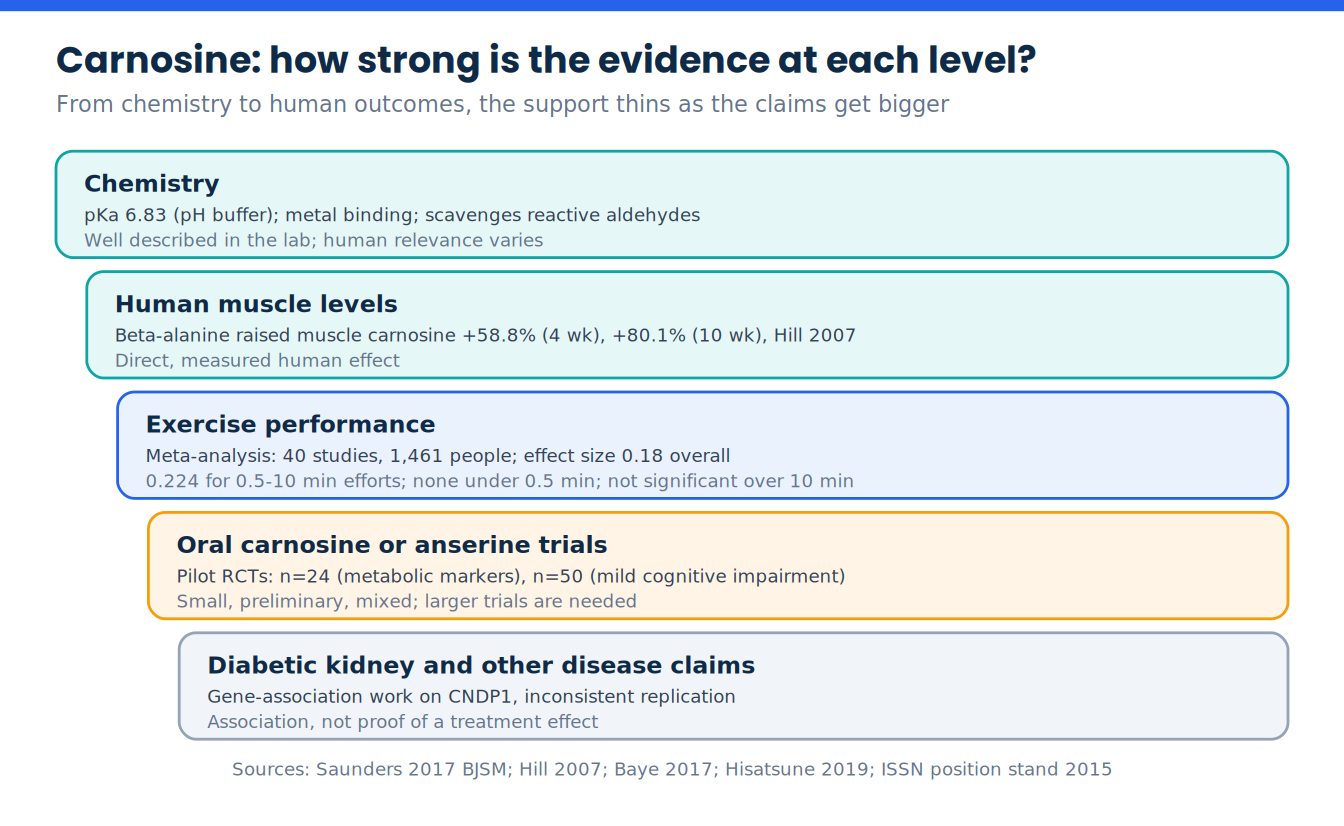
The imidazole ring of histidine has a pKa near 6.83, which makes carnosine a natural pH buffer within the range muscle reaches during hard exercise; human support for buffering comes mainly through the beta-alanine literature. Carnosine can also bind metal ions and scavenge reactive carbonyls, the basis of the “anti-glycation” idea. Those actions are demonstrated mainly in vitro and in animals, and human bioavailability of carnosine is poorly characterized, so they should be treated as mechanisms, not established effects.
What human studies show
- Muscle carnosine can be raised. In Hill et al. (2007), beta-alanine supplementation raised muscle carnosine 58.8 percent at four weeks and 80.1 percent at ten weeks.
- Exercise effect is small and specific. The Saunders et al. (2017) meta-analysis of 40 studies and 1,461 participants found an overall effect size of 0.18 (95% CI 0.08 to 0.28), 0.224 for efforts lasting 0.5 to 10 minutes, no benefit under 30 seconds and no significant effect beyond 10 minutes. The best-known side effect in this literature is paraesthesia (tingling), reported to involve the MrgprD receptor.
- Carnosine or anserine themselves. A 12-week pilot randomized trial (n=24) preserved some lipid-species markers, and a 12-week trial in 50 people with mild cognitive impairment found a global-score signal driven mainly by APOE4-positive participants while most cognitive tests showed no benefit; the authors call the sample small.
- Kidney disease association. A CNDP1 repeat variant was associated with lower serum carnosinase and protection from diabetic nephropathy (Janssen et al., 2005), but replication is inconsistent, with about half of roughly ten studies confirming it.
A related compound with a real regulatory history
Polaprezinc (zinc L-carnosine) was first approved in Japan in 1994 for gastric ulcer, and a Chinese generic followed in 2012 (Li et al., 2021). It shows the molecule can be developed as a drug, but that approval is for a specific zinc complex and indication and does not extend to carnosine in general.
Frequently asked questions
Is carnosine the same as beta-alanine?
No. Beta-alanine is one of the two building blocks. Carnosine is the dipeptide made from beta-alanine and histidine.
Why give beta-alanine in studies rather than carnosine?
Because beta-alanine availability limits muscle carnosine, and oral carnosine meets the high serum carnosinase activity in humans, so it raises plasma levels only slightly.
What is the difference between carnosine and anserine?
Anserine carries a methyl group on the histidine ring’s pi nitrogen. Balenine carries it on the tau nitrogen.
Are trial supplement doses recommendations?
No. Any doses in the literature are study descriptions, and nothing here is guidance for personal use.
References
- Trexler ET et al. International Society of Sports Nutrition position stand: beta-alanine. J Int Soc Sports Nutr 2015. Springer
- Saunders B et al. Beta-alanine supplementation to improve exercise capacity and performance: a systematic review and meta-analysis. Br J Sports Med 2017. BJSM
- Hill CA et al. Influence of beta-alanine supplementation on skeletal muscle carnosine concentrations. Amino Acids 2007. Springer
- Everaert I et al. Vegetarianism, female gender and increasing age, but not CNDP1 genotype, are associated with reduced muscle carnosine levels in humans. Amino Acids 2011. Springer
- de Jager S et al. Acute balenine supplementation in humans as a natural carnosinase-resistant alternative to carnosine. Sci Rep 2023. Nature
- Rizzarelli E et al. Carnosinases, their substrates and diseases. Molecules 2014. MDPI
- Hisatsune T et al. Anserine plus carnosine trial in people with mild cognitive impairment. Nutrients 2019. MDPI
- Li et al. Recent advances on polaprezinc for medical use. Exp Ther Med 2021. Spandidos
- Human Metabolome Database: carnosine (HMDB0000033). HMDB
Informational only — not medical advice · 21+