
What Is Glutathione? The Tripeptide Antioxidant and What the Evidence Shows
Guides · Biochemistry
Glutathione is a three-amino-acid peptide (glutamate, cysteine and glycine) that nearly every cell makes for itself, and it is the cell’s main small-molecule thiol antioxidant. It also turns up in supplement aisles, wellness clinics and compounding pharmacies, which is where the biology and the marketing part ways. This guide explains what glutathione is and what it does, then walks through what human studies actually show for swallowing it, inhaling it or injecting it.
What is glutathione?
Glutathione (GSH) is a tripeptide with the formula C10H17N3O6S (PubChem CID 124886). Its unusual feature is the first bond: the glutamate is joined through its side chain (a gamma-glutamyl bond) rather than the usual backbone link, and the enzyme gamma-glutamyl transpeptidase (GGT) is the one that cleaves it during breakdown outside the cell (Labarrere and Kassab, 2022). Reviews describe it as the most abundant low-molecular-weight thiol made in cells (Forman, Zhang and Rinna, 2009).
Concentration differs enormously by location. Cells typically hold about 1 to 2 mM, hepatocytes up to roughly 10 mM, while plasma sits in the micromolar range (10 to 30 micromolar in one review). That gap matters later, because it means blood levels are a poor stand-in for what is happening inside cells.
How the body makes and recycles it
Synthesis takes two ATP-driven steps. Glutamate-cysteine ligase (GCL) joins glutamate and cysteine and is the rate-limiting step; the supply of cysteine is a key determinant of how much GSH gets made. GSH itself inhibits GCL by competing with glutamate at the active site, a built-in feedback brake. Glutathione synthetase then adds glycine and is not subject to that feedback inhibition (Lu, 2013).
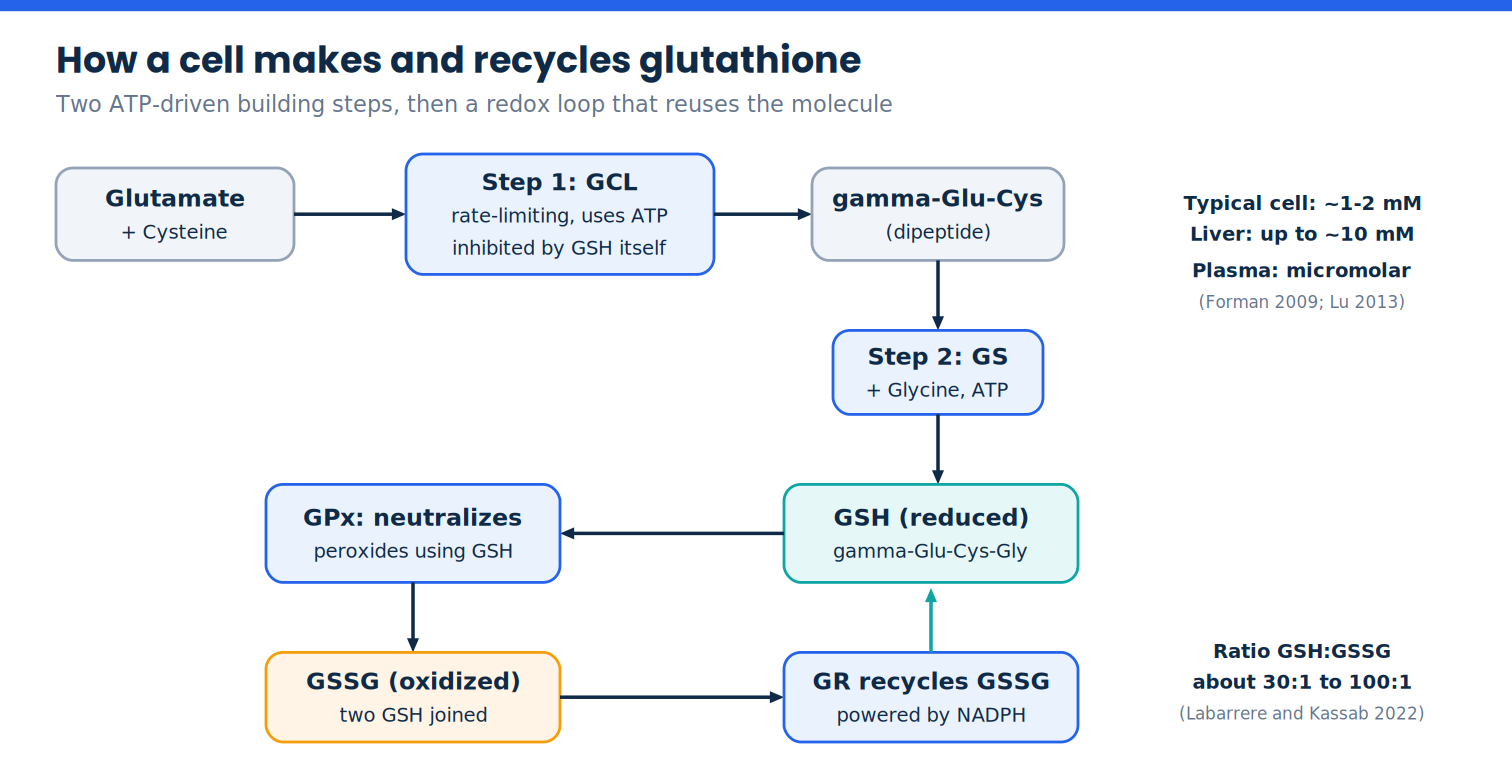
The second half of the story is a loop. Glutathione peroxidase uses GSH to neutralize peroxides and, in doing so, oxidizes it to GSSG (two GSH molecules joined by a disulfide). NADPH-dependent glutathione reductase converts GSSG back to GSH. Healthy cells keep the ratio of GSH to GSSG high, roughly 30:1 to 100:1 in one review. Glutathione S-transferases use GSH for a different job: conjugating it to foreign compounds so they can be cleared. The whole cycle of synthesis, transport and breakdown is called the gamma-glutamyl cycle.
Does swallowing glutathione raise it?
This is the question behind most supplement claims, and the trial record is genuinely mixed:
- Witschi et al., 1992. Seven healthy volunteers took a single large oral dose. Plasma GSH, cysteine and glutamate did not rise significantly over 270 minutes, and the authors concluded a single oral dose could not usefully raise circulating GSH.
- Allen and Bradley, 2011. A randomized, placebo-controlled trial in 40 healthy adults over four weeks found no change in oxidative-stress markers or GSH status.
- Richie et al., 2015. A randomized, double-blind, placebo-controlled trial in 54 non-smoking adults over six months. In the high-dose arm, GSH rose about 30 to 35 percent in erythrocytes, plasma and lymphocytes, and far more in buccal cells; natural-killer cell cytotoxicity also rose. Levels returned to baseline after a one-month washout.
- Sinha et al., 2018. An uncontrolled pilot of a liposomal form in 12 adults for one month reported increases in blood measures at two weeks. With no placebo group and a small sample, it is hypothesis-generating at best.
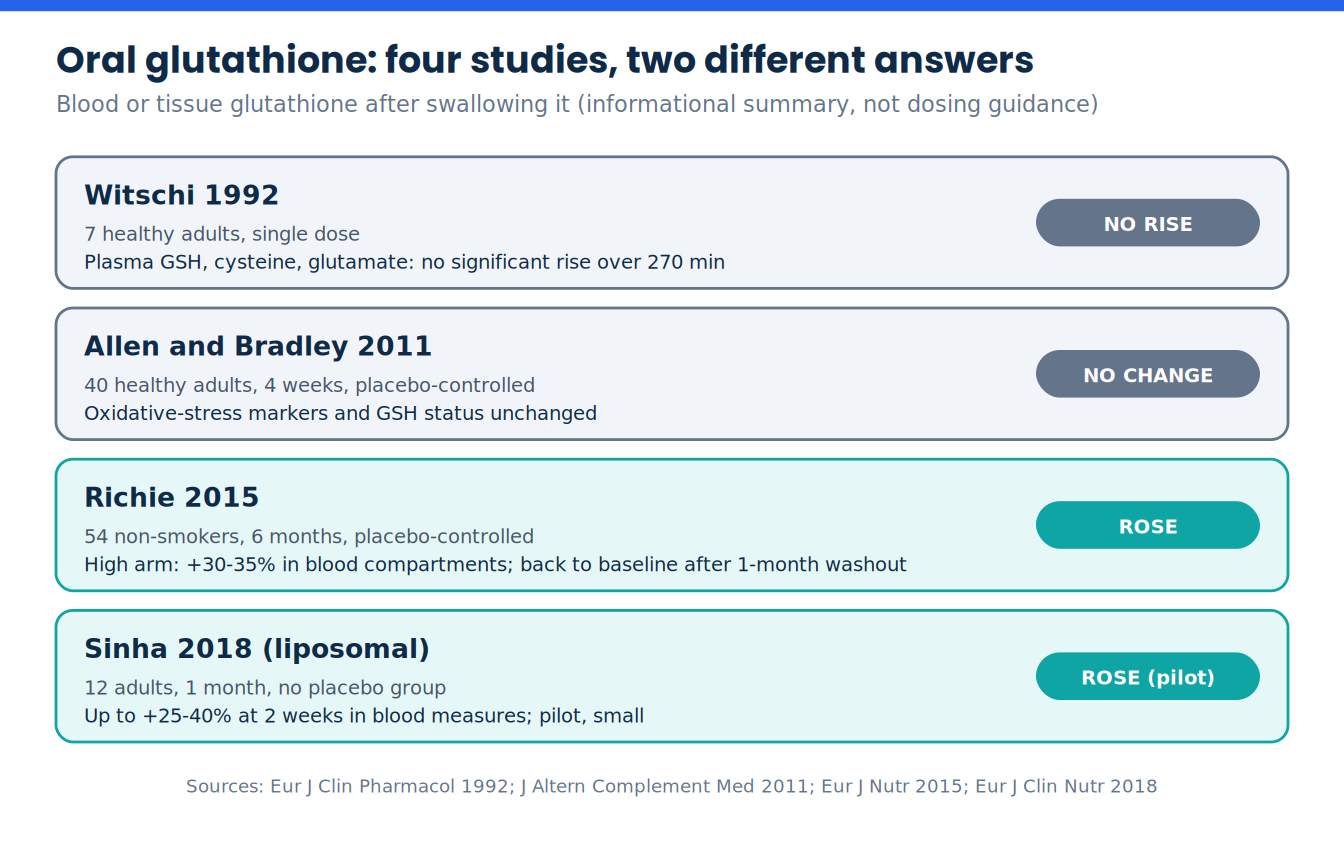
The honest reading is that oral glutathione can move some blood measures under some conditions, but the studies differ in dose, duration, formulation and what was measured, and a change in a blood marker is not the same as a clinical benefit. For the wider reasons peptides struggle by mouth, see oral peptide delivery and why peptides aren’t pills.
What injected and inhaled glutathione trials show
Intravenous glutathione has been tested for preventing nerve damage from platinum chemotherapy. A Cochrane review (Albers et al., 2014) pooled seven glutathione trials with 387 participants and reported a relative risk of 0.29 (95% CI 0.10 to 0.85) on secondary measures, describing the findings as modest but promising while noting the evidence was insufficient on objective testing.
In Parkinson’s disease, a small randomized pilot of intravenous glutathione (21 people) was well tolerated but showed no significant difference in motor scores (Hauser et al., 2009), and a phase IIb intranasal trial of 45 people found glutathione was not superior to placebo (Mischley et al., 2017). In cystic fibrosis, two inhaled-glutathione trials (153 and 105 patients) missed their primary lung-function endpoints (Griese et al., 2013; Calabrese et al., 2015).
Related but distinct: N-acetylcysteine (NAC), a cysteine precursor, is an FDA-approved antidote for acetaminophen overdose, and its label describes protection as probably working by maintaining or restoring glutathione.
Regulatory and safety notes
In February 2019 the US FDA highlighted concerns about compounded glutathione injections made from powder labeled as a dietary supplement: tested samples had endotoxin up to five times the limit, and seven patients had adverse events, one requiring hospitalization. The Philippine FDA (Advisory 2019-182) states injectable glutathione is approved there only as an adjunct in cisplatin chemotherapy, that no injectable is approved for skin lightening, and lists possible liver, kidney and nervous-system toxicity and Stevens-Johnson syndrome. Material-quality issues like these are covered in endotoxin testing, where peptide impurities come from and FDA warning letters.
Low glutathione: cause or marker?
Lower GSH is reported in several conditions. In one diabetes study, erythrocyte GSH was 1.65 versus 6.75 micromoles per gram of hemoglobin in uncontrolled diabetes versus controls, with lower synthesis rates (Sekhar et al., 2011), and narrative reviews link depletion with COPD, atherosclerosis and cancer. These are associations. Whether raising GSH from outside changes outcomes is a separate question that the trials above only partly answer.
Frequently asked questions
Is glutathione an amino acid or a peptide?
A peptide: three amino acids (glutamate, cysteine, glycine) joined together, with an unusual gamma-glutamyl first bond.
Why is cysteine so important for glutathione?
Cysteine availability is a key determinant of synthesis, and GCL, the rate-limiting enzyme, needs it. That is why cysteine precursors such as NAC feature in the research.
Are the glutathione trial doses recommendations?
No. Trial doses are study descriptions. Nothing here is guidance for personal use.
Is lyophilized glutathione handled like other peptides?
Freeze-dried research materials are generally reconstituted for lab work, and the concentration math is the same as for any vial: see the reconstitution calculator and the reconstitution guide. This is lab arithmetic, not use guidance.
References
- Lu SC. Glutathione synthesis. Biochim Biophys Acta 2013. ScienceDirect
- Labarrere CA, Kassab GS. Glutathione: a Samsonian life-sustaining small molecule. Front Nutr 2022. Frontiers
- Witschi A et al. The systemic availability of oral glutathione. Eur J Clin Pharmacol 1992. Springer
- Richie JP et al. Randomized controlled trial of oral glutathione supplementation on body stores of glutathione. Eur J Nutr 2015. Springer
- Mischley LK et al. Phase IIb study of intranasal glutathione in Parkinson’s disease. J Parkinsons Dis 2017. SAGE
- FDA. FDA highlights concerns with using dietary ingredient glutathione to compound sterile injectables. fda.gov
- Cochrane. Chemoprotective agents for preventing chemotherapy-induced peripheral neuropathy (Albers 2014). Cochrane
- Philippine FDA Advisory 2019-182: unsafe use of glutathione as a skin lightening agent. fda.gov.ph
Informational only — not medical advice · 21+