
Longevity Peptide Side Effects: Epitalon, MOTS-c & SS-31
SIDE EFFECTS SERIES · PART 10
Search for longevity peptide side effects and you will find a strange pattern: the compounds with the least evidence look the safest. Epitalon and MOTS-c are routinely described as having “no reported side effects,” while SS-31 (elamipretide) — the only one of the three with an FDA-approved label — comes with a documented list of them. That inversion is not a coincidence, and it is the single most useful thing to understand about this category.
Three compounds, three completely different evidence tiers
These three get grouped together as “longevity peptides,” but they do not belong in the same conversation when it comes to safety data. One has a regulatory dossier. One has two short studies from a single interested institute. One has, in the FDA’s own assessment, no human exposure data at all.
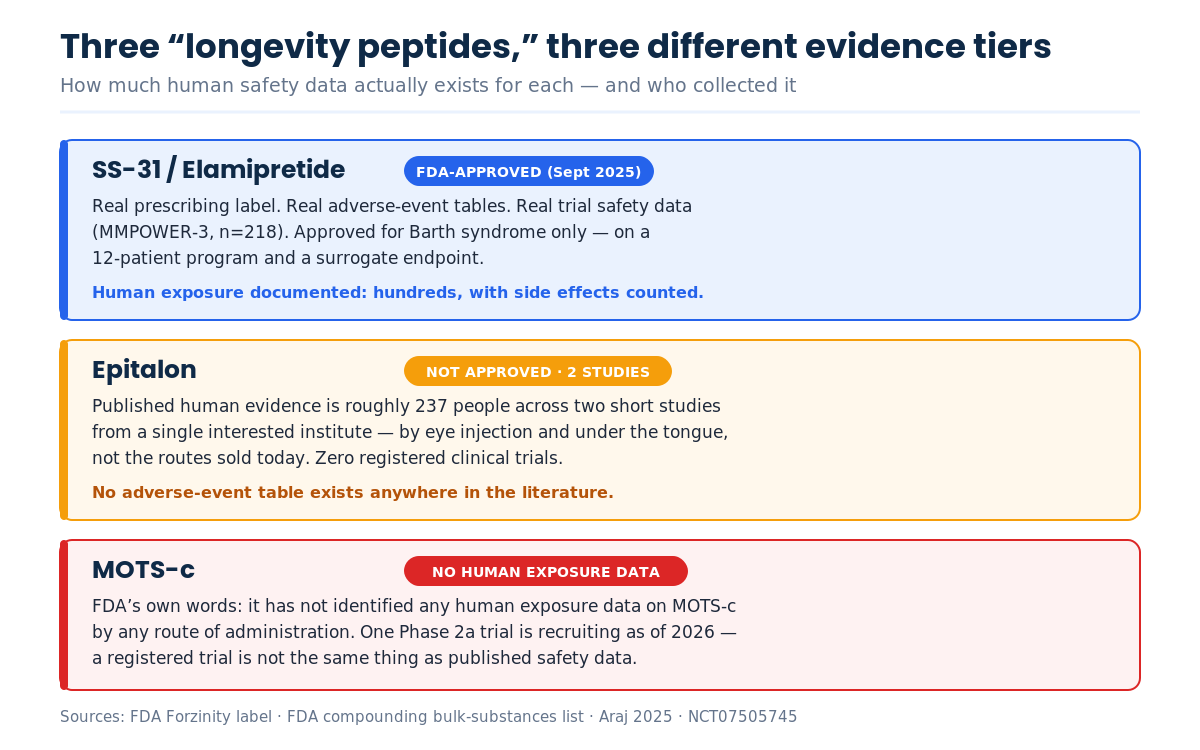
SS-31 / elamipretide: what side effects look like when someone counts
Elamipretide is the outlier here. On 19 September 2025 the FDA granted it accelerated approval as Forzinity, for Barth syndrome in patients weighing at least 30 kg. That approval means a prescribing label exists, and a label means adverse events were systematically collected rather than casually observed.
The headline finding is injection-site reactions, and they are close to universal.
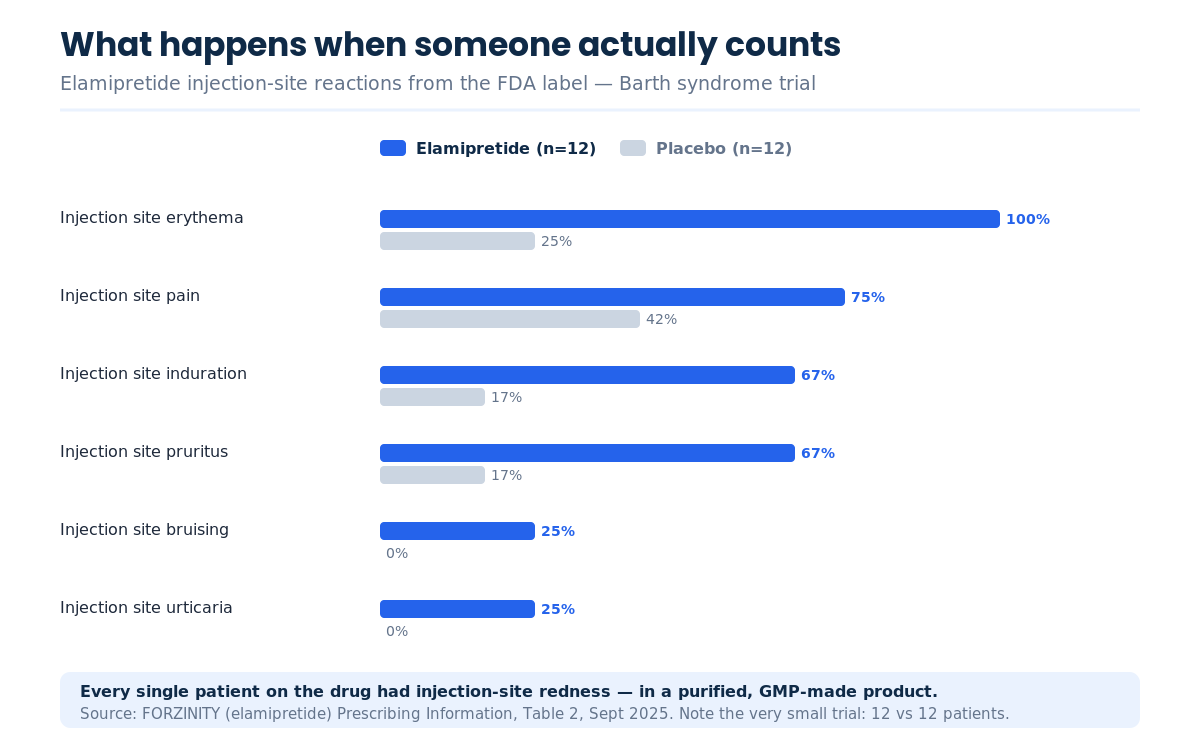
Worth sitting with that first row: 100% of patients receiving elamipretide had injection-site erythema, versus 25% on placebo. Pain, induration and itching each affected two-thirds to three-quarters. This is a purified, pharmaceutical-grade tetrapeptide made under GMP conditions. Read the label past the AE table and a few other things appear:
- Eosinophilia — a rise in a type of white blood cell — was frequent with dosing beyond 30 days, peaked around 90 days, and returned toward baseline by 6 to 12 months or on stopping. No clinical consequences were observed.
- Serious hypersensitivity reactions carry a warning and a contraindication. Notably, they were reported anywhere from minutes to months after starting — tolerating the first dose proves little.
- The formulation contains benzyl alcohol (20 mg/mL), which is why the label warns against use in neonates.
- In severe kidney impairment, metabolite exposure rose substantially, and the label halves the dose below an eGFR of 30.
The honest efficacy picture. In MMPOWER-3, a 218-patient randomized trial in primary mitochondrial myopathy, elamipretide missed both primary endpoints — the six-minute walk test difference was −3.2 metres (95% CI −18.7 to 12.3; p=0.69). Adverse events occurred in 98.2% of the elamipretide group versus 76.1% on placebo, with 7.3% versus 1.8% stopping because of them. There were no deaths. ReCLAIM-2, in geographic atrophy, also missed its primary endpoint (adverse events 86% vs 71%, no drug-related serious events). The approval came in an ultra-rare disease, on a surrogate endpoint, in a 12-patient program.
Epitalon: “no reported side effects” is a statement about the researchers, not the drug
Epitalon’s safety reputation rests on a much thinner foundation than most people realise. A search of ClinicalTrials.gov for epitalon, epithalon or epithalamin returns zero registered studies. The published human evidence, per a 2025 peer-reviewed review, consists of exactly two studies:
- A retinitis pigmentosa study in 162 people, given 5 µg per eye by injection into the eye socket for 10 days. It was not placebo-controlled and not blinded — the comparison arm received conventional treatments — and it was run at the same St. Petersburg institute that developed the compound. Its safety reporting is a single sentence: none of the treated patients reported side effects.
- A circadian-rhythm study in 75 women, 0.5 mg per day under the tongue for 20 days. This one did include placebo and control groups.
So: roughly 237 people, maximum 20 days, by eye injection and sublingual administration — neither of which is how Epitalon is actually used today. Across that entire literature there is no adverse-event table, no tolerability analysis, and no randomized safety study. “No reported side effects” is accurate. It is also close to meaningless, because nobody systematically collected them.
The FDA has reviewed Epitalon and its published position is blunt: compounded Epitalon may pose risk for immunogenicity for certain routes of administration due to the potential for aggregation and peptide-related impurities, and the agency states it has not identified safety information for the proposed route and therefore lacks sufficient information to know whether it would cause harm in humans.
On the telomerase-and-cancer worry: you will see it stated confidently in both directions. Neither is established. The theoretical concern — that activating telomerase could favour tumour growth — has not been demonstrated for Epitalon in humans. The reassuring rodent data claiming reduced tumour incidence come from the same research lineage that has never been independently replicated. Honest answer: cancer risk here is neither demonstrated nor excluded.
MOTS-c: no human exposure data by any route
MOTS-c is a mitochondrial-derived peptide with a genuinely interesting preclinical literature. Its human safety literature does not exist. The FDA’s published assessment is unusually direct: it has not identified any human exposure data on drug products containing MOTS-c by any route of administration, and therefore lacks important information about safety, including whether it would cause harm if given to humans.
A registry search returns nine studies mentioning MOTS-c; eight measure it as a biomarker in exercise, dialysis or diabetes research. Exactly one administers it as a drug: NCT07505745, a Phase 2a placebo-controlled trial in prediabetes, recruiting as of 2026, with no results posted. A recruiting trial is a promise of future data, not data.
One correction worth making, because it circulates widely: the Phase 1 human safety work often cited for MOTS-c was run on CB4211, a modified analog — not MOTS-c itself. It should not be presented as MOTS-c safety data.
The risk that applies to all three
- Nobody is counting. Elamipretide has a manufacturer and a MedWatch reporting pathway. Research-chemical Epitalon and MOTS-c have no pharmacovigilance system at all. Absence of reports is not absence of events.
- Purity and endotoxin. The FDA’s stated concern for both unapproved compounds is aggregation and peptide-related impurities driving immunogenicity. This is the concrete, mechanism-level risk — not a vague quality gripe. See our guides on reading a COA and endotoxins and the LAL test.
- The vehicle carries risk too. Even the approved product needed a benzyl-alcohol warning. Unregulated vials disclose no excipients and carry no endotoxin testing.
- Expect worse, not better. A GMP-purified mitochondrial tetrapeptide produced injection-site erythema in 100% of patients. There is no reason to assume unpurified material behaves more gently.
Regulatory status. Elamipretide is FDA-approved for Barth syndrome only; every other use is investigational. Epitalon and MOTS-c are not approved for anything. Both were nominated for the 503A compounding list and withdrawn by the nominators — which is not the same as being cleared on merit; the FDA’s safety-concern language remains published. On anti-doping: WADA’s S0 category covers non-approved substances and the List is explicitly not exhaustive by name, so unapproved compounds like these are generally captured by category rather than by name. Athletes should check Global DRO rather than rely on a list search.
Frequently asked questions
Does Epitalon have fewer side effects than elamipretide?
There is no evidence for that comparison. Elamipretide’s side effects are documented because a regulated trial documented them. Epitalon has never been studied in a way that would detect side effects, so the two cannot be compared.
Is MOTS-c safe because there are no reports of harm?
No. The FDA’s position is that there is no human exposure data by any route. That is a statement about missing information, not a safety finding.
Elamipretide is FDA-approved — does that mean it works for aging?
No. It is approved for Barth syndrome, an ultra-rare genetic condition, under accelerated approval on a surrogate endpoint. Its large trials in mitochondrial myopathy and geographic atrophy both missed their primary endpoints.
What is the most likely problem someone actually runs into?
Based on the only compound with real data: injection-site reactions, which were close to universal. Beyond that, for the unapproved compounds, the documented concern is immunogenicity from aggregation and impurities — a supply-quality problem rather than a pharmacology one.
Related reading
References
- FORZINITY (elamipretide) injection — Highlights of Prescribing Information. Stealth BioTherapeutics, September 2025. accessdata.fda.gov
- FDA Grants Accelerated Approval to First Treatment for Barth Syndrome. FDA News Release, 19 September 2025. fda.gov
- Karaa A, et al. Efficacy and Safety of Elamipretide in Individuals With Primary Mitochondrial Myopathy: The MMPOWER-3 Randomized Clinical Trial. Neurology. 2023;101(3):e238–e252. PMID 37268435. PMC10382259
- Certain Bulk Drug Substances for Use in Compounding that May Present Significant Safety Risks. U.S. Food & Drug Administration. fda.gov
- Araj SK, et al. Overview of Epitalon — Highly Bioactive Pineal Tetrapeptide with Promising Properties. Int J Mol Sci. 2025;26(6):2691. PMID 40141333. PMC11943447
- NCT07505745 — MOTS-c for Improving Insulin Sensitivity in Adults With Prediabetes and Overweight/Obesity. ClinicalTrials.gov. clinicaltrials.gov
Informational only — not medical advice · 21+. This article summarises published research and regulatory documents. It is not a recommendation to use any compound. Talk to a qualified healthcare professional about anything affecting your health.