
Retatrutide Side Effects & Safety: What the Trials Actually Show
Peptide side-effects series
Retatrutide (LY3437943) is an investigational, once-weekly injectable from Eli Lilly that activates three metabolic-hormone receptors at once — GIP, GLP-1 and glucagon. In completed Phase 2 studies it produced large weight-loss and blood-sugar effects, and its side-effect profile was dominated by gastrointestinal symptoms that were mostly mild-to-moderate and worse during dose build-up. It is not approved by any regulator, its Phase 3 program is still running, and there is no long-term safety data yet. This article summarizes what the published trials actually report.
What retatrutide is
Most weight-management peptides in the news hit one or two receptors: semaglutide is a GLP-1 receptor agonist, and tirzepatide is a dual GIP/GLP-1 agonist. Retatrutide adds a third target — the glucagon receptor — making it a “triple G” agonist. It is a synthetic, fatty-acylated peptide of 39 amino acids (molecular formula C221H342N46O68, molecular weight roughly 4,731 Da) engineered with a fatty-acid chain that binds reversibly to albumin, which is what allows once-weekly dosing.

Retatrutide has been studied in a Phase 2 obesity trial (Jastreboff and colleagues, New England Journal of Medicine, 2023) and a Phase 2 type-2-diabetes trial (Rosenstock and colleagues, The Lancet, 2023). Its large Phase 3 program (the TRIUMPH trials) is ongoing as of mid-2026.
The side effects reported in trials
Across both Phase 2 trials, the most common adverse events were gastrointestinal — nausea, diarrhea, vomiting and constipation — the same class profile seen with GLP-1 and GIP/GLP-1 receptor agonists. Two consistent patterns stand out in the published data: the events were mostly mild-to-moderate and transient, and they were dose- and titration-dependent, clustering during the period when the dose was being stepped up.
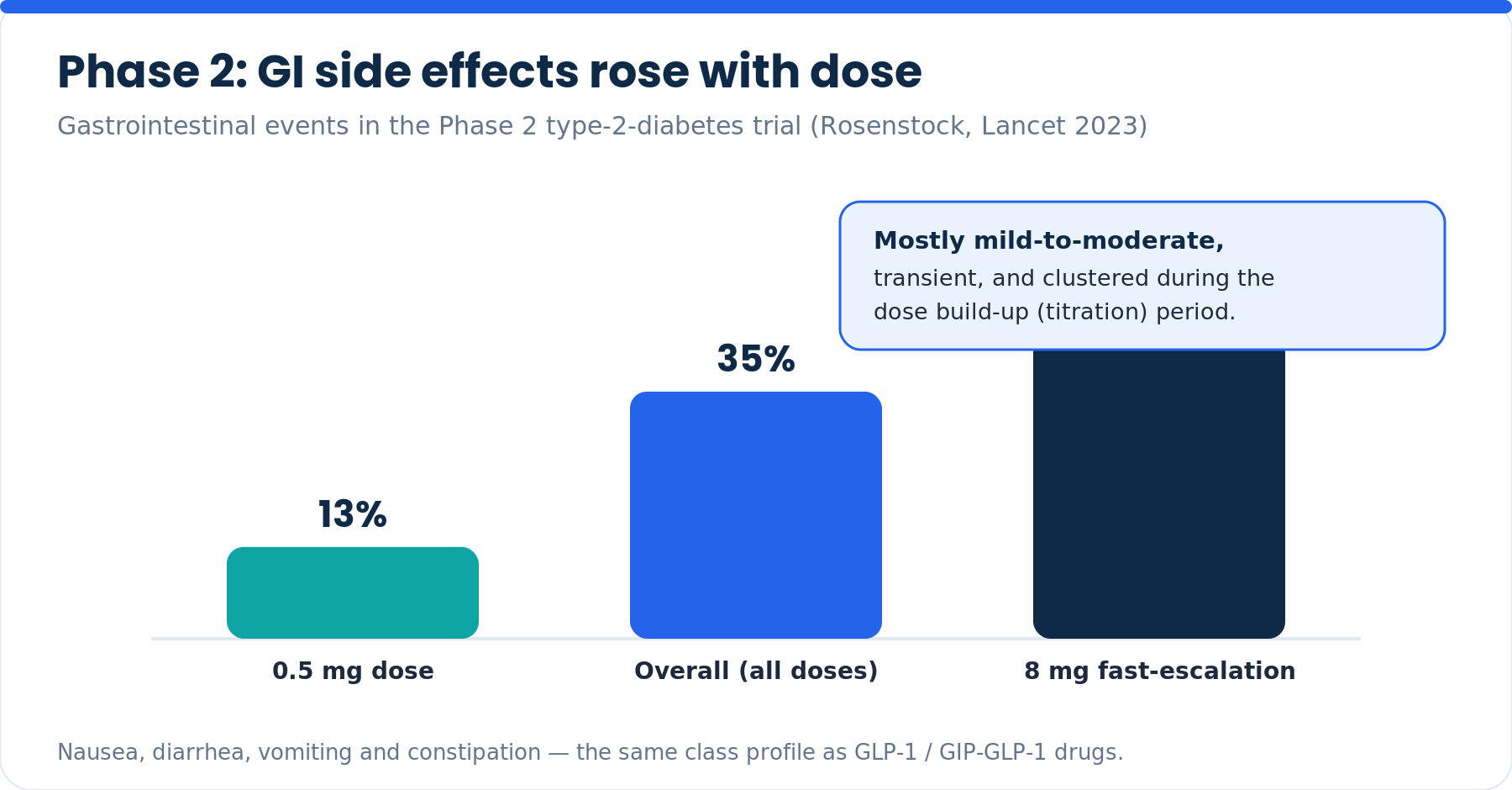
The Lancet diabetes trial put numbers on it: mild-to-moderate GI adverse events occurred in 67 of 190 retatrutide participants (about 35% overall), ranging from roughly 13% in the lowest-dose group to 50% in the fastest dose-escalation group. The obesity trial in NEJM similarly reported that GI events were the most common adverse events, were dose-related, and were partially reduced by starting at a lower dose — a reminder that how quickly the dose is increased matters as much as the final dose.
The glucagon difference
The glucagon-receptor component is what distinguishes retatrutide from pure GLP-1 or GIP/GLP-1 drugs. Glucagon-receptor activation is thought to increase energy expenditure, which may contribute to the drug’s large weight-loss effect, but it also brings its own signals. In the Phase 2 obesity trial, retatrutide produced a dose-dependent increase in heart rate that peaked around week 24 and then declined toward baseline by the end of the study. The diabetes-trial authors described the overall safety profile as consistent with the incretin drug classes, with the GI events being transient and concentrated during titration.
Class-level safety considerations
Because retatrutide is unapproved, it has no official label and therefore no boxed warnings of its own. What it does carry are class-level considerations inherited from the incretin drug family:
Thyroid C-cell tumors. Approved GLP-1-based drugs carry a boxed warning for thyroid C-cell tumors based on rodent studies; the relevance to humans is unestablished. As a GLP-1-containing molecule, this is a mechanistic class caution that would plausibly apply to retatrutide — but it is a class consideration drawn from animal data, not a retatrutide-specific finding.
Pancreatitis and gallbladder disease. Pancreatitis and gallbladder events (such as gallstones) are recognized class considerations for incretin-based therapies, particularly alongside rapid weight loss. They have not been specifically linked to retatrutide in current trials, but long-term outcomes are still being established.
Hypoglycemia. The GLP-1 and GIP components act in a glucose-dependent way, so the intrinsic risk of low blood sugar is low in people who are not also taking insulin or sulfonylureas.
Where retatrutide stands
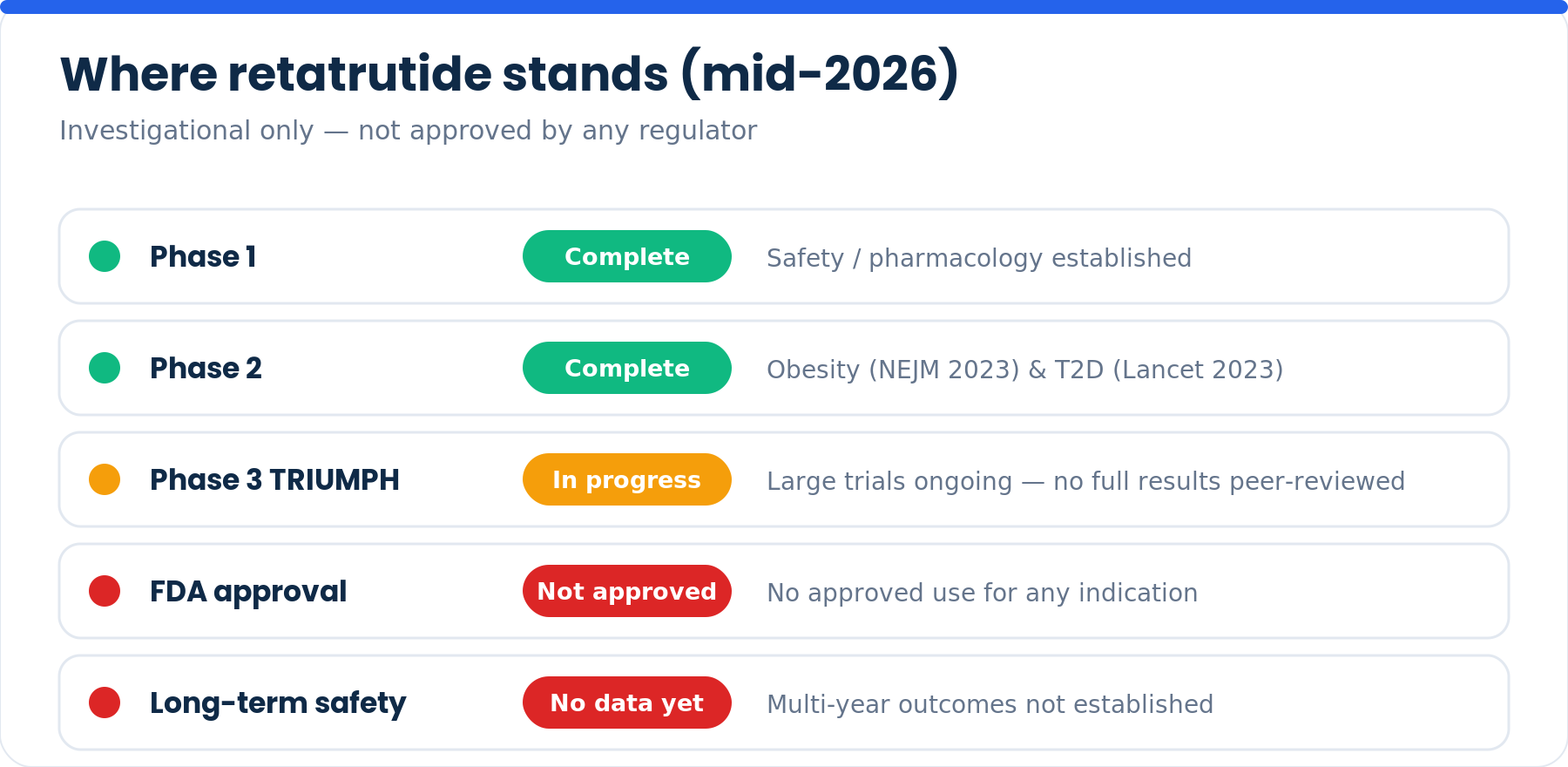
As of mid-2026, retatrutide is investigational only and not approved by the FDA or any other major regulator for any indication. Its Phase 3 TRIUMPH program — covering obesity, type 2 diabetes, cardiovascular and other endpoints — is still underway. Company statements have reported striking topline weight-loss figures, but those are company-announced results, not a substitute for full peer-reviewed safety data or a regulatory review. In anti-doping terms, a non-approved investigational substance like retatrutide falls under WADA’s S0 (Non-Approved Substances) category, which prohibits it in sport at all times.
Frequently asked questions
What are the most common retatrutide side effects?
In published Phase 2 trials, the most common side effects were gastrointestinal — nausea, diarrhea, vomiting and constipation — mostly mild-to-moderate and most frequent while the dose was being increased.
How is retatrutide different from tirzepatide and semaglutide?
Semaglutide targets one receptor (GLP-1), tirzepatide targets two (GIP and GLP-1), and retatrutide targets three (GIP, GLP-1 and glucagon). The glucagon component is the key differentiator.
Is retatrutide FDA-approved?
No. As of mid-2026 it is investigational only, with Phase 3 trials ongoing and no approval for any use.
Does retatrutide affect heart rate?
The Phase 2 obesity trial reported a dose-dependent increase in heart rate that peaked around week 24 and then eased. Heart-rate changes are monitored closely in the ongoing trials.
Related reading
Reconstitution calculator · Peptide library · Guides & how-tos
References
- Jastreboff AM, et al. Triple–Hormone-Receptor Agonist Retatrutide for Obesity — A Phase 2 Trial. NEJM 2023;389(6):514–526. nejm.org
- Rosenstock J, et al. Retatrutide (GIP, GLP-1 and glucagon receptor agonist) for people with type 2 diabetes: a phase 2 trial. The Lancet 2023. thelancet.com
- Coskun T, et al. LY3437943, a novel triple glucagon, GIP, and GLP-1 receptor agonist. Cell Metabolism 2022;34(9):1234–1247. doi.org
- ClinicalTrials.gov. TRIUMPH-1 (Phase 3 obesity), NCT05929066. clinicaltrials.gov
- PubChem. Retatrutide compound summary. pubchem.ncbi.nlm.nih.gov
- Retatrutide for MASLD: a randomized phase 2a trial (PMC free full text). ncbi.nlm.nih.gov
Informational only — not medical advice · 21+. Retatrutide is an investigational compound not approved for human use. This article summarizes published research and does not recommend use.