
Why Peptide Clinical Trials Are So Small
Research literacy
Peptide clinical trials are often tiny — many of the “studies” quoted to support a research compound involved just four to twelve people. That is not a scandal; it is how early science works. But it creates a trap: a small study that reports no side effects can sound reassuring while telling you almost nothing about whether a compound is safe. This guide explains why so many peptide studies are small, introduces a simple statistical rule that shows what “zero side effects” really means, and gives you a short checklist for reading a small study like a scientist rather than a shopper.
Why so many peptide studies have only a handful of people
Most of the early human data on peptides comes from mechanistic or physiology studies — experiments designed to measure a specific biological response, such as how much a hormone rises after a dose. These are built to answer one narrow question with a small, tightly controlled group of volunteers. A classic example is the kisspeptin-10 work in men, where the dose-response experiment used just six participants and the pulse-frequency arm used four. Those studies were powerful for their purpose — showing the peptide stimulates luteinising hormone — but they were never designed to catch side effects.
The same is true of foundational animal work like Belchetz and colleagues’ 1978 study of pulsatile versus continuous GnRH in monkeys, which reshaped reproductive endocrinology using a small group of animals. Small studies are the natural first step: they are faster, cheaper and enough to test whether an idea is worth pursuing. The problem only arises when a four-to-six-person response study gets quoted as if it were a safety trial.
The rule of three: what “zero side effects” actually tells you
There is a well-known piece of statistics that every research-literate reader should know — the rule of three, from a 1983 paper in JAMA titled “If Nothing Goes Wrong, Is Everything All Right?” It says that if you observe a group of n people and see zero events of some kind, the upper limit of the 95% confidence interval for the true rate is roughly 3 divided by n.
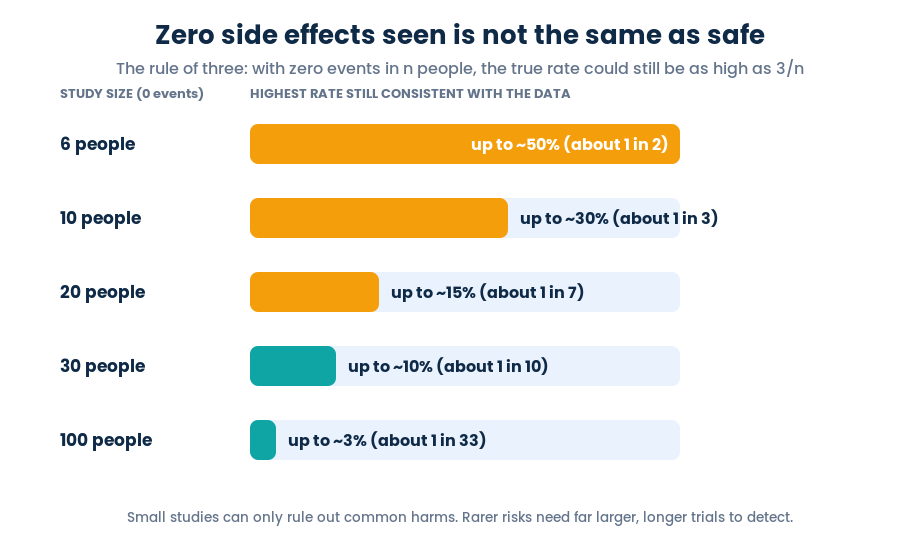
In plain terms: a six-person study that reports zero adverse events is still statistically consistent with a true side-effect rate as high as about one in two. A twenty-person study with zero events only rules out risks worse than roughly one in seven. Even a hundred people with a clean record leaves room for a true rate around one in thirty. Small studies simply cannot see uncommon harms — the numbers do not allow it. “No adverse events reported” in a tiny trial is exactly what you would expect whether the compound is safe or not.
What the clinical trial phases are for
Regulated drug development is deliberately structured to build safety evidence slowly, over increasing numbers of people. Using the FDA’s own description of the phases:
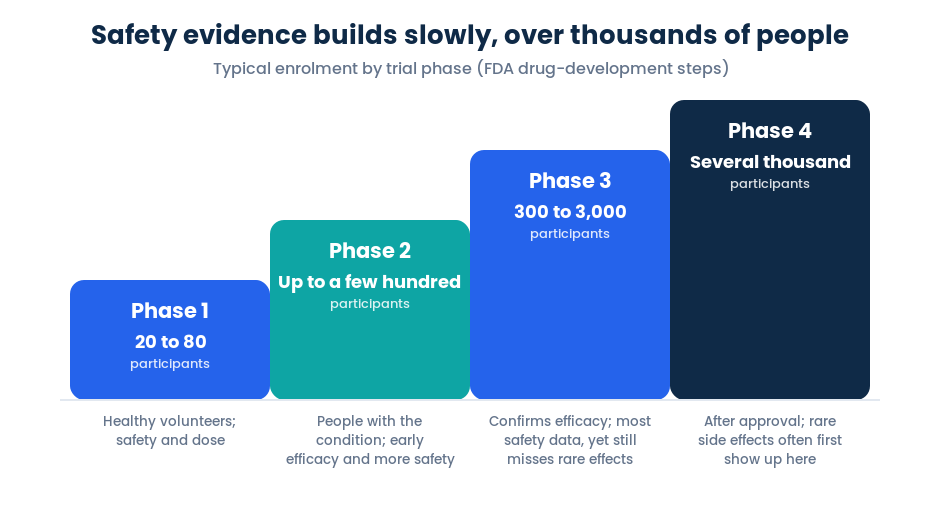
- Phase 1 — a small group (the FDA describes roughly 20 to 80 healthy volunteers) to check basic tolerability and dosing. This is first-in-human territory, and it is far too small to detect anything but the most common, immediate effects.
- Phase 2 — up to a few hundred people who have the condition. The FDA notes these trials are still “not large enough to show whether the drug will be beneficial” and mainly add early safety data.
- Phase 3 — 300 to 3,000 volunteers. This is where most safety data is generated, yet the FDA explicitly warns that less common side effects “might have gone undetected” even here.
- Phase 4 — several thousand people, monitored after approval, precisely because rare effects often surface only once a drug reaches a large, real-world population.
The takeaway is stark: even a properly powered Phase 3 trial with thousands of participants can miss rare harms. A peptide whose entire human record is a couple of small physiology studies has not begun to approach that bar.
Why “no adverse events reported” can be misleading
Beyond raw sample size, several other features of small studies inflate the false sense of safety:
- The wrong endpoint. If a study was powered to measure a hormone response, its sample size was chosen for that goal — not to detect side effects. Safety may not have been a formal endpoint at all.
- Short duration. Many small studies last hours to weeks, so anything that develops over months or years is invisible.
- Selected, healthy volunteers. Early studies often enrol fit young people who are least likely to have problems, which is not the population that ultimately uses a compound.
- Reporting gaps. Small studies may not systematically collect, grade or publish adverse events, and negative results are published less often.
How to read a small study like a scientist
Next time you see a peptide claim backed by “a study,” ask five quick questions:
- How many people? Apply the rule of three — a single-digit sample can only exclude very common effects.
- Was safety even measured? Check whether adverse events were a defined endpoint or an afterthought.
- How long did it run? Short studies cannot speak to long-term risk.
- Who was studied? Healthy volunteers are not the same as long-term users.
- Was there a control group? Without one, it is hard to attribute either benefits or harms to the compound.
Frequently asked questions
Does a small study mean the research is bad?
Not at all. Small mechanistic studies are the correct first step and can be excellent science. The error is treating a small response study as if it settled the safety question.
What is the rule of three in one sentence?
If you see zero events in n people, the true rate could still be as high as about 3/n — so zero events in 30 people only rules out risks worse than roughly one in ten.
Why do approved drugs still get safety warnings years later?
Because even large Phase 3 trials (hundreds to a few thousand people) can miss rare events. Those surface during post-approval monitoring, when millions may be exposed.
How many people does it take to be confident a compound is safe?
There is no single magic number, but the logic of the rule of three means characterising uncommon risks takes thousands of exposures over a meaningful time — far beyond what most peptide compounds have ever had.
References
- FDA — Step 3: Clinical Research (trial phases, enrolment ranges, durations). fda.gov
- FDA — Step 5: FDA Post-Market Drug Safety Monitoring. fda.gov
- Hanley JA, Lippman-Hand A. “If Nothing Goes Wrong, Is Everything All Right?” JAMA. 1983;249(13):1743-1745 (the rule of three). pubmed.ncbi.nlm.nih.gov
- George JT, et al. Kisspeptin-10 is a potent stimulator of LH in men (n=4-6 physiology study). J Clin Endocrinol Metab. 2011. pmc.ncbi.nlm.nih.gov
- Belchetz PE, et al. Hypophysial responses to continuous and intermittent delivery of GnRH. Science. 1978;202:631-633. pubmed.ncbi.nlm.nih.gov
- FDA — Questions and Answers on FDA’s Adverse Event Reporting System (FAERS): why small trials miss rare events. fda.gov
- ICH E9 — Statistical Principles for Clinical Trials (endpoints and sample size are powered for the primary objective). ema.europa.eu
Informational only — not medical advice · 21+. This article is about research methods; it is not a safety endorsement of any compound.