
Natriuretic Peptides (ANP, BNP, CNP) Explained
Endocrine biology · The body’s pressure-release valve
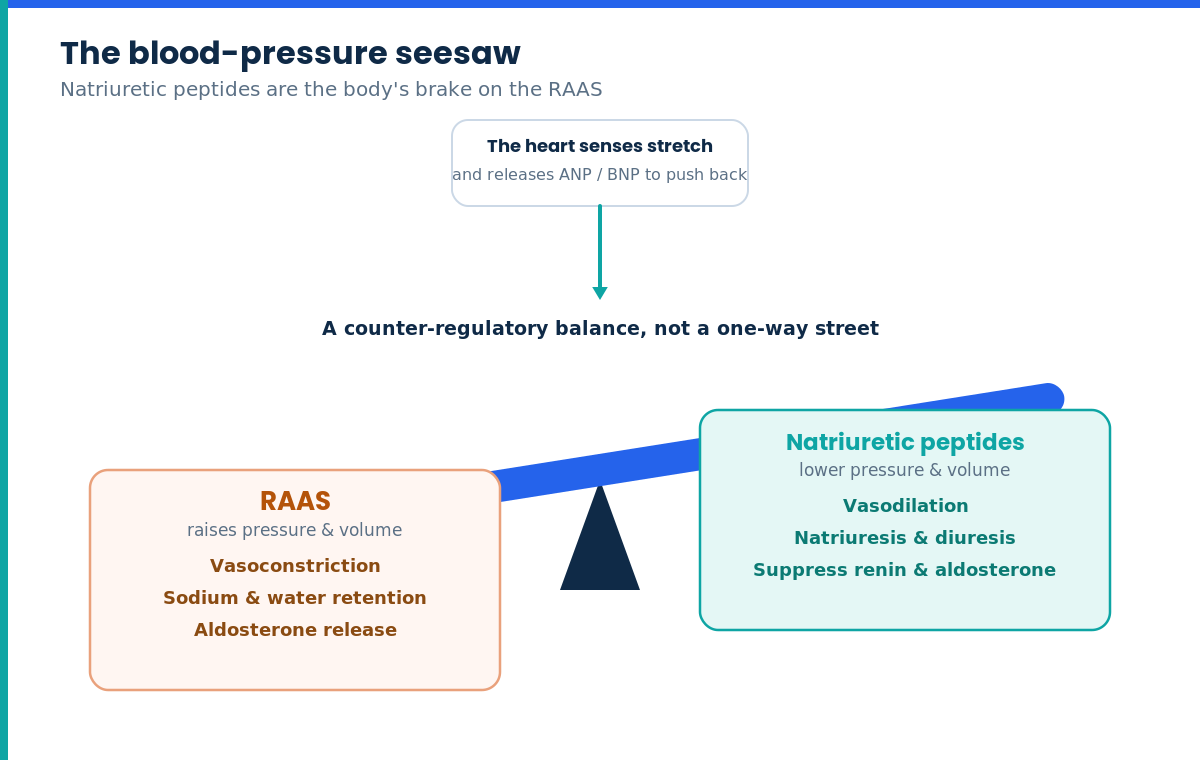
If the renin–angiotensin–aldosterone system is the accelerator that raises blood pressure, the natriuretic peptides are the brake. Released by the heart itself when its chambers are stretched by too much blood, ANP, BNP and CNP tell the body to dump sodium, relax blood vessels, and switch the RAAS off. They are genuine peptide hormones — and they signal through a receptor that is neither a GPCR nor a kinase, which is exactly why they are worth a closer look.
Why the heart makes hormones
The heart is not just a pump; it is also an endocrine organ. When its walls are stretched by rising blood volume or pressure, cardiac muscle cells release peptide hormones whose whole job is to bring that pressure back down. This makes the natriuretic peptides the natural counterweight to the RAAS — a genuine, sourced opposition rather than a rhetorical one, because these peptides directly suppress renin and aldosterone.
Meet the three peptides
The family has three members that share a common design but differ in size and source:
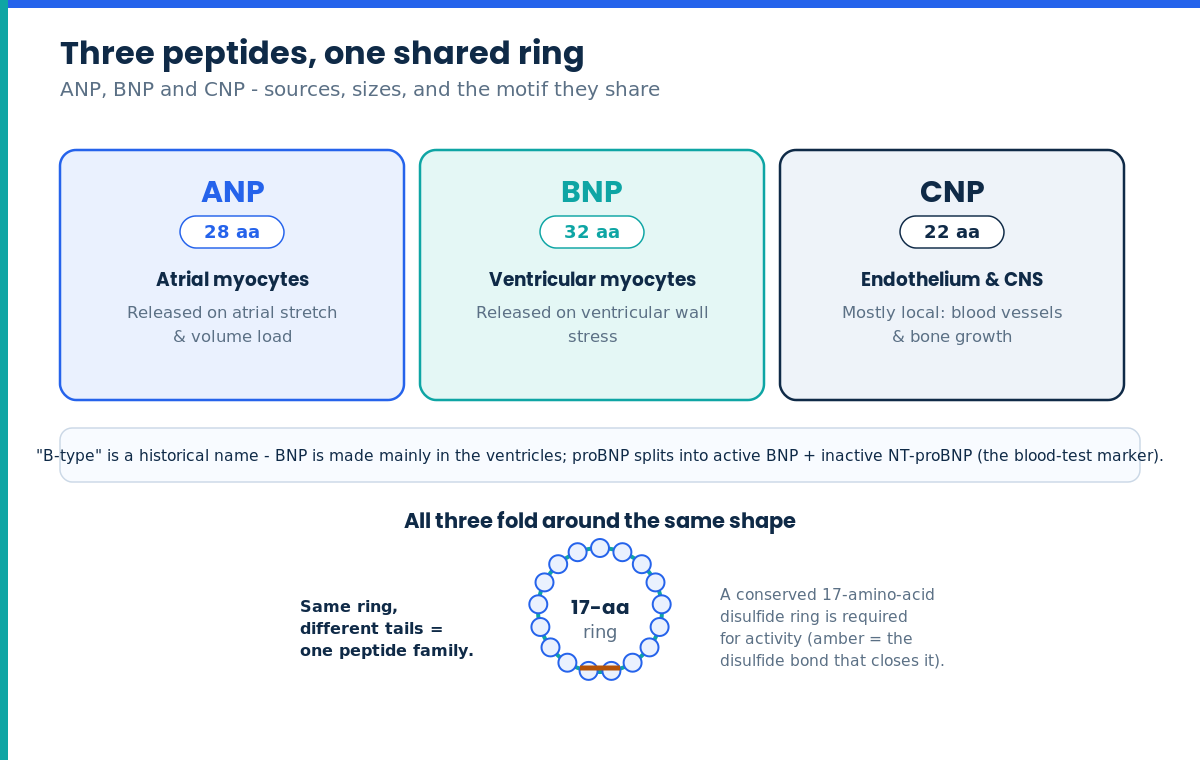
- ANP (atrial natriuretic peptide) — a 28-amino-acid peptide released mainly by the atria in response to stretch and volume load. It is the fast-acting, front-line member.
- BNP (B-type natriuretic peptide) — 32 amino acids, released mainly by the ventricles when the heart muscle is under wall stress. Its precursor, proBNP, is split into active BNP plus an inactive fragment called NT-proBNP.
- CNP (C-type natriuretic peptide) — 22 amino acids, made by the lining of blood vessels and in the nervous system. Unlike ANP and BNP it acts mostly locally, on nearby vessels and on bone growth, and has little diuretic effect.
Despite their different tails, all three fold around the same conserved 17-amino-acid ring, closed by a disulfide bond, and that ring is required for activity. It is what makes them a single family. (The “B” in BNP stands for “brain,” where it was first found — a historical name; BNP is really a heart hormone.)
A receptor that is a cyclase, not a GPCR
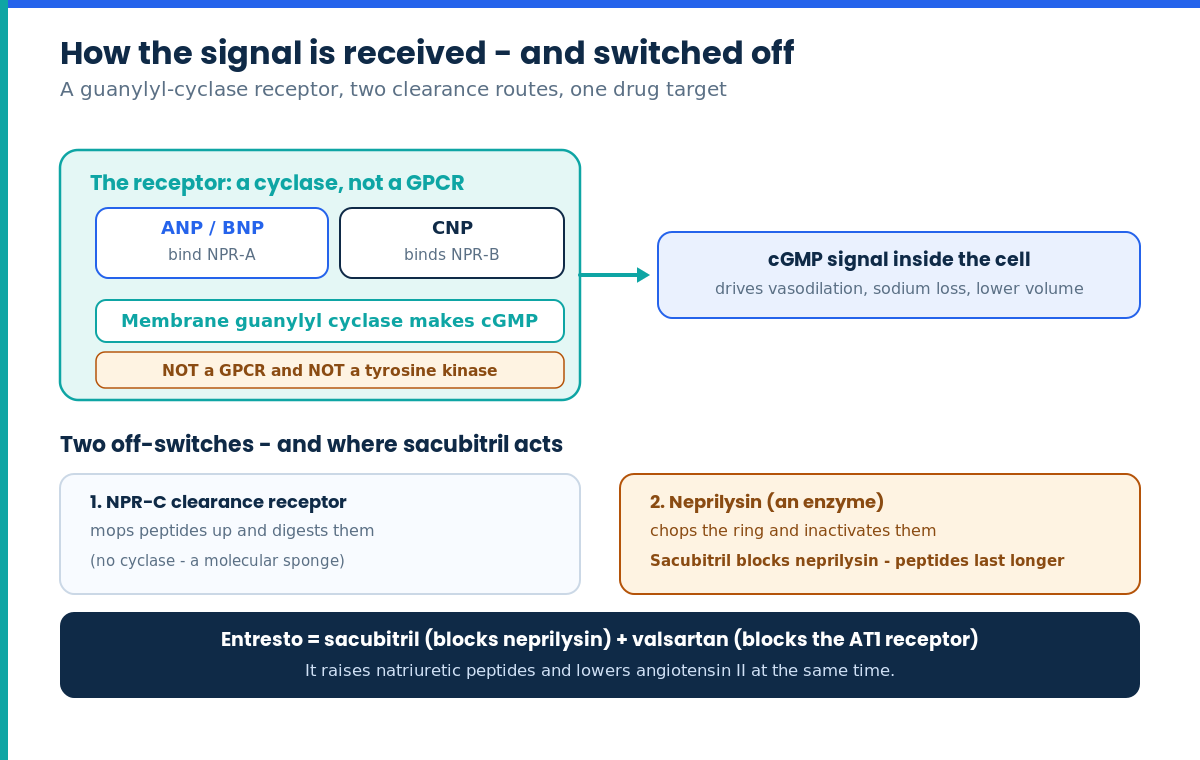
Here is the point that matters most for peptide science. ANP and BNP bind a receptor called NPR-A, and CNP binds NPR-B. These are membrane guanylyl cyclases — receptors with a built-in enzyme that, when the peptide binds, makes the second messenger cGMP inside the cell. They are not G-protein-coupled receptors and not receptor tyrosine kinases. It is a useful reminder that peptide hormones use several different receptor architectures: some route through GPCRs, some through tyrosine kinases, and some — like these — through guanylyl cyclases.
That cGMP signal is what produces the peptides’ effects: it relaxes vascular smooth muscle and drives the kidney to excrete sodium and water.
What they do to blood pressure
Working together, ANP and BNP push blood pressure and volume down in several complementary ways:
- Natriuresis and diuresis — the kidney sheds sodium and water, shrinking blood volume.
- Vasodilation — blood vessels relax, lowering resistance.
- Switching off the RAAS — they suppress renin release and reduce aldosterone, cutting the accelerator.
- Calming the sympathetic system — reducing the “fight-or-flight” pressure drive.
The result is the mirror image of angiotensin II. Where the RAAS constricts, retains salt, and releases aldosterone, the natriuretic peptides dilate, excrete salt, and shut aldosterone down.
How the signal is switched off — and where a drug comes in
Like all peptide signals, these have to be cleared, and there are two routes. The first is the NPR-C clearance receptor, which has no cyclase and simply mops peptides up and digests them — a molecular sponge. The second is an enzyme, neprilysin, which chops the peptide ring and inactivates it. Neprilysin is a shared theme in peptide biology: like DPP-4 for the incretins, it is a peptidase that sets how long a hormone lasts (see what DPP-4 is and peptide pharmacokinetics).
That clearance enzyme is a drug target. Sacubitril/valsartan (Entresto) is an “ARNI” — an angiotensin-receptor/neprilysin inhibitor. Sacubitril blocks neprilysin, so natriuretic peptides last longer and their pressure-lowering effect is amplified; valsartan simultaneously blocks the angiotensin II AT1 receptor. In other words, one pill lifts the brake and eases the accelerator at the same time. This is background pharmacology, not medical advice.
Why this matters for a peptide audience
The natriuretic peptides are a textbook case of genuine peptide hormones that act through a cyclase receptor, that are switched off by a named peptidase, and that already have engineered and recombinant versions in medicine. They round out the picture built by the receptor and enzyme articles on this site, and they complete the blood-pressure story that starts with the RAAS.
Frequently asked questions
What is the difference between ANP and BNP?
ANP is a 28-amino-acid peptide released mainly by the atria on stretch; BNP is 32 amino acids and comes mainly from the ventricles under wall stress. They act on the same receptor (NPR-A) and do similar jobs, but BNP is the one most often measured as a heart-failure marker.
Are natriuretic peptide receptors GPCRs?
No. NPR-A and NPR-B are membrane guanylyl cyclases that make cGMP, not GPCRs and not tyrosine kinases. NPR-C is a third, clearance-only receptor with no enzyme activity.
How do natriuretic peptides relate to the RAAS?
They are the counter-regulatory system. The RAAS raises blood pressure and volume; natriuretic peptides lower them and directly suppress renin and aldosterone. A healthy body balances the two.
What does sacubitril do?
Sacubitril blocks neprilysin, the enzyme that breaks natriuretic peptides down, so those peptides last longer. It is combined with the ARB valsartan in the medicine Entresto.
References
- Sandefur BJ, Jialal I. Atrial Natriuretic Peptide. StatPearls, NCBI Bookshelf.
- Novack ML, Zubair M. Natriuretic Peptide B Type Test. StatPearls, NCBI Bookshelf.
- Transmembrane guanylyl cyclases (NPR-A/GC-A, NPR-B/GC-B, NPR-C). IUPHAR/BPS Guide to Pharmacology.
- UniProt Consortium. NPR1 — Atrial natriuretic peptide receptor 1 / Guanylate cyclase-A (P16066). UniProtKB.
- ENTRESTO (sacubitril and valsartan) — Prescribing Information. FDA.
- McMurray JJV, et al. Angiotensin–Neprilysin Inhibition versus Enalapril in Heart Failure (PARADIGM-HF). New England Journal of Medicine, 2014.
Informational and educational only — not medical advice. Consult a qualified healthcare professional. Intended for adults 21+.