
The Renin–Angiotensin–Aldosterone System (RAAS) Explained
Endocrine biology · How the body sets blood pressure
The renin–angiotensin–aldosterone system (RAAS) is the body’s main hormonal circuit for defending blood pressure and salt balance. It is a peptide relay: a liver protein is snipped, snipped again, and turned into a tiny but powerful signalling peptide — angiotensin II — that clamps blood vessels, tells the kidney to hold onto sodium, and orders the adrenal gland to release a salt-retaining steroid. Understanding it explains a whole shelf of common medicines and gives several research peptides a home.
What the RAAS is, in one line
RAAS is a chain reaction that starts in the liver and ends at the kidney and adrenal gland. Each step hands off to the next, and each step is a place a drug can intervene. The important idea is that the system is reactive: it wakes up when blood pressure or blood volume falls and works to bring them back up.
The cascade, step by step
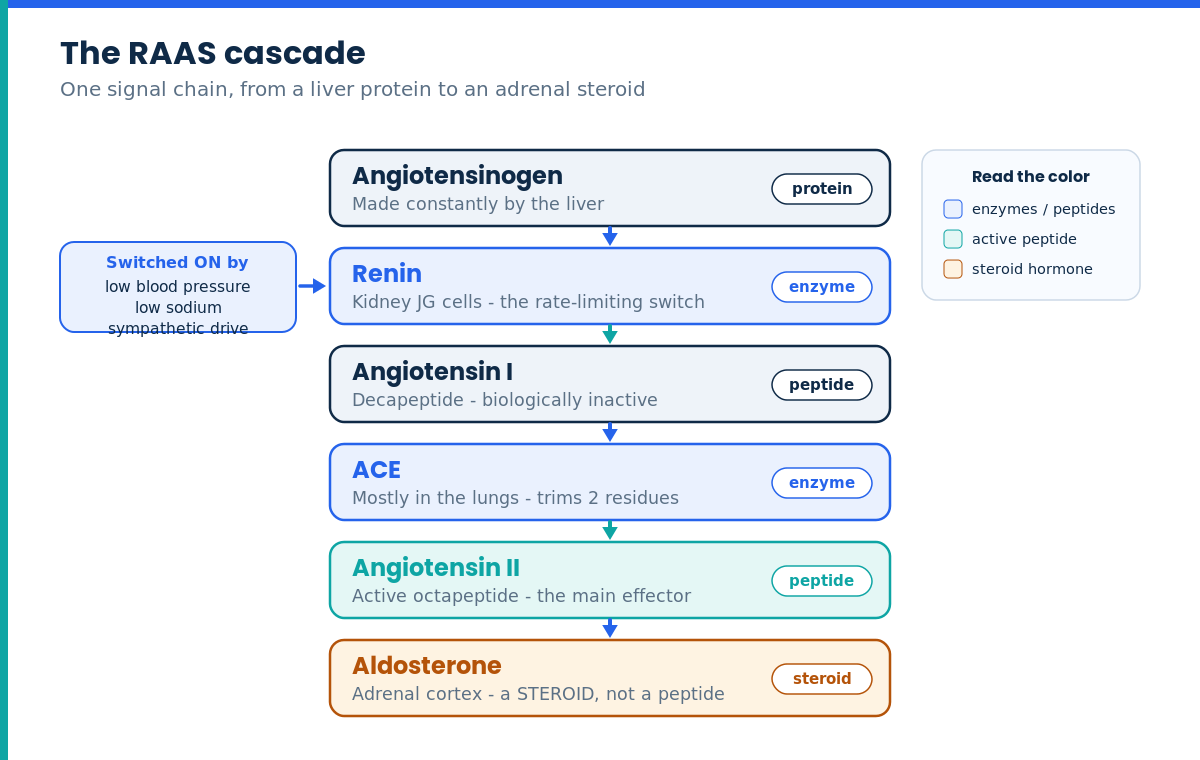
Angiotensinogen is made continuously by the liver and released into the blood, where it circulates as a silent reservoir. On its own it does nothing.
Renin is the switch that starts everything. It is released from the juxtaglomerular cells of the kidney and is the rate-limiting step of the whole system — nothing downstream happens faster than renin allows. Three main triggers open the switch: a drop in blood pressure sensed in the kidney’s afferent arteriole, low sodium delivery sensed by the macula densa, and sympathetic (β1-adrenergic) nerve activity. Renin cleaves angiotensinogen to make angiotensin I.
Angiotensin I is a short peptide that, like angiotensinogen, has essentially no activity of its own. It is purely an intermediate, waiting for one more cut.
Angiotensin-converting enzyme (ACE) makes that cut. ACE sits on the surface of blood-vessel lining cells, concentrated in the lungs, and trims two amino acids off angiotensin I to produce angiotensin II — the active hormone. ACE also breaks down bradykinin, a vasodilator peptide, which is why ACE-inhibitor drugs can cause a dry cough.
Aldosterone is the final output. Angiotensin II tells the outer layer of the adrenal cortex (the zona glomerulosa) to release aldosterone. Crucially, aldosterone is not a peptide — it is a steroid hormone, and it works completely differently from everything upstream of it (more on that below).
What angiotensin II actually does
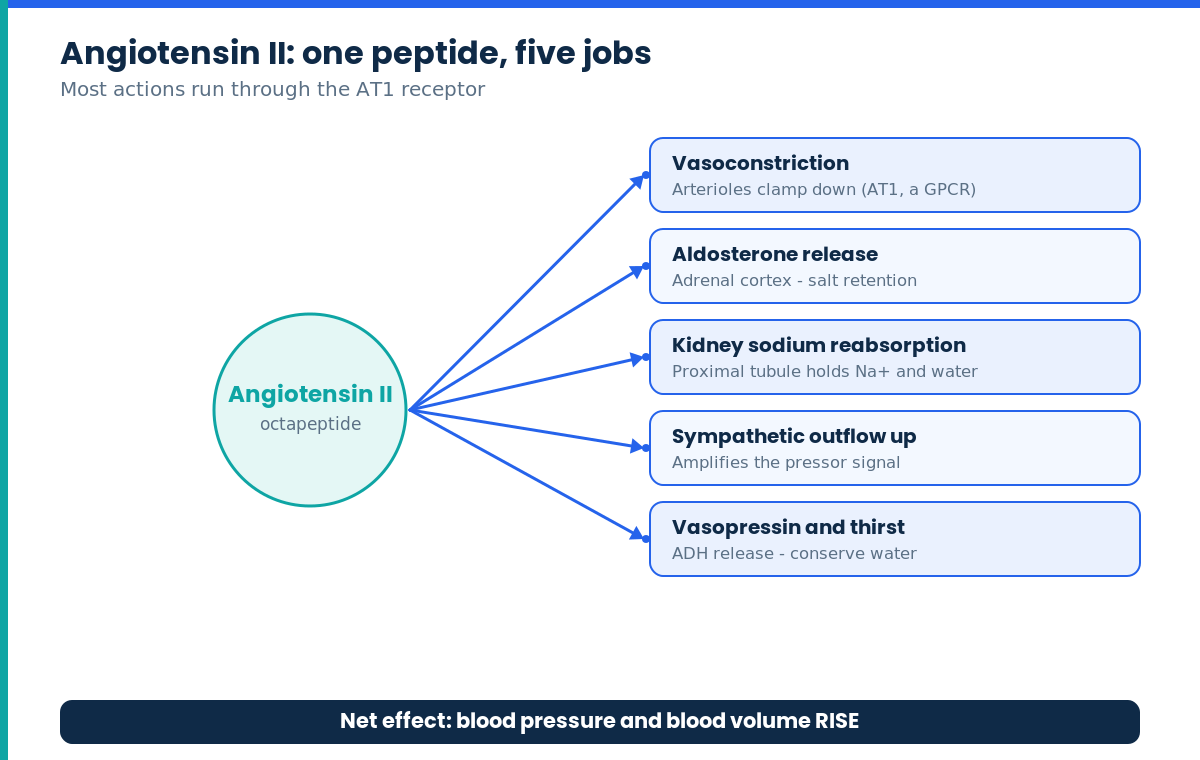
Angiotensin II is the business end of the system. Most of its actions run through the AT1 receptor, which is a class A G-protein-coupled receptor (GPCR). Through AT1 it raises blood pressure and conserves fluid in five overlapping ways:
- Vasoconstriction — it clamps down small arteries, which directly raises pressure.
- Aldosterone release — driving sodium retention at the kidney.
- Direct sodium reabsorption — it makes the kidney’s proximal tubule hold onto sodium and water.
- Sympathetic amplification — it turns up the sympathetic nervous system, reinforcing the whole response.
- Vasopressin and thirst — it releases antidiuretic hormone and makes you drink, conserving water.
There is a second receptor, AT2, which tends to oppose AT1 — promoting vasodilation and natriuresis — and is most prominent in fetal tissue, declining in adults. The net adult effect of angiotensin II is firmly on the pressor, fluid-retaining side.
Beyond angiotensin II: the wider peptide family
Angiotensin II is not the end of the line. Enzymes trim it further into angiotensin III and angiotensin IV. Angiotensin III keeps most of the aldosterone-stimulating effect but far less of the pressor effect; angiotensin IV has little blood-pressure activity and mostly acts in the brain, binding the AT4 site (which turns out to be the enzyme IRAP).
There is also a whole counter-regulatory “protective arm.” A related enzyme, ACE2, converts angiotensin II into angiotensin-(1-7), which acts on the Mas receptor to produce roughly the opposite effects of the AT1 axis: vasodilation, and anti-inflammatory and anti-fibrotic actions. The healthy system is a balance between the pressor ACE/angiotensin II/AT1 arm and the protective ACE2/angiotensin-(1-7)/Mas arm. (ACE2 is also the receptor SARS-CoV-2 uses to enter cells.)

How the RAAS is targeted by medicines
Because each step is a discrete enzyme or receptor, the RAAS is one of the most heavily “drugged” systems in medicine. This is background information, not medical advice:
- Direct renin inhibitors (aliskiren) block the very first step.
- ACE inhibitors — the “-pril” drugs such as lisinopril and ramipril — stop angiotensin II from being made. Their signature side effect, a dry cough, comes from the bradykinin they also spare.
- Angiotensin receptor blockers (ARBs) — the “-sartan” drugs such as losartan and valsartan — block the AT1 receptor itself, so they do not cause the bradykinin cough.
- Mineralocorticoid-receptor antagonists (spironolactone, eplerenone) block aldosterone at the far end of the chain.
Why the RAAS matters for peptide science
For anyone reading about research peptides, the RAAS is worth knowing for three reasons. First, it is a clean example of a peptide relay where tiny sequence changes (removing two amino acids) flip a molecule from inactive to potent — the same logic that governs how peptides are handled and how long they last (see peptide pharmacokinetics). Second, it shows that not every peptide receptor is a GPCR pattern in reverse: AT1 is a GPCR (see what a GPCR is), while the downstream aldosterone works through a nuclear receptor, and the closely related adrenal biology is covered in the adrenal glands explained and the HPA axis. Third, the angiotensin family is the direct ancestor of at least one research compound: Dihexa is a small molecule derived from an angiotensin IV analog, though it is thought to act through a growth-factor pathway rather than classic pressor signalling.
Frequently asked questions
Is angiotensin II a peptide or a steroid?
Angiotensin II is a peptide — a short chain of eight amino acids. The steroid in the RAAS is aldosterone, which sits at the end of the chain and is made from cholesterol, not from a peptide precursor.
Why is renin called the rate-limiting step?
Renin controls how fast the first reaction happens, and everything downstream depends on it. No matter how much angiotensinogen or ACE is available, the system can only move as fast as renin lets it — which is why blocking renin (or its triggers) shuts the whole cascade down.
What is the difference between an ACE inhibitor and an ARB?
An ACE inhibitor stops angiotensin II from being made; an ARB lets it be made but blocks it from acting at the AT1 receptor. Both lower the pressor signal, but only ACE inhibitors also spare bradykinin, which is why the dry cough is an ACE-inhibitor quirk.
What is the “protective arm” of the RAAS?
It is the ACE2 → angiotensin-(1-7) → Mas-receptor pathway, which counterbalances the pressor ACE/angiotensin II/AT1 arm with vasodilation and anti-inflammatory effects. A healthy system is a balance between the two.
References
- Fountain JH, Kaur J, Lappin SL. Physiology, Renin Angiotensin System. StatPearls, NCBI Bookshelf.
- Karnik SS, et al. Angiotensin Receptors: Interpreters of Pathophysiological Angiotensinergic Stimuli. Pharmacological Reviews, 2015.
- Angiotensin receptors (AT1, AT2, AT4/IRAP). IUPHAR/BPS Guide to Pharmacology.
- Santos RAS, et al. The ACE2/Angiotensin-(1–7)/MAS Axis of the Renin-Angiotensin System. Physiological Reviews, 2018.
- UniProt Consortium. REN — Renin (Homo sapiens), P00797. UniProtKB.
- Lisinopril tablet — Prescribing Information. FDA / DailyMed.
Informational and educational only — not medical advice. Consult a qualified healthcare professional. Intended for adults 21+.