
What Is PACAP? The Other Migraine Peptide
Peptide science
In 1989 Akira Arimura’s team at Tulane worked through an extract of sheep hypothalamus, screening fraction after fraction for anything that would switch on adenylate cyclase in cultured rat pituitary cells. One 38-amino-acid peptide did it powerfully, and they named it after exactly what they had watched it do: pituitary adenylate cyclase-activating polypeptide, or PACAP. Thirty-seven years later PACAP is the most promising second peptide target in migraine, and its clinical record contains one result nobody predicted.
What is PACAP?
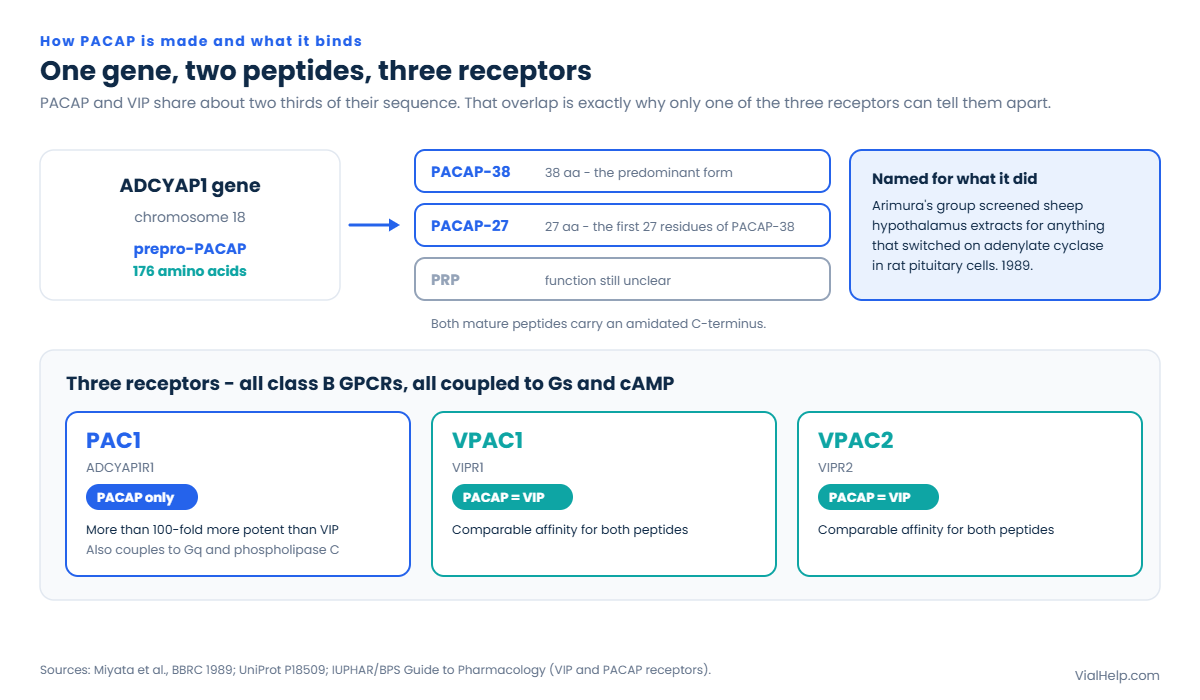
PACAP is a neuropeptide encoded by the ADCYAP1 gene on chromosome 18, catalogued in UniProt as P18509. The gene produces a 176-amino-acid precursor, prepro-PACAP, which is cut down into two active peptides and one whose job is still unclear.
- PACAP-38 — 38 amino acids, the predominant form in tissue.
- PACAP-27 — the first 27 residues of PACAP-38, produced by further enzymatic trimming rather than by alternative splicing.
- PACAP-related peptide (PRP) — also cut from the same precursor; its function has not been established.
Both active peptides finish with an amidated C-terminus, a small chemical flourish that is common among signalling peptides and matters for receptor binding. If you want the background on how one gene ends up producing several finished peptides, prohormone processing covers it.
PACAP belongs to the VIP/secretin/glucagon superfamily, which also includes GHRH and peptide histidine isoleucine. Its closest relative is vasoactive intestinal peptide: the original 1989 paper reported roughly 68% homology between PACAP’s N-terminal region and VIP, and later reviews repeat the figure. That overlap is not trivia — it is the reason two of PACAP’s three receptors cannot tell the two peptides apart.
PACAP is also strikingly well conserved. Its sequence is identical across mammals, and PACAP-27 peptides from a tunicate share 96% and 85% amino acid identity with the human peptide. It is often described as one of the best-conserved neuropeptides in the animal kingdom, though a 2020 phylogenomic analysis found no convincing evidence for a PACAP system outside vertebrates and argued that some reported invertebrate sequences may be artefacts. The vertebrate story is solid; the deeper one is contested.
Three receptors, and one useful asymmetry
PACAP acts through three receptors: PAC1 (ADCYAP1R1), VPAC1 (VIPR1) and VPAC2 (VIPR2). All three are class B G-protein-coupled receptors — the same structural family as the receptors for parathyroid hormone, calcitonin and corticotropin-releasing factor. All three couple to Gs, which activates adenylate cyclase and raises cyclic AMP. PAC1 additionally couples to Gq, engaging phospholipase C.
The asymmetry is what makes PACAP pharmacologically interesting. According to the IUPHAR/BPS Guide to Pharmacology, PACAP-27 and PACAP-38 are more than 100-fold more potent than VIP at most isoforms of the PAC1 receptor, while VPAC1 and VPAC2 show comparable affinity for PACAP and VIP alike. Some reviews put the PAC1 figure considerably higher, in the 400 to 1,000-fold range. Either way, PAC1 is the PACAP-preferring receptor and the VPACs are shared.
PAC1 is further complicated by splicing. Two alternative exon cassettes, known as “hip” and “hop”, can be inserted into the receptor’s third intracellular loop, and because the hop exon exists in two forms there are six possible variants that differ in how they signal inside the cell. One human variant carrying a 21-residue deletion in its extracellular region binds PACAP-27, PACAP-38 and VIP with similar high affinity — so even PAC1’s selectivity is not absolute. For the general vocabulary here, see agonists vs antagonists.
What PACAP does in the body
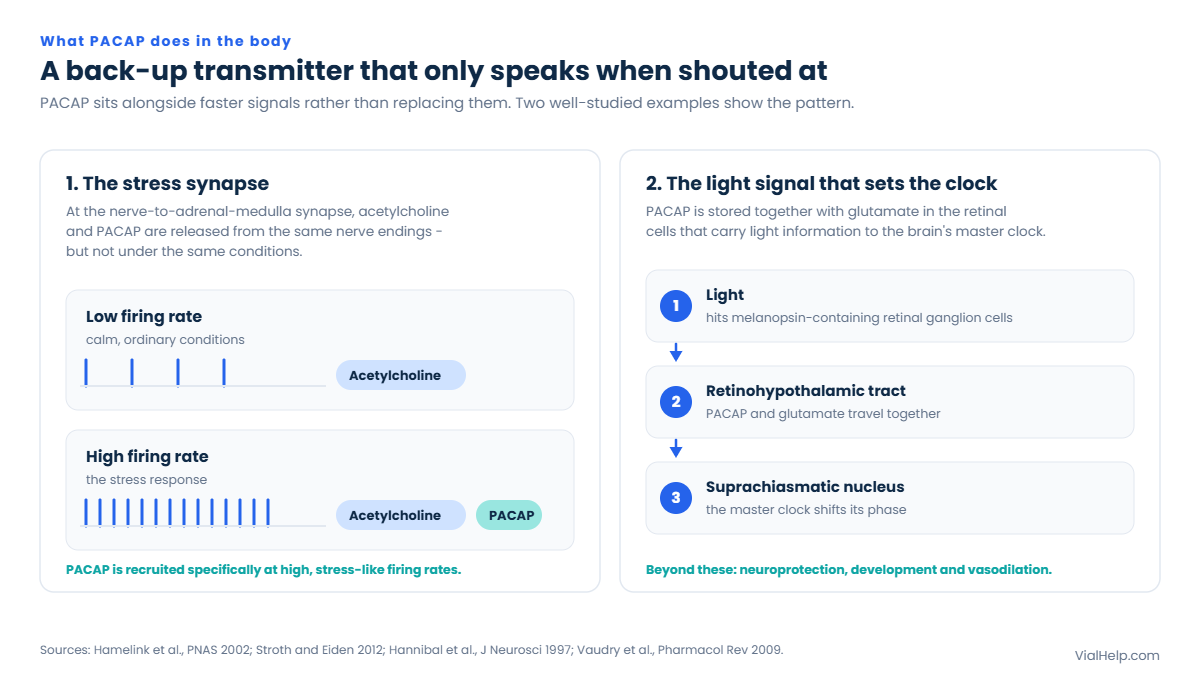
PACAP is best understood not as a primary signal but as one that gets recruited when a system is pushed. Two well-studied examples make the pattern clear.
The stress synapse. At the junction between the splanchnic nerve and the adrenal medulla, PACAP and acetylcholine are released from the same nerve terminals. Acetylcholine is released across a wide range of firing rates. PACAP is released selectively at high firing rates — the kind produced during a stress response — and it controls catecholamine secretion and the expression of catecholamine-synthesising enzymes under exactly those conditions. It is, in effect, a transmitter reserved for emergencies. The slower hormonal arm of the stress response is covered in our guide to the HPA axis.
The circadian light signal. PACAP is stored together with glutamate in the melanopsin-containing retinal ganglion cells whose axons form the retinohypothalamic tract, the direct wire from the eye to the suprachiasmatic nucleus. Light information travels along it and shifts the phase of the master clock. That clock in turn drives the pineal gland and melatonin, and sits inside the broader anatomy described in the hypothalamus explained. Sleep and wake also depend on orexin, a separate hypothalamic peptide system.
Beyond these, PACAP promotes neuronal survival and differentiation, reduces injury in animal models of cerebral and retinal ischaemia, and acts as a potent vasodilator.
PACAP and PTSD: the honest version
In 2011 a Nature paper reported that a single-nucleotide variant, rs2267735, sitting in a putative oestrogen response element within ADCYAP1R1, predicted post-traumatic stress disorder diagnosis and symptom severity — but only in women, across a combined sample of 1,237 people from a heavily trauma-exposed cohort.
What happened next is instructive. A 2017 meta-analysis of nine studies found the risk allele conferred a significant but modest effect overall, with a stronger and still-significant association in women and girls and no significant association in men. At the same time, at least one direct replication attempt in two independent samples found no association, and a 2022 longitudinal study found no main effect. The sex-specific direction has survived in aggregate; the effect is small, individual replications have failed, and this remains a single-variant candidate-gene finding of the kind the field now treats with caution. Our piece on why peptide trials are so small explains why results like these need care.
The migraine story
The reason PACAP is in the news is migraine, and the case was built in a specific order.
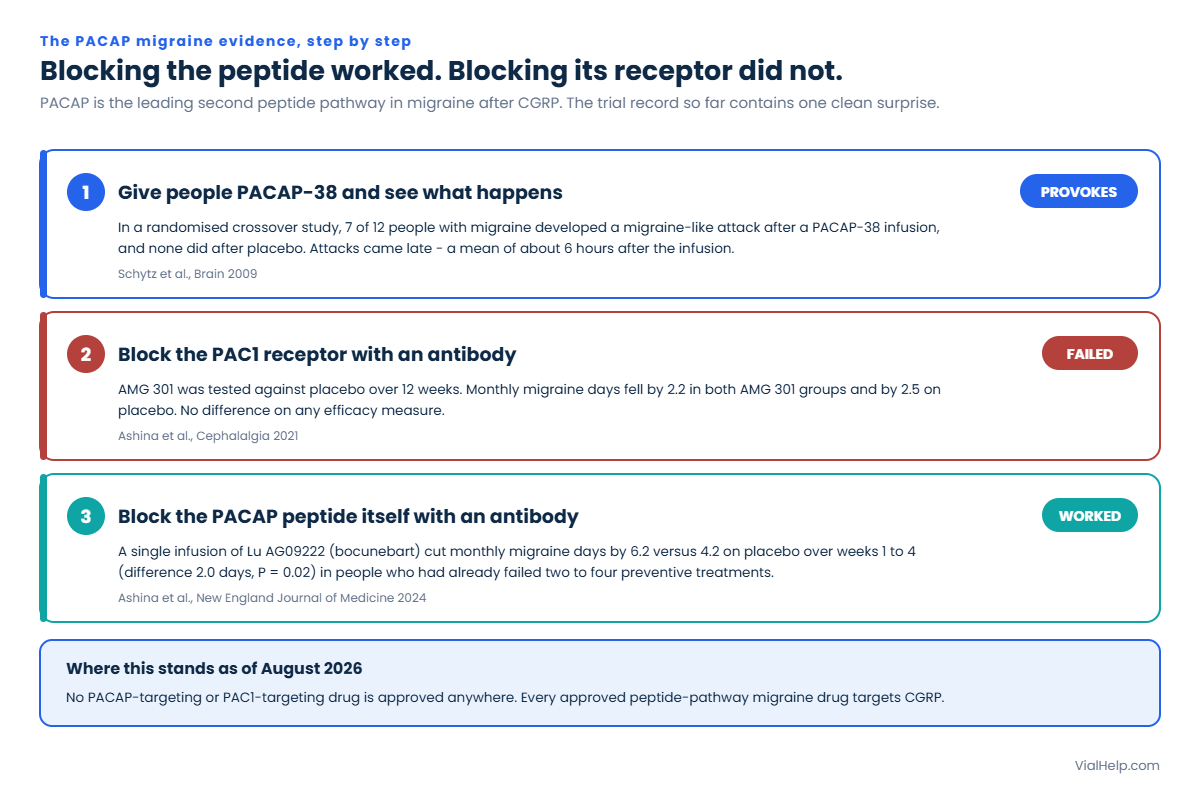
First, provoke it. In a randomised, double-blind crossover study published in Brain in 2009, 12 healthy volunteers and 12 people with migraine without aura received an infusion of PACAP-38 or placebo. Headache followed in all 12 healthy subjects and 11 of 12 patients. More importantly, 7 of the 12 migraine patients went on to develop a migraine-like attack after PACAP-38 and none did after placebo. The attacks were delayed, arriving a mean of about six hours after the infusion — the signature of a mechanism that is not simply “the peptide widened a blood vessel”.
For years the clean counterpoint was VIP: a short infusion produced marked cephalic vasodilation but did not trigger migraine, which was taken as evidence that PACAP’s effect ran through PAC1 rather than through vasodilation. That contrast no longer holds in its simple form. A two-hour VIP infusion did provoke attacks, in 71% of migraine patients versus 5% after placebo. The difference now looks more like duration of receptor exposure than a clean split between the two peptides — a good example of a tidy textbook fact being overtaken by better experiments.
Then, block it — twice, with opposite results. AMG 301, an antibody against the PAC1 receptor, was tested against placebo over 12 weeks. Monthly migraine days fell by 2.2 in both AMG 301 groups and by 2.5 on placebo, with no difference on any efficacy measure. The trial failed outright.
Lu AG09222 (bocunebart), an antibody against the PACAP peptide itself, did work. In a phase 2 trial published in the New England Journal of Medicine in 2024, 237 participants who had already failed two to four preventive treatments received a single intravenous infusion. Monthly migraine days fell by 6.2 on the 750 mg dose versus 4.2 on placebo over weeks 1 to 4 — a difference of 2.0 days (95% CI −3.8 to −0.3, P = 0.02). A phase 2b programme reported in 2026 saw the subcutaneous arm stop at a pre-specified futility analysis while the intravenous arm met its primary endpoint in roughly 430 patients; those results were presented at a headache congress in June 2026 and have not yet been peer-reviewed.
The clinical stakes are straightforward. Drugs targeting CGRP transformed migraine prevention, but they do not help everyone. PACAP is the leading second pathway. As of August 2026, no PACAP-targeting or PAC1-targeting drug is approved anywhere, and every approved peptide-pathway migraine medicine still targets CGRP.
Frequently asked questions
What does PACAP stand for?
Pituitary adenylate cyclase-activating polypeptide. The name is purely descriptive of how it was discovered: Arimura’s group screened sheep hypothalamus extracts for anything that would activate adenylate cyclase in cultured rat pituitary cells, and this 38-residue peptide did so powerfully.
What is the difference between PACAP-38 and PACAP-27?
They come from the same 176-amino-acid precursor. PACAP-27 is simply the first 27 amino acids of PACAP-38, released by additional trimming rather than by a separate gene or splice variant. Both end in an amidated C-terminus, and PACAP-38 is the more abundant form in tissue.
Is PACAP the same thing as VIP?
No, but they are close relatives in the same peptide superfamily, sharing roughly 68% of their sequence. The practical difference is receptor preference: PACAP is far more potent than VIP at PAC1, while VPAC1 and VPAC2 respond to both peptides with comparable affinity.
Is there a PACAP drug for migraine yet?
Not an approved one. An antibody against PACAP itself reduced monthly migraine days versus placebo in a phase 2 trial published in 2024 and met its primary endpoint again in a phase 2b intravenous cohort reported in 2026, and its developer has said it is discussing phase 3 design with regulators. An antibody against the PAC1 receptor failed in 2021. No PACAP- or PAC1-targeting medicine has regulatory approval as of August 2026.
References
- Miyata A, Arimura A, Dahl RR, et al. Isolation of a novel 38 residue-hypothalamic polypeptide which stimulates adenylate cyclase in pituitary cells. Biochem Biophys Res Commun 1989;164(1):567-574. PubMed 2803320
- UniProt P18509 — PACAP precursor (ADCYAP1), Homo sapiens. uniprot.org
- VIP and PACAP receptors. IUPHAR/BPS Guide to Pharmacology. guidetopharmacology.org
- Schytz HW, Birk S, Wienecke T, et al. PACAP38 induces migraine-like attacks in patients with migraine without aura. Brain 2009;132(1):16-25. academic.oup.com
- Ashina M, et al. A monoclonal antibody to PACAP for migraine prevention. N Engl J Med 2024. nejm.org
- Ashina M, Dolezil D, Bonner JH, et al. A phase 2 trial of AMG 301, a PACAP PAC1 receptor monoclonal antibody, for migraine prevention. Cephalalgia 2021. sagepub.com
- Ressler KJ, et al. Post-traumatic stress disorder is associated with PACAP and the PAC1 receptor. Nature 2011;470:492-497. nature.com
- Hirabayashi T, Nakamachi T, Shioda S. Discovery of PACAP and its receptors in the brain. J Headache Pain 2018;19:28. biomedcentral.com
Informational only — not medical advice · 21+. Consult a qualified healthcare professional about migraine or any other medical condition.