
Prohormone Processing Explained: How Cells Build Peptide Hormones
Peptide Science
Prohormone processing is how a cell turns a long, inactive precursor protein into the small, finished peptide hormones it actually uses. Almost no peptide hormone is made in its final form. Instead, the cell builds a larger chain and then trims, folds and decorates it with a set of dedicated enzymes. Understanding that assembly line explains why a single gene can give rise to several different hormones, and why a research or therapeutic peptide only works if it reproduces the correctly finished molecule.
What a prohormone is
Peptide hormones start life as a preprohormone: the freshly made chain still carrying a short “signal” tag at its front. As the chain is threaded into the endoplasmic reticulum (ER), an enzyme called signal peptidase clips off that tag, leaving a prohormone (or, more generally, a proprotein). The prohormone still contains extra “pro” segments that have to be removed before the mature peptide is released. So the tier is simple: preprohormone becomes prohormone, and the prohormone is cut down to one or more mature peptides.

The secretory assembly line
Inside the ER the prohormone folds and forms its disulfide bonds — the internal bridges that lock a peptide into its working shape. It then moves through the Golgi to the trans-Golgi network, where the cell decides its route. Some precursors travel the constitutive path and are secreted continuously; others are packaged into dense-core secretory granules and held until the cell is told to release them. As those granules mature, their interior becomes more acidic and calcium-rich — exactly the conditions that switch on the granule cutting enzymes.
The convertases: the cell’s molecular scissors
The enzymes that make the key cuts are the proprotein convertases, a family of calcium-dependent proteases that snip after pairs of basic amino acids (Lys-Arg or Arg-Arg). The main players are:
PC1/3 and PC2 (genes PCSK1 and PCSK2) work inside regulated secretory granules and do most classic hormone processing, often acting one after the other on the same precursor.
Furin (gene FURIN/PCSK3) sits in the trans-Golgi network and handles the constitutive route.
Carboxypeptidase E (CPE) trims the leftover basic residues from each new end.
PAM adds a protective amide cap to the C-terminus of many peptides, a finishing touch that is often required for full activity.
One clarification worth making: PCSK9, famous from cholesterol biology, belongs to the same broad family by name but is not one of these dibasic hormone-processing scissors — a common point of confusion.
One precursor, many hormones
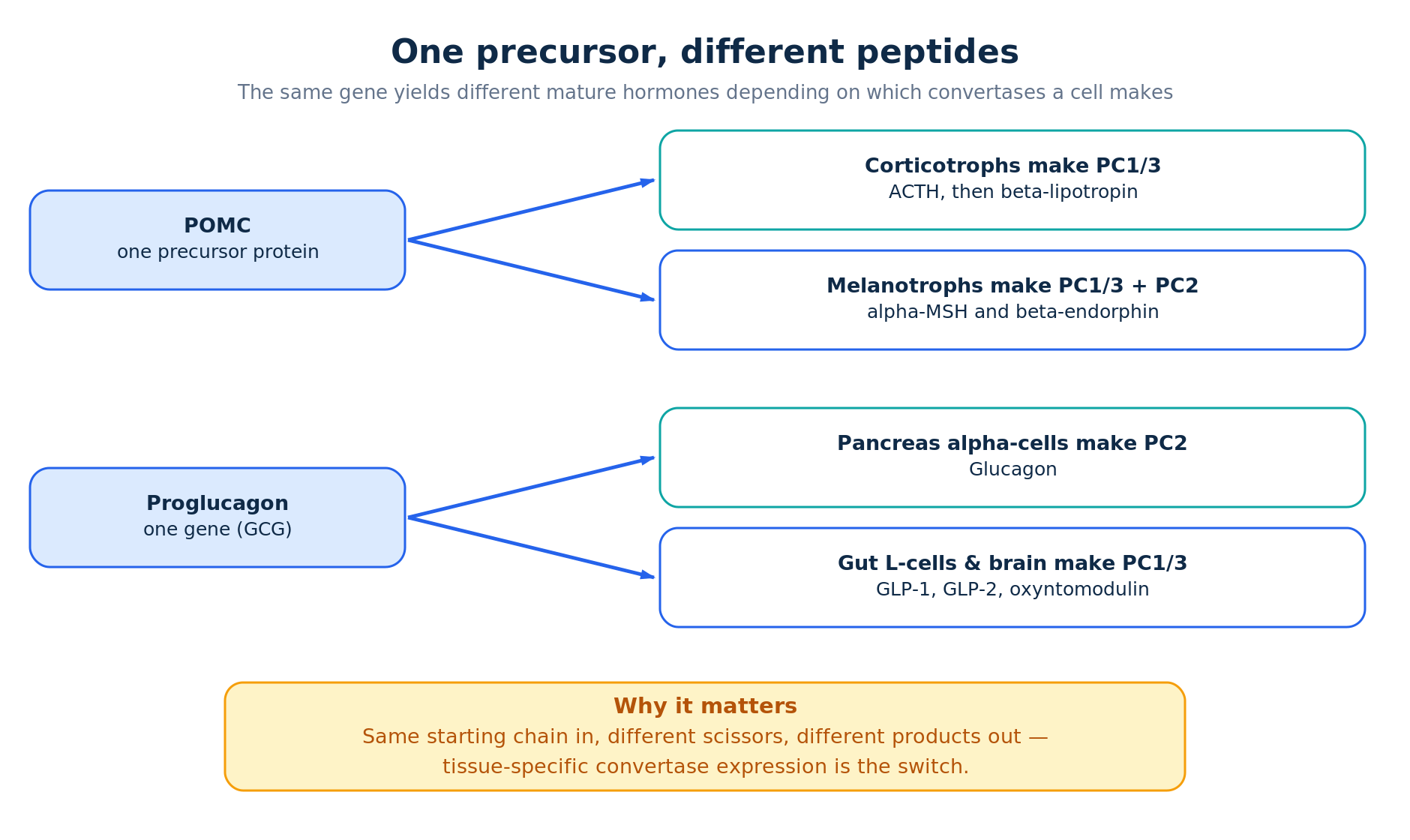
The most striking feature of prohormone processing is that the same precursor can yield different hormones in different tissues, simply because different cells express different convertases. Pro-opiomelanocortin (POMC) is the classic case: in the pituitary’s corticotrophs, PC1/3 releases ACTH; in melanotrophs and certain brain neurons, PC1/3 and PC2 together carve the chain further into α-MSH and β-endorphin. Proglucagon tells the same story — the pancreas uses PC2 to make glucagon, while gut and brain cells use PC1/3 to make GLP-1 and GLP-2 from the identical precursor. Same chain in; different scissors; different products out.
Worked example: insulin and C-peptide
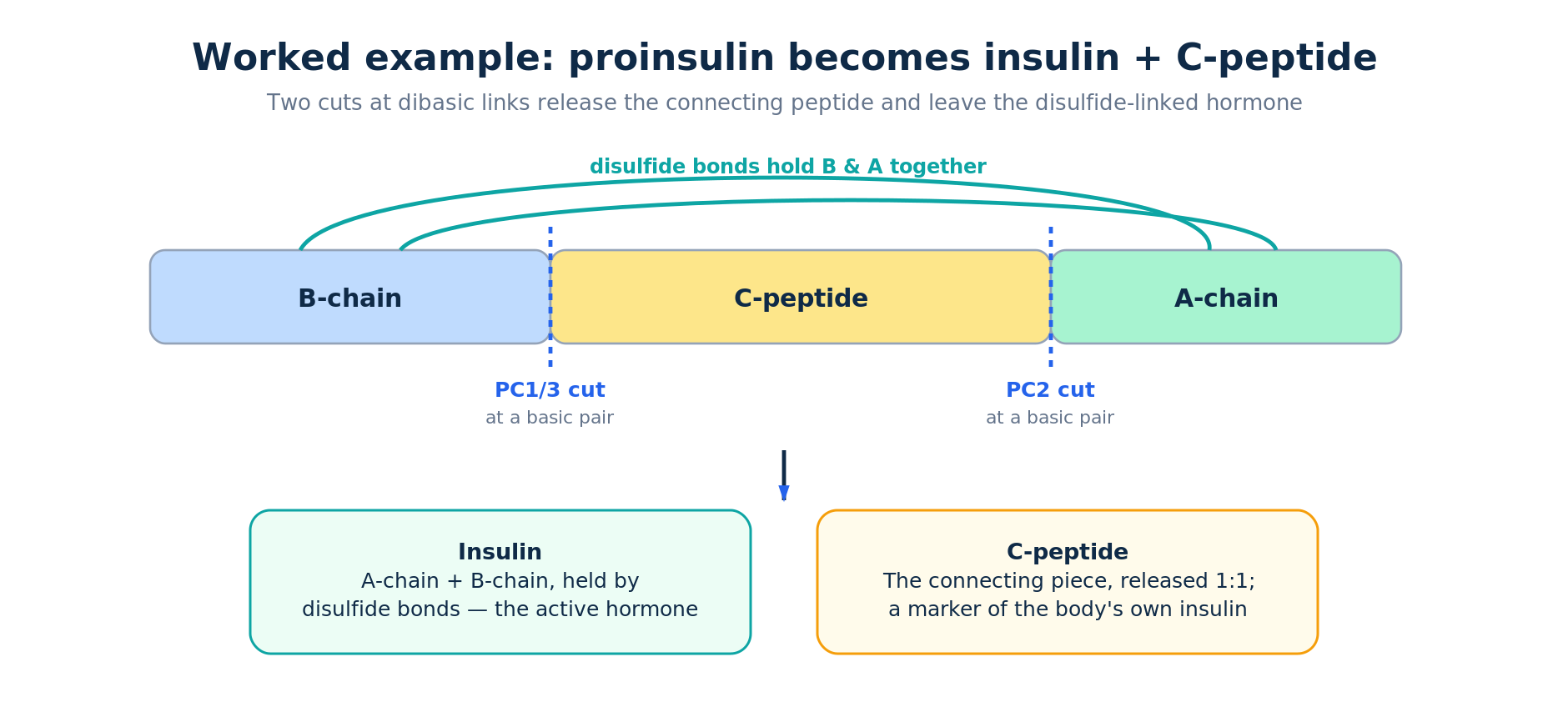
Insulin is the textbook illustration. Its precursor, proinsulin, is arranged as B-chain – C-peptide – A-chain, with the A and B chains already stitched together by disulfide bonds. PC1/3 and PC2 cut at the two dibasic junctions and CPE cleans up the ends, releasing mature insulin (the A and B chains held by their disulfide bridges) plus the freed connecting piece, C-peptide. Because C-peptide is released in equal amounts with insulin and is absent from injected insulin, laboratories use it as a marker of the body’s own insulin output — a biochemical fact, not a treatment recommendation.
Why this matters for peptide science
A large share of well-known research and therapeutic peptides — insulin, glucagon, the GLP-1 family, ACTH, β-endorphin, somatostatin and many neuropeptides — are the mature end-products of this machinery. That has a practical consequence: to be active, a peptide has to reproduce the correctly finished molecule, with the right cut points, the right disulfide pairing and any finishing modifications such as C-terminal amidation. Chemical synthesis skips the convertases entirely, so those features must be built in deliberately; recombinant production may lean on the host cell’s own convertases and can still need a separate amidation step. In short, the sequence on a label only matters if it matches the biologically mature peptide. Handling matters too — see our guides on how to reconstitute peptides and sterile technique, and the reconstitution calculator for the underlying concentration math.
What this does not mean: knowing how a hormone is processed says nothing about how anyone should use a compound. This article describes molecular biology for education only.
Frequently asked questions
What is the difference between a prohormone and a hormone?
A prohormone is the larger precursor form; the hormone is the smaller, active peptide released after the convertases and trimming enzymes have done their work. The prohormone is generally inactive or far less active until it is processed.
Why does the body make hormones as big precursors at all?
Building a longer chain lets the cell fold and store the peptide safely, and it allows one gene to be processed into different products in different tissues. It is an efficient, tightly controlled way to produce and release peptides on demand.
What are proprotein convertases?
They are a family of enzymes (including PC1/3, PC2 and furin) that cut precursor proteins after specific pairs of basic amino acids, releasing the mature peptides. Their tissue-specific pattern is what decides which products a cell makes.
Is C-peptide biologically important?
C-peptide is best known as the connecting segment removed during insulin maturation and as a marker of endogenous insulin production. Whether it has independent signaling roles of its own is still an area of research.
References
1. Insulin Biosynthesis, Secretion, Structure, and Structure-Activity Relationships — Endotext (NCBI Bookshelf). ncbi.nlm.nih.gov/books/NBK279029
2. Glucagon Physiology — Endotext (NCBI Bookshelf). ncbi.nlm.nih.gov/books/NBK279127
3. Harno E, et al. POMC: The Physiological Power of Hormone Processing. Physiol Rev, 2018. pubmed.ncbi.nlm.nih.gov/30156493
4. The Proinsulin C-peptide — A Multirole Model. PMC2478623. ncbi.nlm.nih.gov/pmc/articles/PMC2478623
5. Galanopoulou AS, et al. Comparative proteolytic processing of prosomatostatin by convertases. Biochem J, 1995. pubmed.ncbi.nlm.nih.gov/7720860
6. Physiology of Proglucagon Peptides. Physiol Rev, 2014. physiology.org (Physiol Rev 2014)
Informational only — not medical advice. For research and educational purposes; intended for audiences 21+. Always consult a qualified healthcare professional.