
The Pineal Gland and Melatonin: The Body’s Clock Hormone
Endocrine system
The pineal gland is a pea-sized organ buried deep in the middle of the brain, and it has one famous job: at night it releases melatonin, the hormone that tells the rest of the body it is dark. Unusually for an endocrine gland, its output is timed almost entirely by light — which is why the pineal gland sits at the heart of how we keep time.
What the pineal gland is
The pineal gland sits in the midline of the brain, attached to the roof of the third ventricle, and is made mostly of hormone-secreting cells called pinealocytes. Two features make it distinctive: it lies largely outside the blood-brain barrier, so its hormone reaches the bloodstream easily, and it tends to calcify with age — the gritty deposits (sometimes called “brain sand”) are a useful landmark on brain scans. That calcification is one reason melatonin output generally declines over a lifetime.
Melatonin: made from an amino acid, not a chain of them
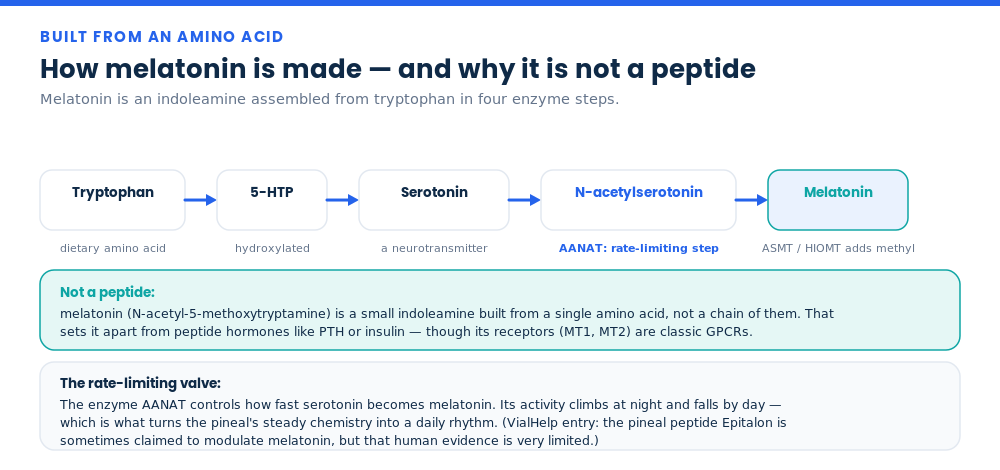
For a peptide-focused audience, melatonin is a useful contrast. It is not a peptide. It is an indoleamine — a small molecule built from the single amino acid tryptophan, which is converted to 5-HTP, then to serotonin, then acetylated and methylated into melatonin. The enzyme AANAT controls the pace of that assembly line and is the rate-limiting step; its activity climbs at night and falls by day, which is what turns steady chemistry into a daily rhythm. So while melatonin differs from peptide hormones like PTH or insulin, its receptors — MT1 and MT2 — are classic G-protein-coupled receptors, the same signalling family many peptide hormones use.
The light–dark signal: how the clock works
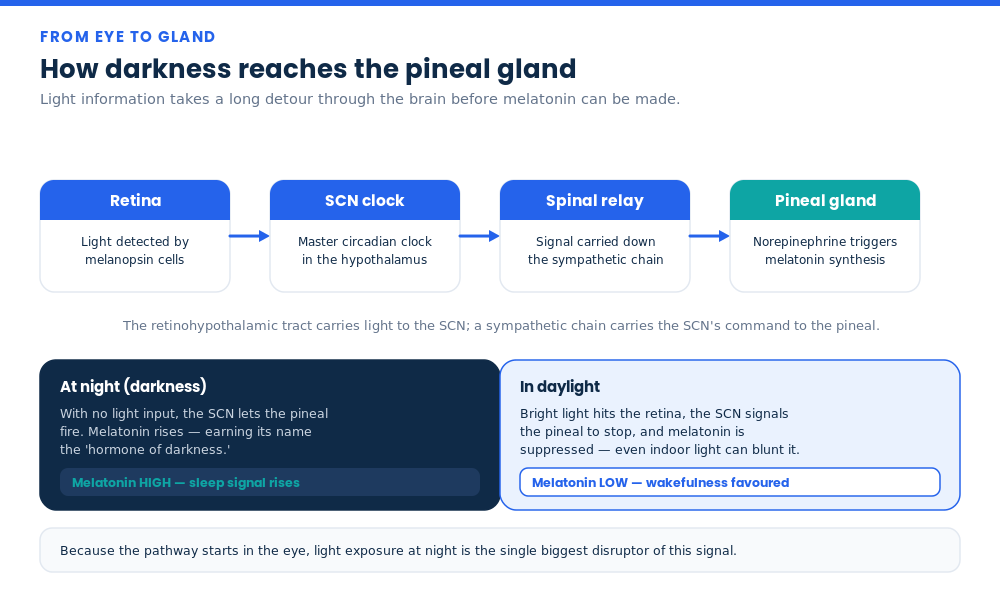
Melatonin does not run itself. The body’s master clock is the suprachiasmatic nucleus (SCN) in the hypothalamus. Special light-sensing cells in the retina — containing the pigment melanopsin — report daylight to the SCN through the retinohypothalamic tract. From there, the signal travels an indirect route down through the hypothalamus and spinal cord and up a sympathetic nerve chain to the pineal, where the neurotransmitter norepinephrine finally switches melatonin production on. Because the whole pathway begins in the eye, light is the master switch: darkness allows melatonin to rise, and light shuts it down.
The nightly rhythm
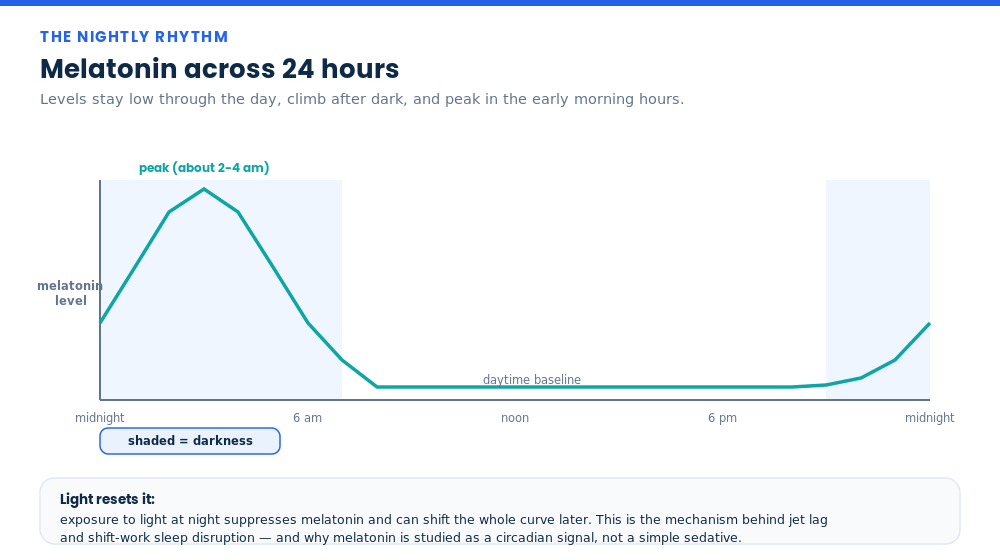
Across 24 hours, melatonin stays low during daylight, climbs after dark, and peaks in the early-morning hours (roughly 2–4 a.m.) before fading toward morning. Its clearance is fairly quick — reported figures range from around 40 minutes to a couple of hours depending on the study and formulation, so it is best thought of as a short-lived timing signal rather than a long-acting sedative. Shifting this curve is exactly what happens in jet lag and shift work: light at the wrong time moves the peak, and the body’s sense of “night” drifts out of step with the clock on the wall. In controlled studies, taking melatonin nudges sleep onset earlier by only a small amount on average, reinforcing that its main role is circadian, not knock-you-out sedation.
Melatonin as a supplement and a drug
In the United States melatonin is sold as a dietary supplement, not an approved drug, and its content is unregulated — analyses have found actual amounts varying widely from what the label claims. Several prescription medicines instead target the melatonin receptors directly: ramelteon (an MT1/MT2 agonist for sleep onset) and tasimelteon (approved for Non-24-Hour Sleep-Wake Disorder) are FDA-approved, while agomelatine is used for depression in Europe. This section is informational only and is not medical or dosing advice.
The peptide angle: Epitalon and the pineal
Because this is a peptide-research resource, one compound deserves a careful note. Epitalon (Epithalon) is a synthetic tetrapeptide (Ala-Glu-Asp-Gly) derived from a bovine pineal extract and marketed as a “pineal peptide” said to restore melatonin rhythms and slow aging. Unlike melatonin, Epitalon is a peptide — hence its appeal to this audience — but the evidence behind those claims is weak. Much of it comes from small, older, largely unreplicated studies, and at least one animal experiment found the peptide had no significant effect on melatonin secretion. It is not an approved drug, and its longevity and melatonin-boosting claims should be treated as unproven.
Frequently asked questions
Is melatonin a peptide?
No. Melatonin is an indoleamine — an amine hormone built from one amino acid, tryptophan. That sets it apart from peptide hormones, which are chains of amino acids.
Why does light at night disrupt sleep?
Light reaching the retina signals the SCN to tell the pineal gland to stop making melatonin. Evening light therefore suppresses the melatonin rise and can shift the whole rhythm later.
Does the pineal gland really calcify?
Yes. Calcified deposits (“brain sand”) commonly accumulate with age and are visible on imaging. This is normal, though it is associated with a general decline in melatonin output over time.
Does Epitalon boost melatonin?
The claim is not well supported. Human evidence is very limited, and an animal study found no significant effect on melatonin. Treat Epitalon’s melatonin and anti-aging claims as unproven.
References
- Savage RA, Zafar N, Yohannan S, Miller JMM. Melatonin. StatPearls (NBK534823). ncbi.nlm.nih.gov/books/NBK534823
- Physiology of the Pineal Gland and Melatonin. Endotext (NBK550972). ncbi.nlm.nih.gov/books/NBK550972
- PubChem: Melatonin, CID 896. pubchem.ncbi.nlm.nih.gov/compound/896
- FDA Label: ROZEREM (ramelteon). accessdata.fda.gov
- FDA Label: HETLIOZ (tasimelteon). accessdata.fda.gov
- Overview of Epitalon: a pineal tetrapeptide. Int J Mol Sci 2025 (PMC11943447). ncbi.nlm.nih.gov/pmc/articles/PMC11943447
Informational only — not medical advice · 21+