
The Thymus Gland and Thymic Peptides Explained
Immune & endocrine system
The thymus gland is easy to overlook — a soft, two-lobed organ behind the breastbone that does most of its work before you reach adulthood, then quietly shrinks away. Yet it is where the immune system’s T cells are trained, and it doubles as an endocrine gland, secreting a family of thymic peptides that have drawn heavy interest in peptide-research circles.

What the thymus gland is
The thymus sits in the front of the chest (the anterior mediastinum), just behind the sternum, and is divided into two lobes. Each lobe has an outer cortex, densely packed with developing immune cells, and an inner medulla containing distinctive whorls called Hassall’s corpuscles. In the embryo it develops from the third pharyngeal pouch — the same pouch that gives rise to the inferior parathyroid glands, which is why the two can share a developmental journey down the neck.
Its main job: training T cells
The thymus is a primary lymphoid organ, meaning it is a place where immune cells are made competent. Immature T cells (thymocytes) arrive from the bone marrow and face two tests. In the cortex, positive selection checks whether a cell can recognise the body’s own MHC molecules; cells that cannot are quietly discarded. In the medulla, negative selection does the opposite — cells that react too strongly against the body’s own proteins are deleted, building self-tolerance. A gene called AIRE helps by displaying a broad sample of the body’s proteins so self-reactive cells can be caught. Only a small fraction — roughly 5% by common estimates — pass both tests and graduate into the bloodstream. Fail the self-tolerance step, and autoimmunity can follow.
A gland that shrinks: thymic involution
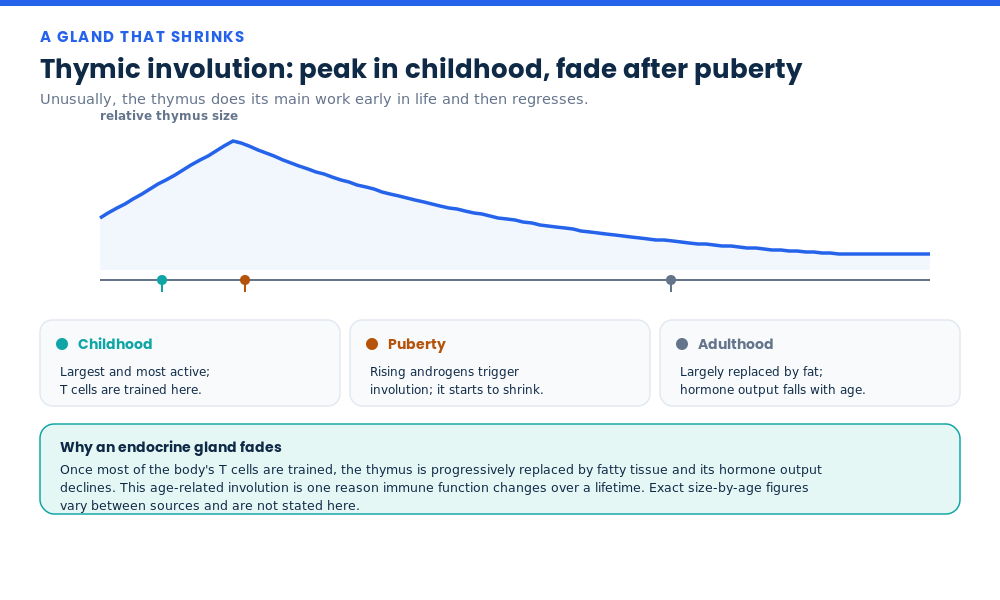
The thymus is unusual among glands: it is largest and most active in early childhood and then, from puberty onward, progressively regresses. Rising sex-hormone (androgen) levels are thought to drive this involution, and over the years the working tissue is gradually replaced by fat, with a matching decline in output. This is one reason immune function changes across a lifetime. Exact size-by-age figures vary between sources, so this piece describes the trend rather than specific numbers.
The thymus as an endocrine gland: thymic peptides
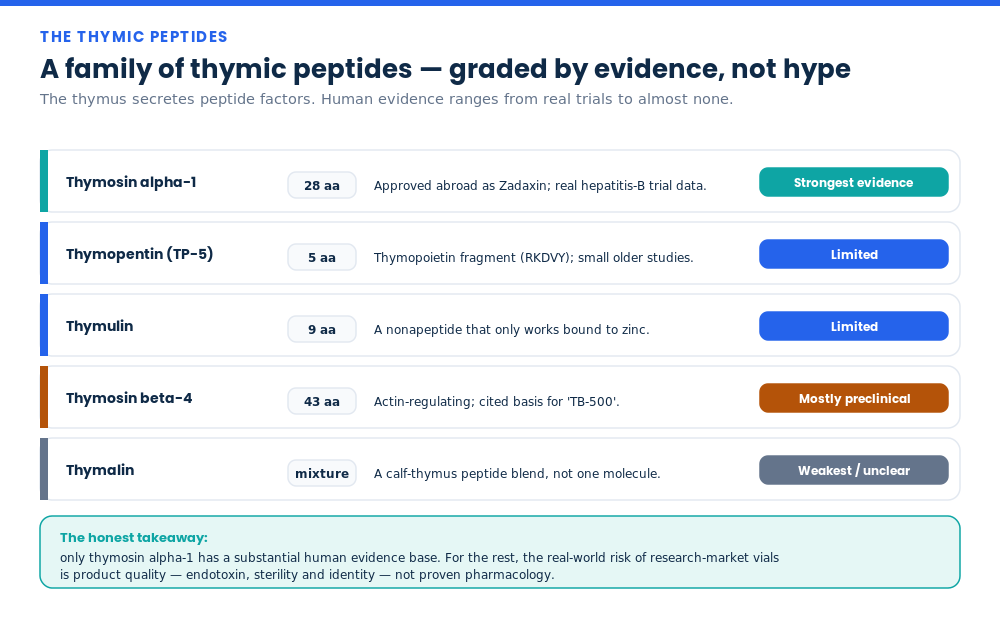
Beyond training cells, the thymus secretes peptide factors, and several named ones are widely discussed:
- Thymosin alpha-1 (thymalfasin) — a 28-amino-acid peptide with the strongest evidence base. It is marketed as Zadaxin and approved in roughly 30 countries (though not in the United States), and has been studied in hepatitis B and as a vaccine adjuvant. VialHelp covers it in the thymosin alpha-1 side-effects guide and the library entry.
- Thymopentin (TP-5) — a five-residue fragment (sequence RKDVY) of the larger protein thymopoietin, studied as an immunomodulator in older, mostly small studies.
- Thymulin — a nine-amino-acid peptide that is only active when bound to zinc; without its zinc, it does nothing. Its evidence is largely preclinical.
- Thymosin beta-4 — a 43-amino-acid peptide whose real job is regulating the cell’s actin skeleton. It is often cited as the basis of the research-market compound “TB-500”, commonly described as a fragment of its actin-binding region — though the identity and purity of anything sold under that name is a research-market claim, not a regulated fact.
- Thymalin — historically a calf-thymus extract, this is a mixture of peptides rather than a single defined molecule, backed by small, largely unreplicated studies.
When the thymus goes wrong
Because the thymus builds the T-cell repertoire, problems there show up in immunity. DiGeorge syndrome (a 22q11.2 deletion) involves failed thymic development and T-cell deficiency. The thymus is also linked to myasthenia gravis, an autoimmune disorder of nerve-muscle signalling: thymic hyperplasia is common, and thymic tumours (thymomas) are associated with the disease — which is why surgical removal of the thymus (thymectomy) is sometimes part of management.
Frequently asked questions
What does the thymus gland actually do?
It trains T cells. Immature cells are tested for the ability to recognise the body’s own molecules (positive selection) and screened out if they attack the body itself (negative selection), producing a self-tolerant immune repertoire.
Why does the thymus shrink with age?
This is called involution. From puberty onward, rising androgen levels are thought to drive the gland to regress, and its tissue is gradually replaced by fat, reducing output over time.
Is TB-500 the same as thymosin beta-4?
They are related but not identical. Thymosin beta-4 is a natural 43-amino-acid peptide; “TB-500” is a research-market product commonly described as a fragment of its actin-binding region. Product identity and purity under that name are not regulated, so claims should be treated cautiously.
Are thymic peptides proven to work?
Mostly no. Thymosin alpha-1 has real trial data and is approved in some countries, but thymopentin, thymulin, thymosin beta-4 and thymalin rest on limited, older or preclinical evidence.
References
- Anatomy, Head and Neck, Thymus. StatPearls (NBK539748). ncbi.nlm.nih.gov/books/NBK539748
- PubChem: Thymalfasin (thymosin alpha-1), CID 16130571. pubchem.ncbi.nlm.nih.gov/compound/16130571
- PubChem: Thymosin beta-4, CID 45382195. pubchem.ncbi.nlm.nih.gov/compound/45382195
- DrugBank: Thymalfasin (DB04900). go.drugbank.com/drugs/DB04900
- Dominari A, et al. Thymosin alpha 1: a comprehensive review. World J Virol 2020 (PMC7747025). ncbi.nlm.nih.gov/pmc/articles/PMC7747025
- Interactions Between Zinc and Thymulin (PMC2364880). ncbi.nlm.nih.gov/pmc/articles/PMC2364880
Informational only — not medical advice · 21+