
CGRP Explained: The Migraine Peptide and the Drugs That Block It
Guides · Peptide biology
CGRP is the peptide that turned migraine treatment upside down, and it did it by being blocked rather than given. Calcitonin gene-related peptide is a 37-amino-acid messenger released from sensory nerve endings, including the trigeminal nerves that wrap the blood vessels of the head. Infuse it into someone prone to migraine and you can trigger an attack. Take it out of circulation, or block the receptor it lands on, and you have eight approved drugs. For a site about peptides, it is the most instructive story in the field: a peptide that became a blockbuster drug target without a single one of those drugs being the peptide itself.
Where the name comes from
The clumsy name is a historical fossil, and it is worth unpacking because it explains the biology. In 1982, Amara, Rosenfeld and colleagues reported in Nature that transcripts of the calcitonin gene are processed differently in different tissues. In thyroid C cells the result is calcitonin, a hormone involved in calcium handling. In nerve cells the same gene yields something else entirely: a peptide they called calcitonin gene-related peptide. One gene, two products, decided by how the transcript is spliced.

There is a second gene, CALCB, which produces only beta-CGRP and never calcitonin; it is expressed mainly in the nervous system of the gut. The two isoforms differ at just three positions. Structurally, CGRP carries a disulfide bridge between the cysteines at positions 2 and 7, forming a small ring at the front end, and its terminal phenylalanine is capped with an amide. Both features are required for it to bind — a good illustration of why how a peptide is processed matters as much as its sequence.
Its best-known property was reported three years after its discovery: in 1985, Brain and colleagues showed in Nature that CGRP is a potent vasodilator, widening microvessels at femtomole doses and producing persistent local reddening in human skin. Reviews routinely place it among the most potent vessel-widening signals the body makes.
The receptor takes two proteins to exist
This is where CGRP stops behaving like a textbook peptide. Most peptides bind a single receptor protein. The CGRP receptor is a partnership: the calcitonin receptor-like receptor (CLR, from the gene CALCRL) does nothing useful for CGRP on its own. It has to be escorted to the surface and reshaped by a small accessory protein called RAMP1 — a receptor activity-modifying protein — with a third component, RCP, working on the inside of the cell to couple the complex to its G protein.
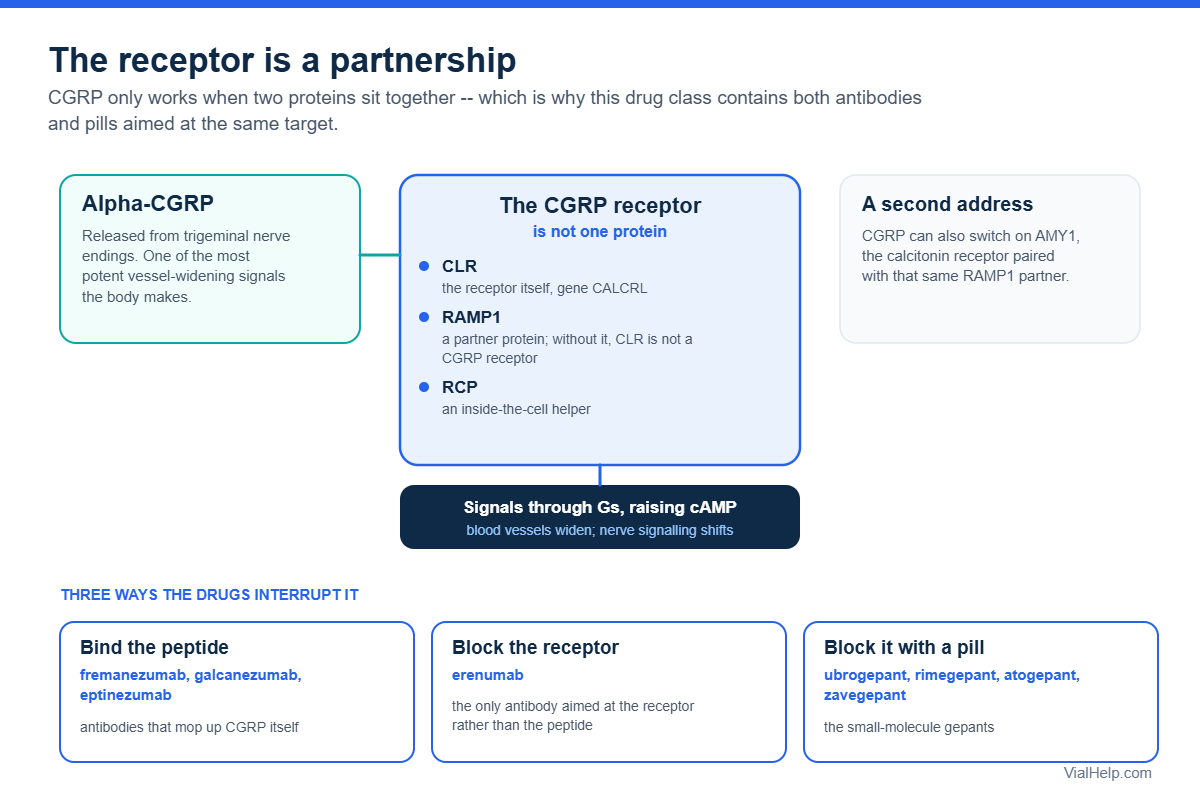
Once assembled, the complex signals principally through Gs, raising cyclic AMP — one of the classic second messengers. The same trick works elsewhere: pair the calcitonin receptor with RAMP1 instead and you get the AMY1 receptor, which CGRP can also potently activate. That overlap is real and acknowledged in the international pharmacology nomenclature, and it is a reminder that receptor selectivity in this family is a matter of which accessory protein is present, not just which peptide arrives.
The evidence that links CGRP to migraine
The chain is unusually complete, and it was built over about twelve years.
- It rises during attacks. In 1990, Goadsby, Edvinsson and Ekman sampled blood from the external jugular vein of patients during migraine headache and measured several vasoactive peptides by radioimmunoassay. CGRP stood out.
- Treatment brings it down. In 1993 the same group reported that in patients responding to subcutaneous sumatriptan, the elevated CGRP normalised as the headache resolved.
- Giving it triggers attacks. The decisive study came in 2002. Lassen and colleagues infused human alpha-CGRP intravenously in a double-blind crossover design in patients with migraine without aura. Over the following eleven hours, every patient developed headache after CGRP against one after placebo, and in three patients the delayed headache met formal diagnostic criteria for migraine without aura. The paper was titled, plainly, “CGRP may play a causative role in migraine.”
CGRP is not the only peptide in this neighbourhood. It sits alongside substance P and the tachykinins in sensory neurons, and like them it is cleared by peptidases — a general problem covered in our piece on peptide degradation.
The drugs: four antibodies and four pills
Eight approved drugs now target this single pathway, and they split into two mechanisms and two purposes.
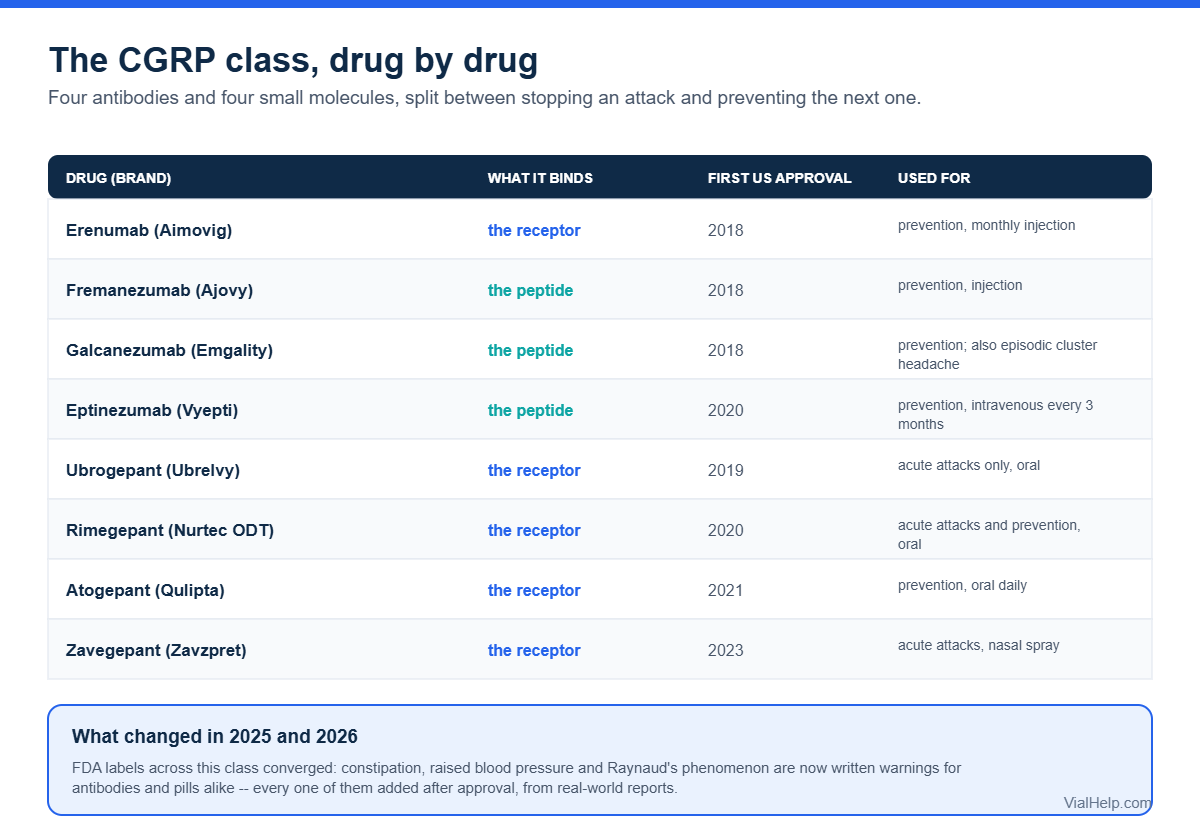
Three of the antibodies — fremanezumab (Ajovy), galcanezumab (Emgality) and eptinezumab (Vyepti) — bind the peptide itself, mopping up CGRP before it reaches anything. Erenumab (Aimovig) is the outlier: it is an antibody against the receptor. All four are approved for prevention rather than for stopping an attack in progress, and eptinezumab is the only intravenous one. Galcanezumab additionally carries an approval for episodic cluster headache.
The four small molecules, known as gepants, all block the receptor. Ubrogepant (Ubrelvy) and zavegepant (Zavzpret, a nasal spray) are for acute attacks only; atogepant (Qulipta) is for prevention; rimegepant (Nurtec ODT) is approved for both. In 2024 the American Headache Society issued a position statement that CGRP-targeting therapies should be considered a first-line option for migraine prevention, without requiring that other preventive classes be tried and fail first.
What the labels say about safety — and how that changed
This is the part most summaries skip, and it is genuinely interesting because it is a live example of how drug safety knowledge accumulates after approval rather than before it.
When erenumab was first approved in 2018, its label listed no contraindications and carried neither a constipation nor a hypertension warning. Today it carries a contraindication for serious hypersensitivity and named warnings for constipation with serious complications, hypertension, and Raynaud’s phenomenon. Constipation is one of only two adverse reactions common enough to be listed on the label, reported in 3 percent of patients at the higher dose against 1 percent on placebo.
Across 2025 and 2026 the same warnings spread across the class. Hypertension and Raynaud’s phenomenon were added to the gepant labels in March 2025; a Raynaud’s warning was added to erenumab in the same month; constipation warnings were added to galcanezumab and eptinezumab in June 2026, with the eptinezumab label describing it as a class effect reported after marketing. Injection-site reactions remain the most common adverse reaction for the injected antibodies.
Why CGRP belongs on a peptide site
Most peptide stories are about supplying something: a hormone analogue, a growth factor, a replacement signal. CGRP is the opposite, and it is worth sitting with. The target is an endogenous peptide, the strategy is subtraction, and the resulting drugs are an antibody against the peptide, an antibody against the receptor, and small molecules against the same receptor — three tools for one pathway, each with different dosing, different duration, and different label warnings. If you want the general framing, see peptides versus small-molecule drugs and agonists versus antagonists.
Frequently asked questions
Is CGRP a peptide you can buy or inject?
No approved product contains CGRP. The peptide has been given intravenously in research settings — that is how the causative link to migraine was demonstrated — but every approved drug in this area works by removing or blocking CGRP, not supplying it. Giving it to a migraine-prone person is, by demonstration, a way to trigger an attack.
What is the difference between a gepant and an anti-CGRP antibody?
Gepants are small molecules taken by mouth or as a nasal spray, and they block the receptor. The antibodies are large proteins given by injection or infusion; three bind the peptide and one, erenumab, binds the receptor. The practical differences follow from size: the antibodies last for weeks to months and are used for prevention, while the gepants act quickly and several are used to stop an attack in progress.
Why does the CGRP receptor need RAMP1?
On its own, CLR is not a functional CGRP receptor. RAMP1 escorts it to the cell surface and shapes the binding site so that CGRP is recognised. Pair the same RAMP1 with a different partner, the calcitonin receptor, and you get the AMY1 receptor instead — which is why the same peptide can act at more than one address.
Does blocking CGRP cause problems because it is a vasodilator?
This was a reasonable concern from the start, and it is the likeliest explanation for the hypertension and Raynaud’s warnings that regulators have added across the class since 2025. What the labels establish is that these effects occur and are considered worth warning about. Whether and how they apply to any individual is a clinical question, not one this article can answer.
References
- Amara SG, et al. Alternative RNA processing in calcitonin gene expression generates mRNAs encoding different polypeptide products. Nature 1982;298:240-244.
- Brain SD, et al. Calcitonin gene-related peptide is a potent vasodilator. Nature 1985;313:54-56.
- Lassen LH, et al. CGRP may play a causative role in migraine. Cephalalgia 2002;22:54-61.
- CGRP receptor — Calcitonin receptors, IUPHAR/BPS Guide to Pharmacology.
- AIMOVIG (erenumab-aooe) injection — FDA prescribing information, DailyMed.
- NURTEC ODT (rimegepant) orally disintegrating tablets — FDA prescribing information, DailyMed.
- Ho TW, et al. Randomized controlled trial of the CGRP receptor antagonist telcagepant for migraine prevention. Neurology 2014.
Informational only. This article is educational and is not medical advice. It does not recommend or instruct personal human use. Consult a qualified healthcare professional for any health decision. Content is intended for adults 21+. Verify scientific details against the primary sources cited.