
Orexin (Hypocretin) Explained: The Peptide That Keeps You Awake
Guides · Peptide biology
Orexin is the peptide that holds wakefulness together, and it is one of the very few molecules in biology to have been discovered twice within six weeks. In January and February of 1998, two laboratories that did not know about each other arrived at the same small hypothalamic peptide from completely opposite directions, gave it two different names, and neither name has been retired since. Within eighteen months, the peptide had explained narcolepsy. Within thirty years, it had produced both a class of sleeping pills and, in August 2026, the first drug aimed at the cause of narcolepsy type 1 rather than its symptoms.
Two laboratories, two names, one peptide
Luis de Lecea and colleagues published first, in the Proceedings of the National Academy of Sciences in January 1998. Their method was a fishing expedition: hunt for messenger RNAs made only in the hypothalamus and then work out what the resulting proteins did. They found a precursor that produced two peptides sharing a run of identical residues with the gut hormone secretin, and on that basis they placed the new peptides in the incretin family. The name they chose, hypocretin, was built from hypothalamic and incretin — a detail that most popular accounts get subtly wrong by describing it as hypothalamus plus secretin.
Six weeks later, in Cell, Takeshi Sakurai, Masashi Yanagisawa and colleagues arrived from the other end. They had two orphan G protein-coupled receptors with no known ligand, and they worked backwards to find what switched them on. When they injected the peptide into rat brains, the rats ate more; when the rats were fasted, the messenger RNA for the precursor went up. They named it orexin, after the Greek word for appetite.
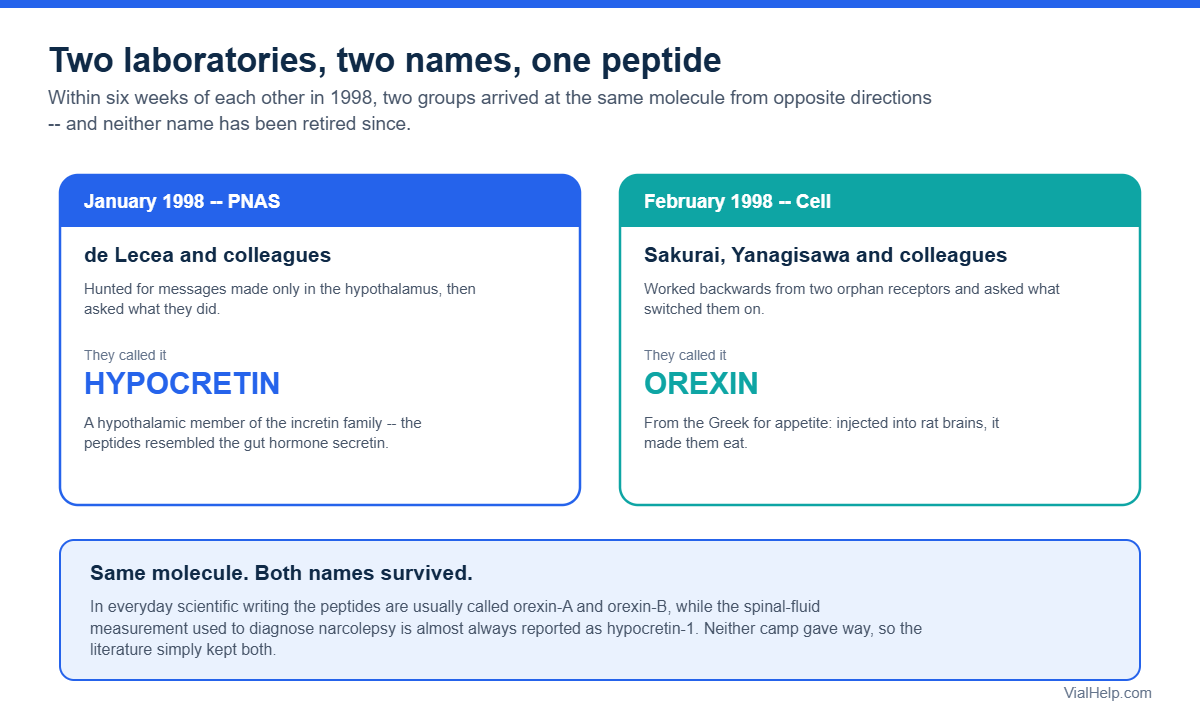
The compromise the field settled into is quietly practical. In everyday writing the peptides are usually called orexin-A and orexin-B, while the spinal-fluid measurement used to diagnose narcolepsy is almost always reported as hypocretin-1. A 2015 note in Lancet Neurology was titled, simply, “Orexin or hypocretin?”
What orexin is, chemically
The HCRT gene encodes a 131-amino-acid precursor called prepro-orexin. After the signal sequence is removed, the remainder is cut into two mature peptides:
- Orexin-A (hypocretin-1) — 33 amino acids, with a pyroglutamate cap at the front end, an amide cap at the tail, and two internal disulfide bridges holding the chain in shape. That structure is completely conserved in every mammal examined so far, from mouse to dolphin.
- Orexin-B (hypocretin-2) — 28 amino acids, amidated at the tail, and linear: no disulfide bonds are annotated. Unlike orexin-A it does vary slightly between species.
Two receptors read these signals: OX1 (gene HCRTR1) and OX2 (gene HCRTR2), both class A, rhodopsin-like G protein-coupled receptors. Orexin-A is roughly equipotent at both; orexin-B strongly prefers OX2. The receptors are usually described as coupling through Gq/G11, though the international pharmacology nomenclature committee flags that assignment as partly inferred rather than settled, and notes that for most native responses the G protein involved is simply unknown.
The cells themselves are startlingly few. They sit in the lateral and posterior hypothalamus and project widely — to the locus coeruleus, the raphe nuclei, the tuberomammillary nucleus, the basal forebrain and the medial thalamus. In the one published human study that counted them directly by unbiased stereology, nine neurologically normal brains contained between roughly 50,000 and 83,000 orexin neurons. For a system that governs whether you are conscious, that is a very small committee.
What orexin actually does
The name records what was seen first, not what turned out to matter most. By 2007, Sakurai himself was describing orexins in Nature Reviews Neuroscience as crucial regulators of sleep and wakefulness, acting on wake-active monoaminergic and cholinergic neurons to maintain a long, consolidated period of being awake. Feeding, reward, autonomic tone and stress responses are all genuinely on the list, but wake stabilisation leads it.
The clearest way to picture the job is the flip-flop switch model. Sleep-promoting and wake-promoting cell groups inhibit each other, which produces sharp transitions rather than a slow dimmer. Orexin does not sit at either pole; it stabilises the switch so it does not flutter. That distinction matters, because it explains a fact about narcolepsy that surprises most people: total daily sleep is roughly normal. What breaks is stability — wakefulness leaks into sleep and sleep leaks into wakefulness.
Narcolepsy: one pathway, broken three different ways
The evidence linking orexin to narcolepsy is unusually clean, because three species lost three different parts of the same system and all ended up with the same disease.
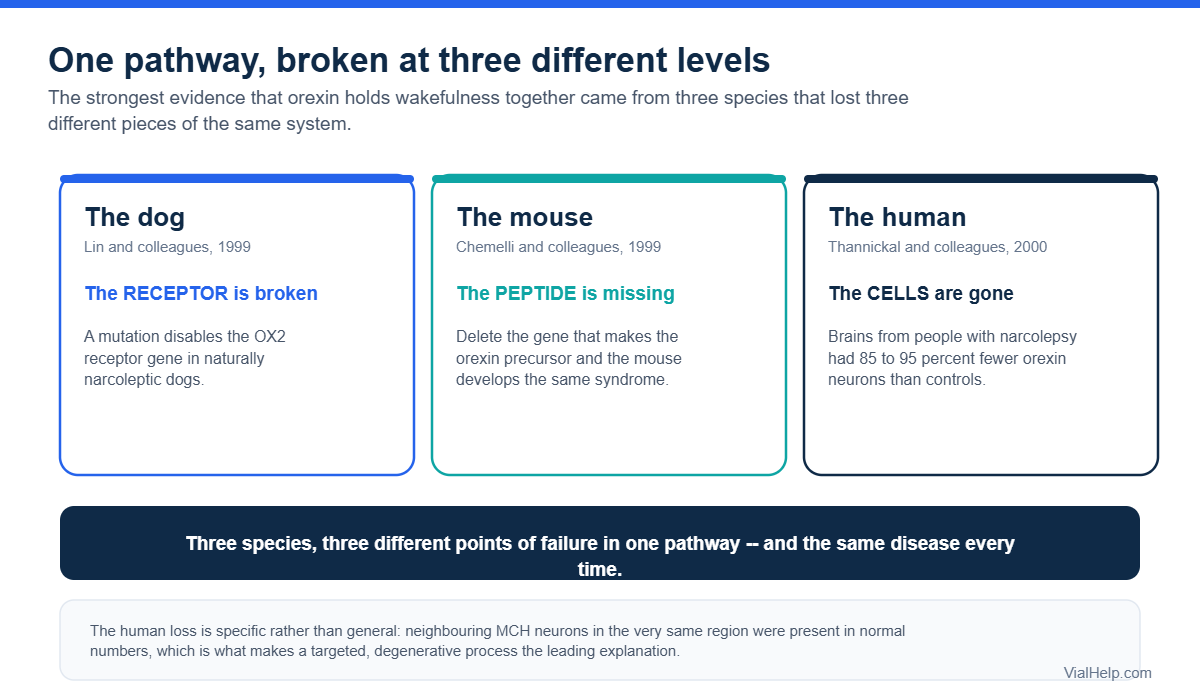
In 1999, Lin and colleagues showed that naturally narcoleptic dogs carry a mutation disabling the OX2 receptor gene. Weeks later, Chemelli and colleagues showed that deleting the gene for the orexin precursor in mice reproduced the same syndrome. In 2000, Thannickal and colleagues examined human brains and found that people with narcolepsy had 85 to 95 percent fewer orexin neurons than controls. Critically, the neighbouring MCH neurons in the very same region were present in normal numbers, so this was not general shrinkage of the hypothalamus but a targeted loss, accompanied by the astrocyte changes that usually mark a degenerative process.
That is why the diagnostic criteria are written the way they are. Narcolepsy type 1 can be confirmed either by cataplexy plus sleep-study findings, or by a cerebrospinal fluid hypocretin-1 concentration of 110 pg/mL or less — or below one third of the mean value for normal subjects measured by the same standardised assay. That second clause gets dropped constantly in secondary summaries, and it matters, because the assay is not standardised between laboratories.
The Pandemrix episode, stated carefully
Any honest account of orexin has to mention this, and it is easy to get wrong in either direction. Pandemrix, an AS03-adjuvanted H1N1 influenza vaccine, was authorised in the European Union in September 2009, and at least 30.8 million people in the EU were vaccinated with it. Data from some EU countries subsequently showed an increased risk of narcolepsy in children and adolescents; a similar risk elsewhere was, in the regulator’s words, not confirmed but not ruled out. In 2011 the European Medicines Agency restricted its use in people under 20. In October 2012, after reviewing Finnish immunological research, the agency concluded the data were preliminary, raised no new concerns, and stated that the role of the vaccine antigen and its adjuvant in the association remained unknown.
So: an epidemiological association was observed and acted on, and the mechanism was never established. This concerned one specific adjuvanted vaccine, which was never licensed in the United States, and not influenza vaccines in general.
The drugs: block it, or restore it
Because orexin holds wakefulness on, the pharmacology runs in two opposite directions, and both directions now have approved products.
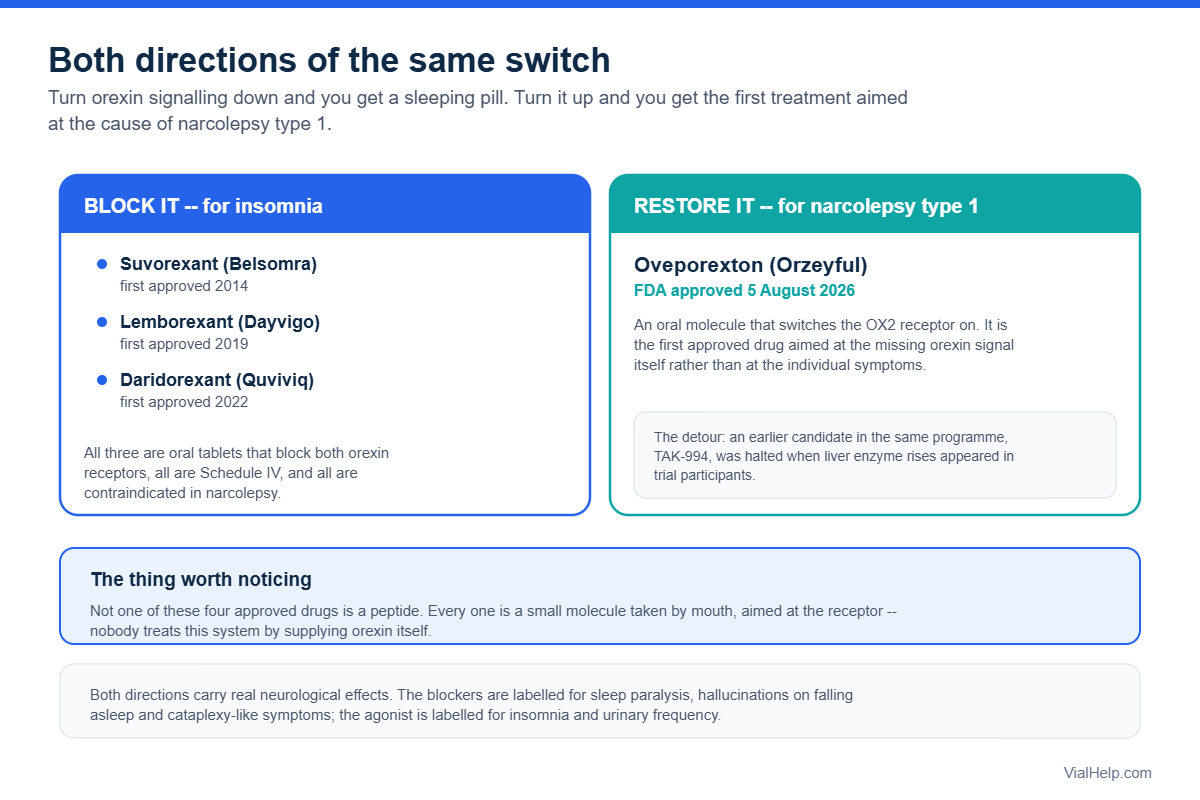
Blocking the receptors produces sleep. Three dual orexin receptor antagonists are approved for insomnia: suvorexant (Belsomra, first approved 2014), lemborexant (Dayvigo, 2019) and daridorexant (Quviviq, 2022). All three are oral tablets, all are Schedule IV controlled substances, and all are contraindicated in narcolepsy for the obvious reason. Their labels carry warnings for next-day impairment, complex sleep behaviours, and — tellingly — sleep paralysis, hallucinations on falling asleep, and cataplexy-like symptoms. Suvorexant produced cataplexy-like behaviour in dogs during development. You are, in effect, inducing a temporary and reversible version of the disease.
Restoring the signal treats the disease. On 5 August 2026 the FDA approved oveporexton (Orzeyful), an oral OX2 receptor agonist, for narcolepsy type 1 in adults — the first drug aimed at the missing orexin signal itself rather than at individual symptoms. The FDA puts narcolepsy type 1 at roughly one person in 2,000 in the United States. The path was not smooth: an earlier candidate in the same programme, TAK-994, was halted when liver enzyme elevations appeared in trial participants, a signal now thought to reflect reactive metabolites rather than anything intrinsic to switching the receptor on. Oveporexton’s own label carries warnings for insomnia and for urinary frequency and urgency, both reported far more often than on placebo, along with asymptomatic creatine kinase elevations.
Is orexin something people inject?
No, and the reasons are worth spelling out. There is no approved injectable orexin product anywhere in the world. The human data on giving the peptide directly amount to small experimental studies — a pilot in eight people with narcolepsy using a single intranasal dose, plus work in sleep-deprived monkeys — whose authors framed them as grounds for further study, not as treatment.
One common argument against injecting it is actually wrong, and it is worth correcting. Orexin-A does cross from blood into brain, rapidly and largely intact, by simple diffusion; orexin-B does not. So the barrier is not the reason. The reason is that a decade of development, one programme terminated for liver injury, and an eventual oral small molecule is what it actually took to move this system safely — and that both directions of manipulation produce real neurological effects, which is exactly why every approved drug here carries the warnings it does. If you are curious about the general question, see whether peptides can cross the blood-brain barrier.
Frequently asked questions
Is orexin the same thing as hypocretin?
Yes. They are two names for the same peptides, coined independently in 1998 by two laboratories working from opposite directions. Neither name won, so both survive. In practice you will see orexin-A and orexin-B for the peptides and hypocretin-1 for the spinal-fluid measurement.
Does orexin control appetite?
It influences feeding, and that is where its name came from — injecting it into rat brains increased food intake, and fasting increased production of its precursor. But the role that dominates the modern literature is stabilising wakefulness. Feeding is better understood today as part of a broader arousal and motivation function rather than as the peptide’s main job. For the peptides that genuinely sit at the centre of appetite regulation, see ghrelin and leptin.
What does a low hypocretin-1 level in spinal fluid mean?
A cerebrospinal fluid hypocretin-1 level at or below 110 pg/mL, or below one third of the mean for normal subjects on the same standardised assay, is one of the two accepted ways to confirm narcolepsy type 1. It reflects loss of the neurons that make the peptide. Interpreting it is a clinical matter, not a self-testing one, partly because the assay is not standardised across laboratories.
Are orexin peptides sold for research or personal use?
There is no approved orexin product in injectable form, and the human evidence base for administering the peptide consists of a handful of small experimental intranasal studies. The therapies that reached approval are oral small molecules acting on the receptors, not the peptide itself.
References
- de Lecea L, et al. The hypocretins: hypothalamus-specific peptides with neuroexcitatory activity. PNAS 1998;95:322-327.
- Sakurai T, et al. Orexins and orexin receptors: a family of hypothalamic neuropeptides and G protein-coupled receptors that regulate feeding behavior. Cell 1998;92:573-585.
- Orexin receptors. IUPHAR/BPS Guide to Pharmacology (NC-IUPHAR Subcommittee on Orexin Receptors).
- Thannickal TC, et al. Reduced number of hypocretin neurons in human narcolepsy. Neuron 2000;27:469-474.
- BELSOMRA (suvorexant) tablets, C-IV — FDA prescribing information, DailyMed.
- FDA approves first drug to treat the full range of narcolepsy type 1 symptoms (oveporexton), 5 August 2026.
- European Medicines Agency reviews hypothesis on Pandemrix and development of narcolepsy.
Informational only. This article is educational and is not medical advice. It does not recommend or instruct personal human use. Consult a qualified healthcare professional for any health decision. Content is intended for adults 21+. Verify scientific details against the primary sources cited.