
Endogenous Opioid Peptides: Endorphins, Enkephalins, and Dynorphins
Peptide biology
Long before anyone isolated morphine from a poppy, the human body was making its own opioids. These endogenous opioid peptides — the endorphins, enkephalins and dynorphins — are short chains of amino acids that dial pain, stress and reward up and down by acting on the very same receptors that opioid drugs target.

What are endogenous opioid peptides?
They are signalling peptides that your own cells produce and that bind opioid receptors. The classical members come from three separate precursor proteins, each sliced by enzymes into a family of active peptides. A striking feature ties them together: every classical opioid peptide begins with the same four-amino-acid “address,” Tyr-Gly-Gly-Phe (YGGF), and the leading tyrosine is essential for binding. The two smallest members, the enkephalins, are just five residues long: Met-enkephalin (Tyr-Gly-Gly-Phe-Met) and Leu-enkephalin (Tyr-Gly-Gly-Phe-Leu).
The three families (and one cousin)
Proopiomelanocortin (POMC) is cut into beta-endorphin, a long and potent opioid that also circulates as a blood-borne hormone. Notably, POMC is the same precursor that yields ACTH, the hormone that drives cortisol release — so the opioid system and the stress (HPA) axis literally share one parent molecule. Proenkephalin (PENK) yields the two enkephalins. Prodynorphin (PDYN) yields the dynorphins and neo-endorphins. A related “cousin,” nociceptin (from the PNOC gene), begins with Phe instead of Tyr — a single swap that keeps it off the classical opioid receptors and onto its own receptor, NOP.
The receptors: mu, delta and kappa
Opioid peptides act through three classical receptors — mu (MOR), delta (DOR) and kappa (KOR), plus the related NOP. All are class A G-protein-coupled receptors wired to inhibitory Gi/Go proteins: they lower cAMP, open potassium channels and close calcium channels, which quiets the neuron and reduces neurotransmitter release. Different peptides prefer different subtypes.
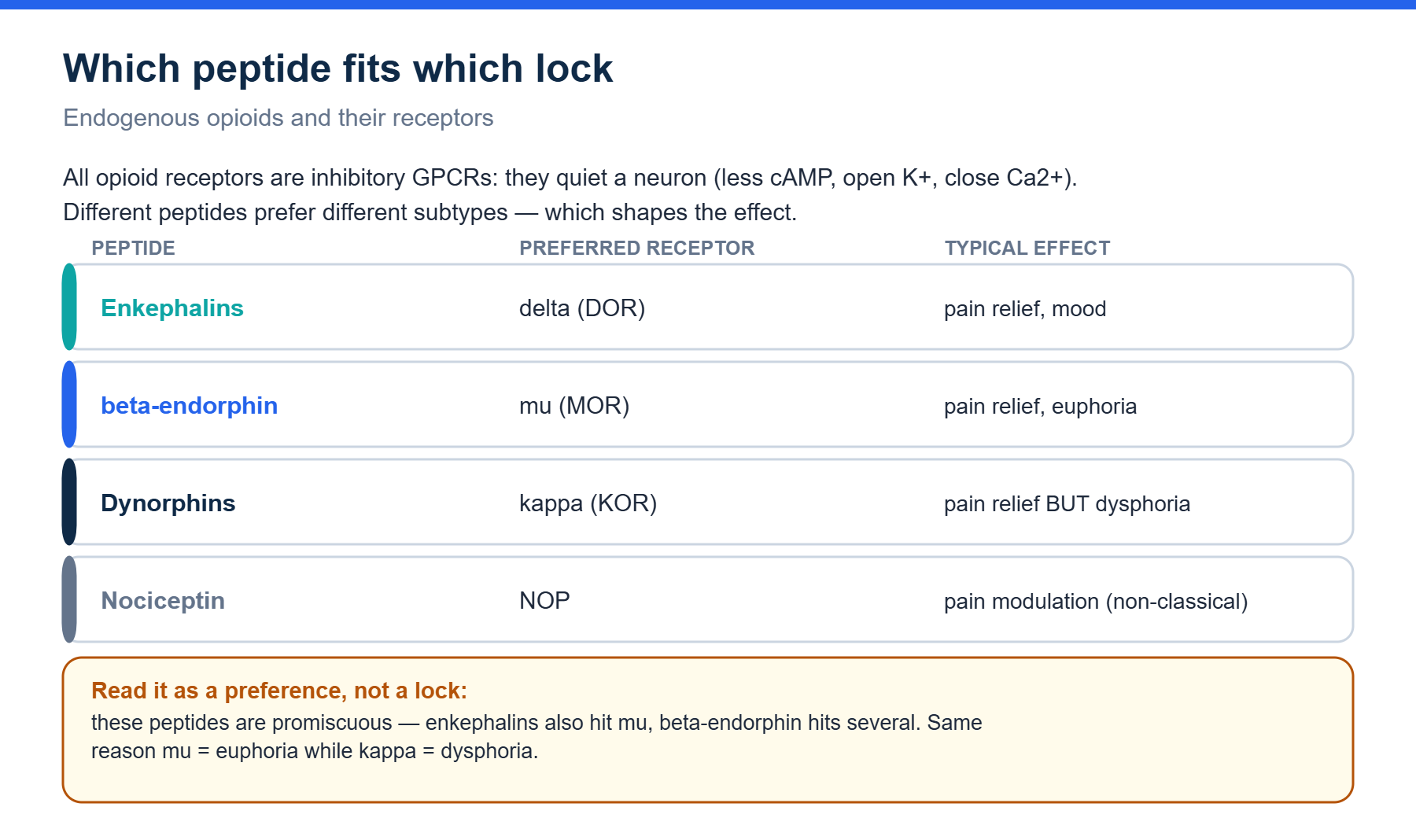
As a rough guide, enkephalins favour delta, beta-endorphin favours mu (and hits delta), and dynorphins favour kappa. These are preferences, not locks — the peptides are promiscuous and overlap. The receptor a peptide hits shapes the experience: mu activation tends toward pain relief and euphoria, whereas kappa activation relieves pain but produces dysphoria — a genuinely unpleasant, stress-linked feeling that is a hot topic in depression research.
What they do
The endogenous opioid system modulates pain at both the spinal cord and the brain, tunes the stress response, and feeds into reward and mood through the brain’s dopamine circuits. The kappa/dynorphin arm is the system’s “dark side,” pushing in the opposite, dysphoric direction. Other effects — on breathing, gut motility, and immune signalling — mirror what exogenous opioids do, because they share the same receptors.
The “runner’s high” — not just endorphins
The popular story credits endorphins for the euphoria of a long run. It is only half right. Human brain-imaging work (Boecker and colleagues, 2008) does show opioids released in mood-related brain regions after prolonged running, tracking the euphoria. But blood endorphins are large peptides that do not readily cross into the brain, and controlled studies point to a second player.
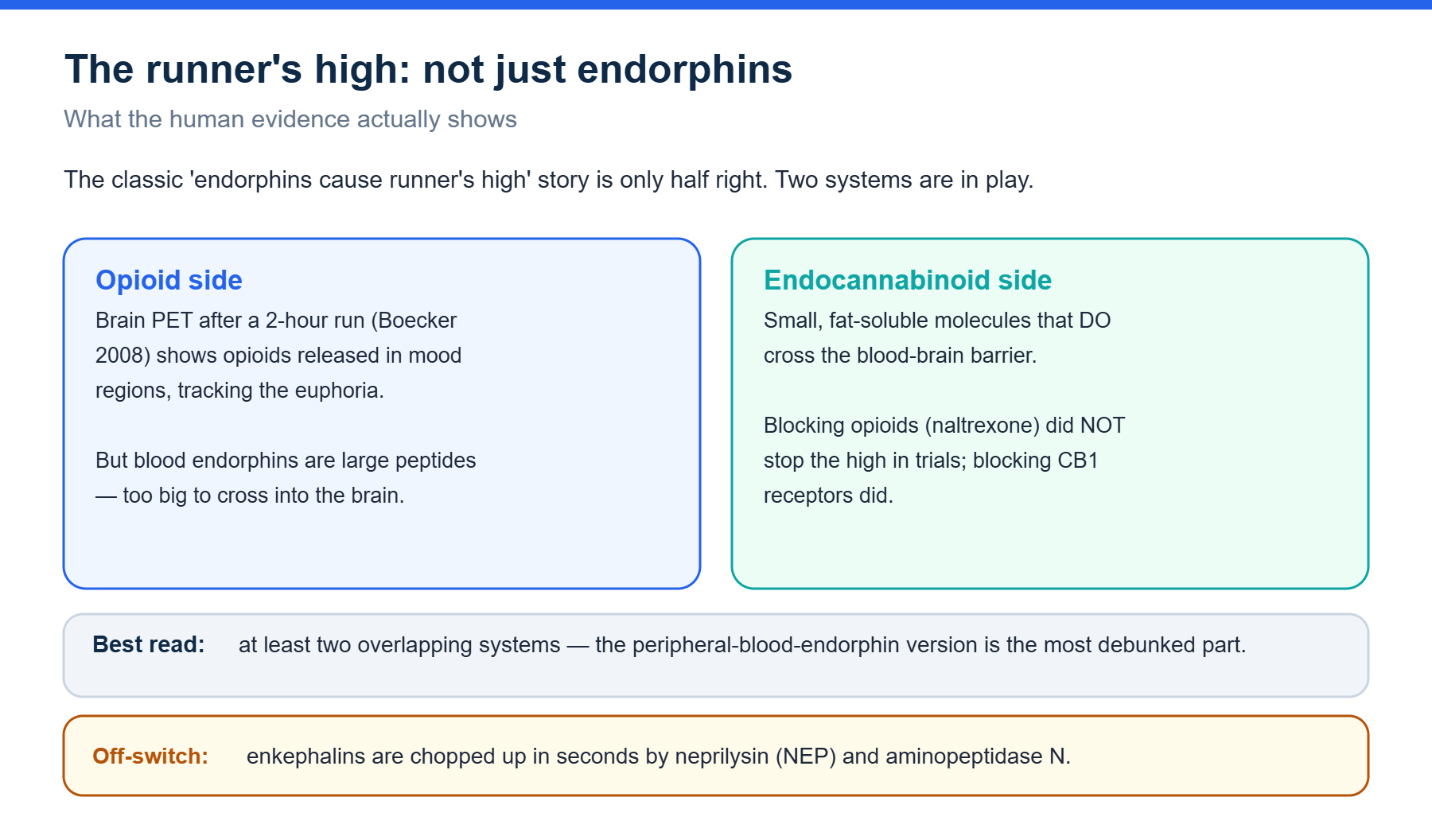
Endocannabinoids are small, fat-soluble molecules that cross the blood-brain barrier easily. In blockade experiments, blocking opioid receptors did not prevent the post-run mood lift, whereas blocking cannabinoid CB1 receptors did. The fair conclusion is that at least two overlapping systems are involved, and the peripheral-blood-endorphin version of the story is the most debunked part.
How the body switches them off
Endogenous opioid peptides are short-lived by design. Enkephalins are chopped up within seconds by peptidases, including neprilysin (historically nicknamed “enkephalinase”) and aminopeptidase N. That is why one research strategy is not to inject the peptides at all but to inhibit the enzymes that destroy them, raising local enkephalin levels where they are already being released.
Endogenous versus exogenous opioids
Morphine, heroin and fentanyl bind the same receptors as your own opioid peptides, which is why antagonists such as naloxone and naltrexone — molecules that block those receptors — can reverse or blunt opioid effects and reveal the tone of the body’s own system. The endogenous peptides themselves are not oral drugs: as peptides they are degraded quickly and do not efficiently cross the blood-brain barrier, which is exactly why research aims at peptidase inhibitors or small-molecule receptor drugs instead.
A note on “research” opioid peptides
Two clarifications worth making. DSIP (delta-sleep-inducing peptide), often lumped in with this group, is not an opioid and does not bind opioid receptors. Dermorphin is a genuine mu-opioid peptide, but it comes from frog skin and is not human or endogenous. For any peptide circulating in “research” channels, human evidence is thin — this article is educational and offers no doses or protocols. If you are reconstituting a lyophilized research peptide, our reconstitution calculator handles the concentration math.
Frequently asked questions
Are endorphins and enkephalins the same thing?
No. Both are endogenous opioid peptides that share the YGGF opener, but they come from different precursor genes: beta-endorphin from POMC, and the enkephalins from proenkephalin.
Do endorphins cause the runner’s high?
Partly. Brain imaging shows real opioid activity, but blood endorphins do not cross into the brain well, and endocannabinoids appear necessary for the mood effect. It is best seen as more than one system.
Why can’t you take these peptides as a pill?
They are broken down within seconds by peptidases and do not cross the blood-brain barrier efficiently, so swallowing or injecting the native peptides is not a practical drug strategy.
What is the difference between mu and kappa effects?
Mu-receptor activation leans toward pain relief and euphoria; kappa-receptor activation also relieves pain but tends to produce dysphoria, an unpleasant, stress-associated state.
- Biochemistry, Endogenous Opioids. StatPearls (NBK532899)
- Physiology, Opioid Receptor. StatPearls (NBK546642)
- IUPHAR/BPS Guide to Pharmacology — Opioid receptors
- Boecker H, et al. The Runner’s High. Cerebral Cortex 2008
- Siebers M, et al. Do Endocannabinoids Cause the Runner’s High? (PMID 35081831)
- Alvarez-Perez B, et al. Dual enkephalinase inhibition. Br J Pharmacol 2023
Informational only — not medical advice · 21+. This article summarizes published science for educational purposes. It is not medical guidance or a recommendation to use any substance. Consult a qualified healthcare professional for medical concerns.