
The HPA Axis: How the Body Controls Cortisol
Hormone biology
The hypothalamic–pituitary–adrenal (HPA) axis is the body’s stress-and-metabolism thermostat — the circuit that sets your cortisol. It shares its three-tier design with the reproductive and thyroid axes, but adds a strong daily rhythm and a fast reaction to stress. It also links neatly to the melanocortin peptides, because the pituitary hormone at its center is carved from the same parent protein.
What the HPA axis is
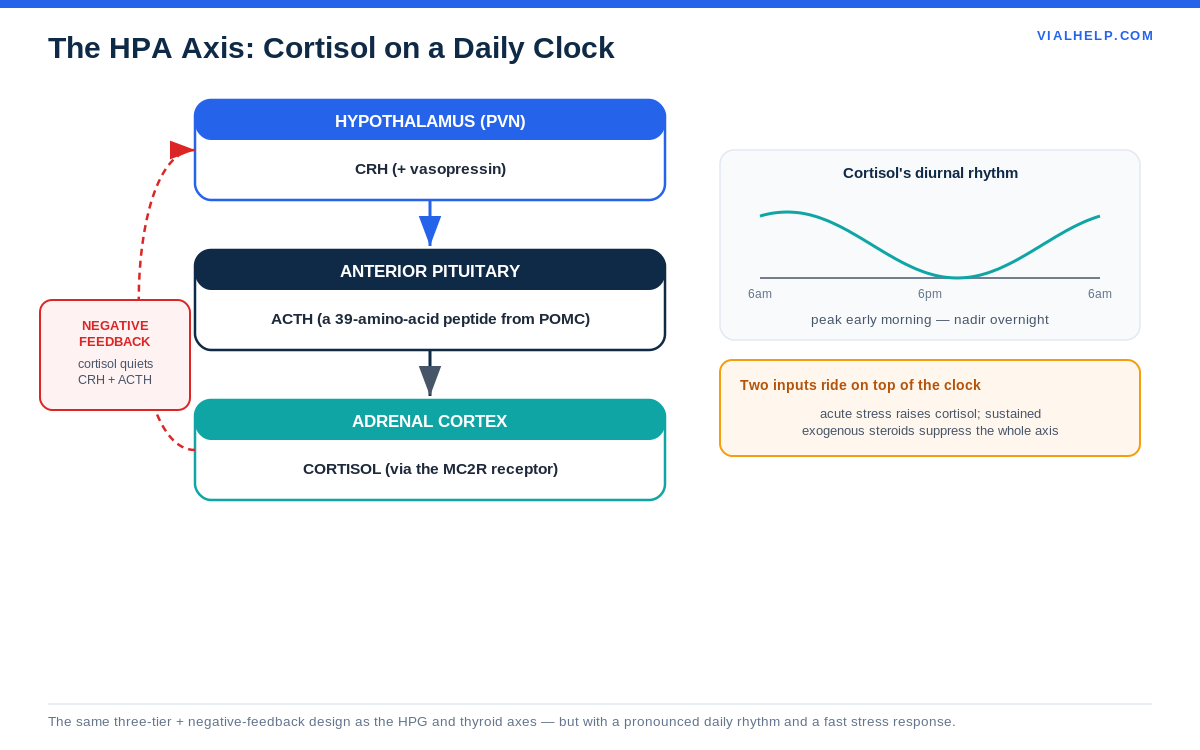
The HPA axis is a three-tier cascade. The hypothalamus (specifically its paraventricular nucleus) releases corticotropin-releasing hormone (CRH), aided by vasopressin. CRH prompts the anterior pituitary to release ACTH (adrenocorticotropic hormone), a 39-amino-acid peptide. ACTH travels to the adrenal cortex, which makes cortisol. Cortisol then feeds back to quiet CRH and ACTH — the same self-correcting design as the GH/IGF-1 axis and the HPG axis, but with a pronounced daily clock layered on top.
From POMC to ACTH: one precursor, many peptides
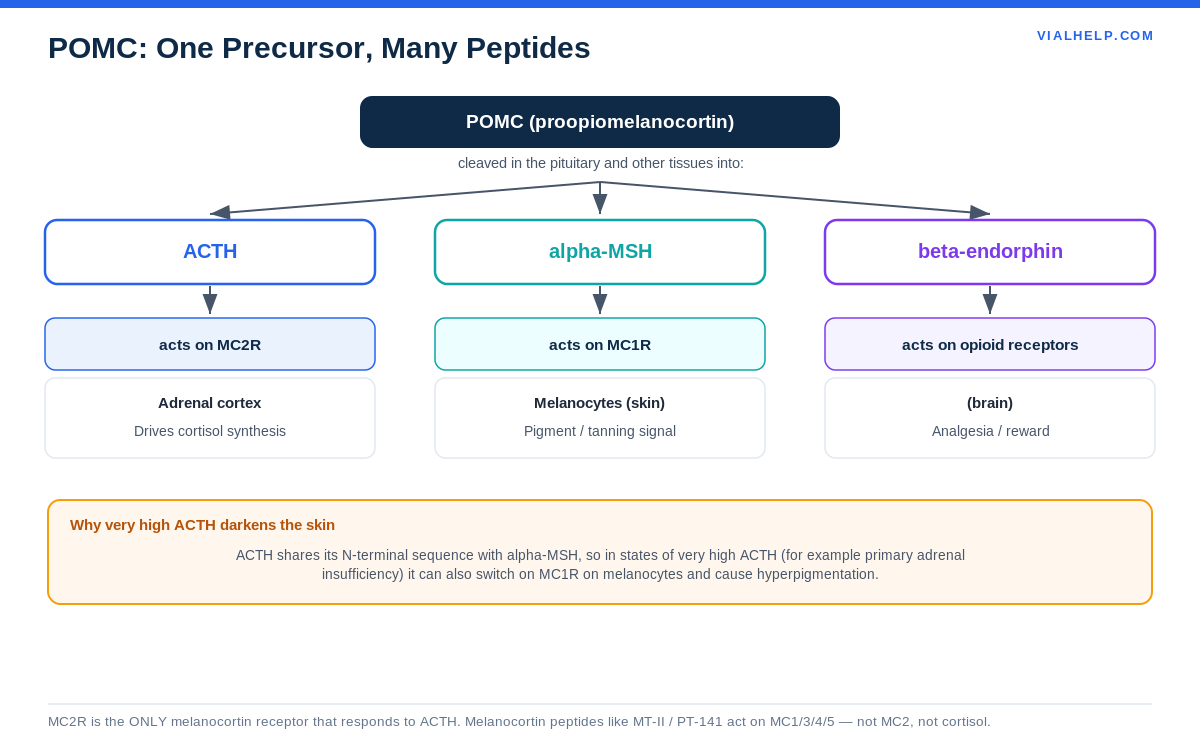
ACTH does not exist as a standalone gene product. It is cut out of a much larger precursor protein called proopiomelanocortin (POMC). Depending on the tissue, POMC is cleaved into a family of peptides — ACTH, the melanocyte-stimulating hormones (MSH), and beta-endorphin among them. In the pituitary corticotrophs the main product is ACTH; elsewhere the same precursor yields the MSH peptides and the endorphins. That shared origin is why the stress axis and the pigment system are chemically related, a point that becomes important below.
What cortisol actually does
Cortisol is often called “the stress hormone,” but that badly undersells it. It is a broad metabolic and regulatory signal:
- Raises blood glucose by driving gluconeogenesis and opposing insulin — making fuel available.
- Dampens inflammation and immune activity (the basis of glucocorticoid drugs).
- Supports blood pressure through a permissive effect — it sensitizes blood vessels to catecholamines.
- Follows a daily rhythm, peaking in the early morning around waking and reaching its low point overnight.
On top of that steady rhythm, acute stress can rapidly raise cortisol. So the axis is really two things at once: a metabolic clock and a stress-response system.
Feedback, and why steroids can’t just be stopped
Cortisol restrains its own axis by inhibiting both CRH and ACTH. This is why prolonged treatment with exogenous glucocorticoids suppresses the axis: the body reads plenty of steroid, cuts its own ACTH, and over time the adrenal cortex can shrink. Stopping such steroids abruptly can leave a suppressed axis unable to make cortisol on demand — which is why they are tapered rather than halted. (This is background physiology, not a treatment instruction.)
MC2R and the melanocortin connection
ACTH does its adrenal job through a specific receptor: MC2R, one of five melanocortin receptors. This is a detail worth getting right, because MC2R is the only melanocortin receptor that responds to ACTH — no MSH peptide activates it.
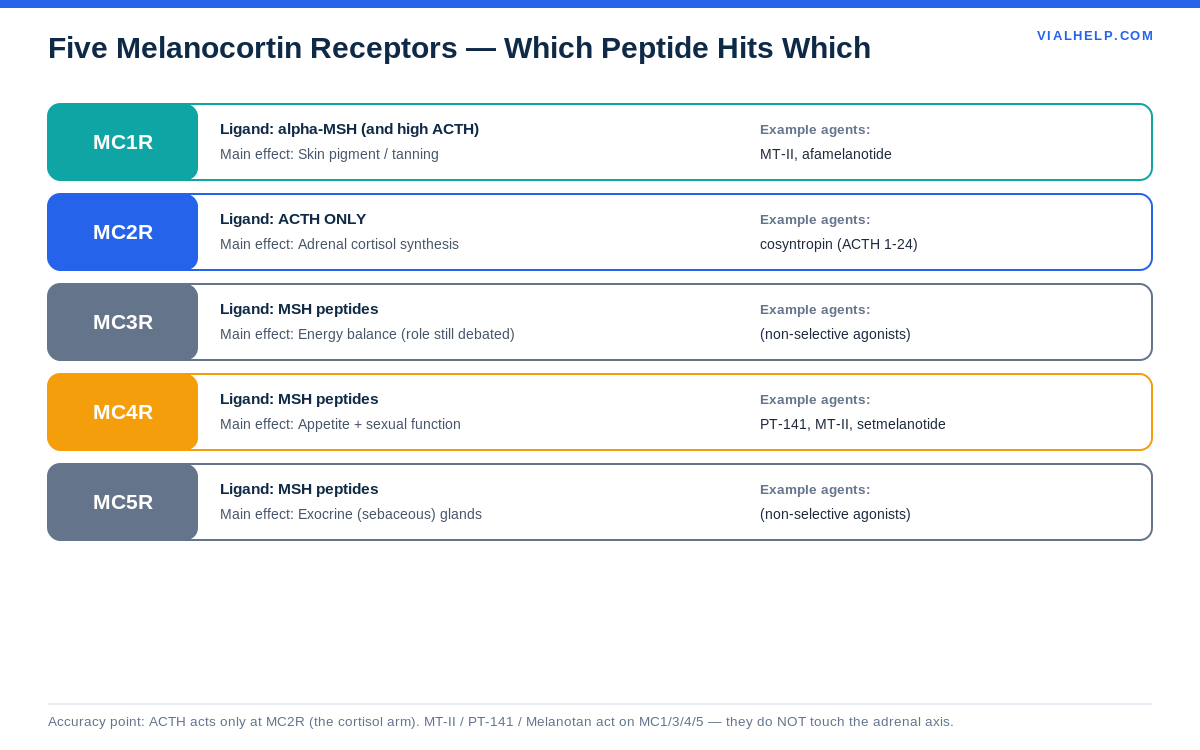
The shared POMC origin has a visible consequence. Because ACTH shares its front-end sequence with alpha-MSH, states of very high ACTH — as in primary adrenal insufficiency — can also switch on MC1R on skin cells and cause hyperpigmentation. It is a neat illustration of one precursor touching two systems.
How the axis is tested
Two classic tests probe the axis from opposite ends. The dexamethasone suppression test gives a potent synthetic glucocorticoid at night and measures whether morning cortisol falls as it should — a failure to suppress points toward autonomous cortisol excess. The ACTH (cosyntropin) stimulation test does the reverse: it gives a synthetic form of ACTH (corresponding to the first 24 amino acids of the hormone) and checks whether the adrenal glands respond by raising cortisol. Too little response suggests adrenal insufficiency. At the extremes lie Cushing syndrome (cortisol excess) and Addison disease (cortisol deficiency).
Frequently asked questions
Is cortisol bad for you?
No — cortisol is essential. It manages fuel, blood pressure and inflammation and follows a healthy daily rhythm. Problems come from too much (Cushing) or too little (Addison), or from disrupting the rhythm, not from cortisol itself.
What is the difference between Cushing syndrome and Cushing disease?
Cushing syndrome is any cause of cortisol excess, including exogenous steroids. Cushing disease is the specific case of a pituitary tumor over-producing ACTH.
Do melanocortin peptides like PT-141 raise cortisol?
No. Cortisol is driven by ACTH acting at MC2R. PT-141 and Melanotan II act on the other melanocortin receptors (MC1/3/4/5) and do not touch the adrenal axis.
Why is high ACTH sometimes linked to darker skin?
Because ACTH shares sequence with alpha-MSH, very high ACTH can also activate MC1R on melanocytes and increase pigment — classically seen in primary adrenal insufficiency.
References
- Yamamoto R, Kaur J. Physiology, Adrenocorticotropic Hormone (ACTH). StatPearls. NBK500031
- Harno E, et al. POMC: the physiological power of hormone processing. Physiol Rev. 2018;98(4):2381–2430. PMC6170974
- Melanocortin receptors — Introduction. IUPHAR/BPS Guide to Pharmacology. guidetopharmacology.org
- Dexamethasone Suppression Test. StatPearls. NBK542317
- Adrenocorticotropic Hormone (Cosyntropin) Stimulation Test. StatPearls. NBK555940
- Addison Disease. StatPearls. NBK441994
Informational only — not medical advice · 21+. VialHelp does not sell or recommend peptides. Questions about steroids, cortisol or adrenal conditions belong with a qualified healthcare professional.