
The HPG Axis: How the Body Runs Its Reproductive Hormones
Hormone biology
The hypothalamic–pituitary–gonadal (HPG) axis is the command chain that runs your reproductive hormones — from a pea-sized patch of the brain down to the testes and ovaries. It is worth understanding because it explains how fertility drugs and several research peptides actually work, and why, on this axis, timing can matter as much as amount.
The three tiers of the HPG axis
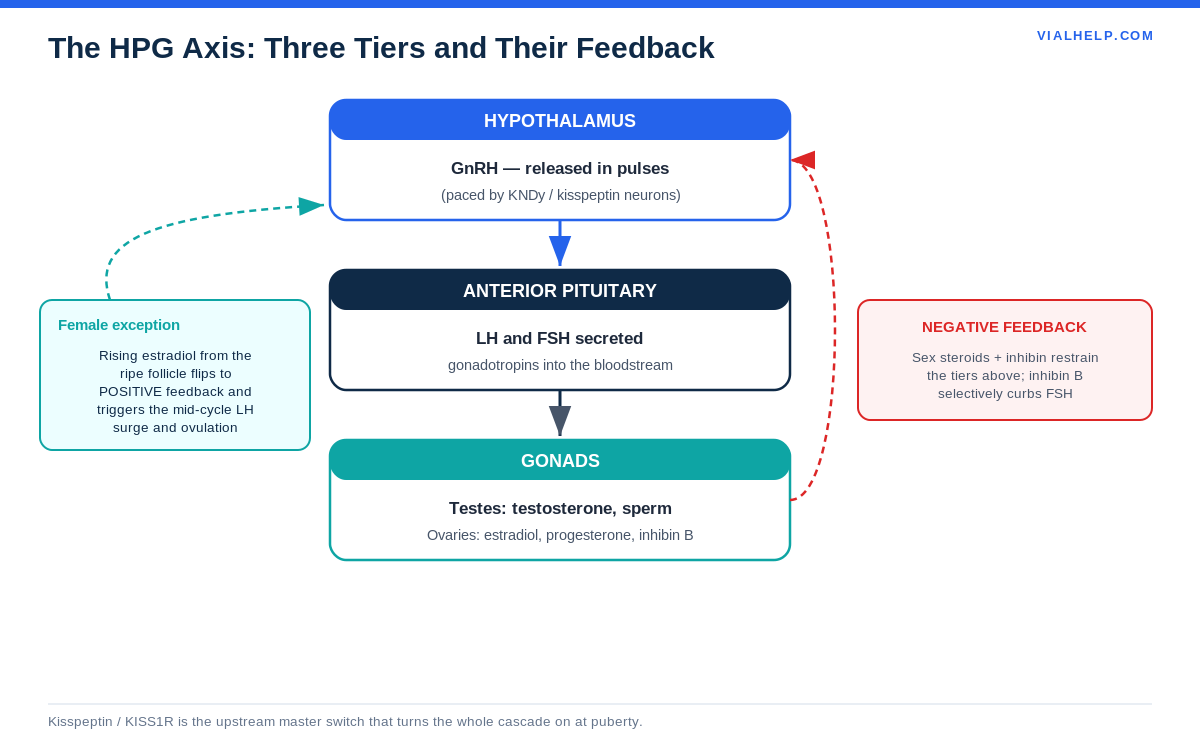
Like the GH/IGF-1 axis and the thyroid axis, the HPG axis is a three-tier cascade with feedback. The hypothalamus releases gonadotropin-releasing hormone (GnRH), a ten-amino-acid peptide. GnRH travels a short distance to the anterior pituitary, which responds by secreting two gonadotropins — luteinizing hormone (LH) and follicle-stimulating hormone (FSH) — into the bloodstream. Those hormones reach the gonads (testes or ovaries), which make the sex steroids (testosterone, estradiol, progesterone) and the peptide hormone inhibin. The sex steroids and inhibin then feed back upward to keep the whole system in balance.
Why the pulse matters more than the amount
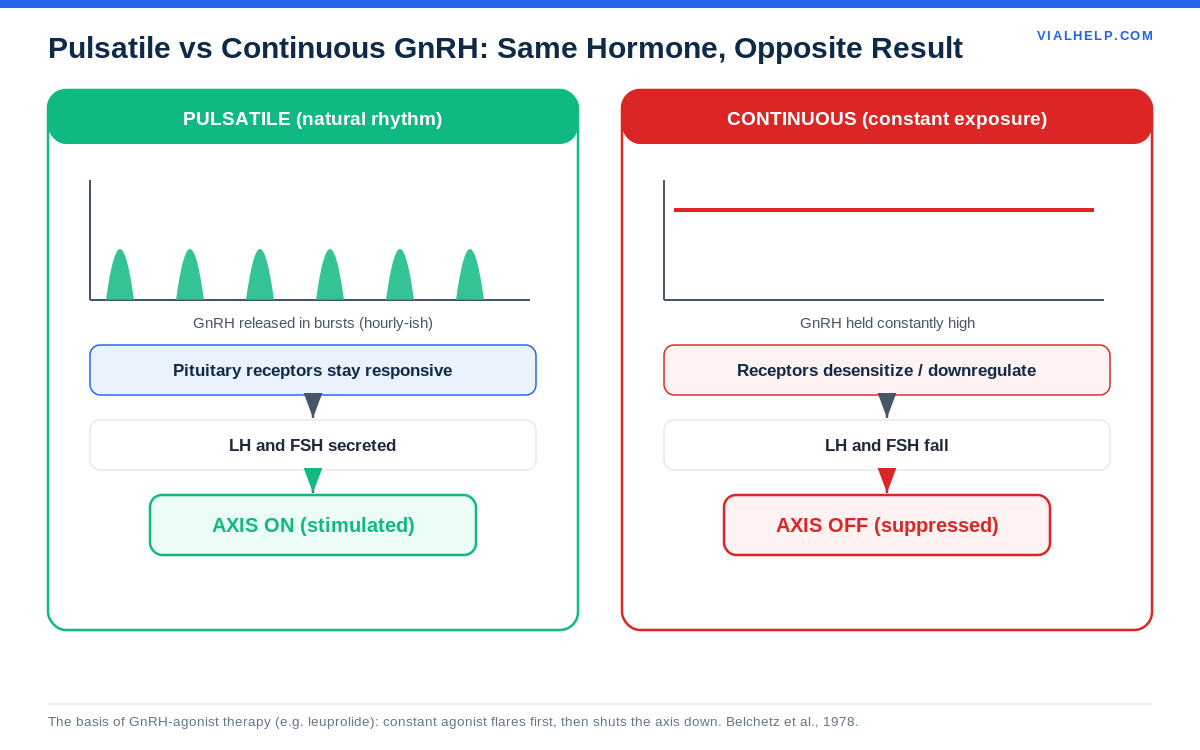
The defining feature of GnRH is that it is released in pulses, not as a steady stream — and the pituitary reads the pattern, not just the quantity. Intermittent pulses keep the pituitary responsive and gonadotropins flowing. Constant, unrelenting GnRH does the opposite: it desensitizes and downregulates the receptors, and the axis switches off.
The classic demonstration came from Ernst Knobil’s group (Belchetz and colleagues, 1978): in monkeys whose own GnRH had been removed, a continuous infusion failed to restore LH and FSH, while the same hormone delivered as hourly pulses switched the axis back on. The difference was the delivery pattern, not the dose.
What LH and FSH actually do
In males, LH stimulates the testicular Leydig cells to make testosterone, while FSH supports the Sertoli cells and spermatogenesis. In females, FSH drives follicle development in the ovary; a mid-cycle surge of LH triggers ovulation; and the leftover follicle becomes the corpus luteum, which secretes progesterone to prepare for a possible pregnancy. Two hormones, very different jobs depending on the target tissue.
Feedback: how the axis regulates itself
Most of the time the axis runs on negative feedback: rising testosterone or estradiol, together with inhibin, restrains the hypothalamus and pituitary. (Inhibin B is selective — it specifically curbs FSH.) This is why adding exogenous testosterone suppresses the body’s own LH, FSH and sperm production — the brain senses plenty and stops signalling.
The female cycle adds a twist found nowhere else in the body. As a dominant follicle ripens, its estradiol climbs; once high enough for long enough, estradiol flips from negative to positive feedback and triggers the ovulatory LH surge. A brake becomes an accelerator, briefly, to release the egg.
Kisspeptin: the master switch
One tier sits above GnRH. Neurons that release kisspeptin, acting through its receptor KISS1R (formerly called GPR54), are the upstream gatekeeper that turns GnRH neurons on. The evidence is striking: people who inherit loss-of-function mutations in this receptor fail to enter puberty — yet the problem can be bypassed with GnRH, proving the defect lies above the GnRH neuron. Kisspeptin is, in effect, the switch that starts the whole axis at puberty.
Drugs and research peptides that act on the axis
Because each tier is a distinct target, different agents push the axis in different directions:
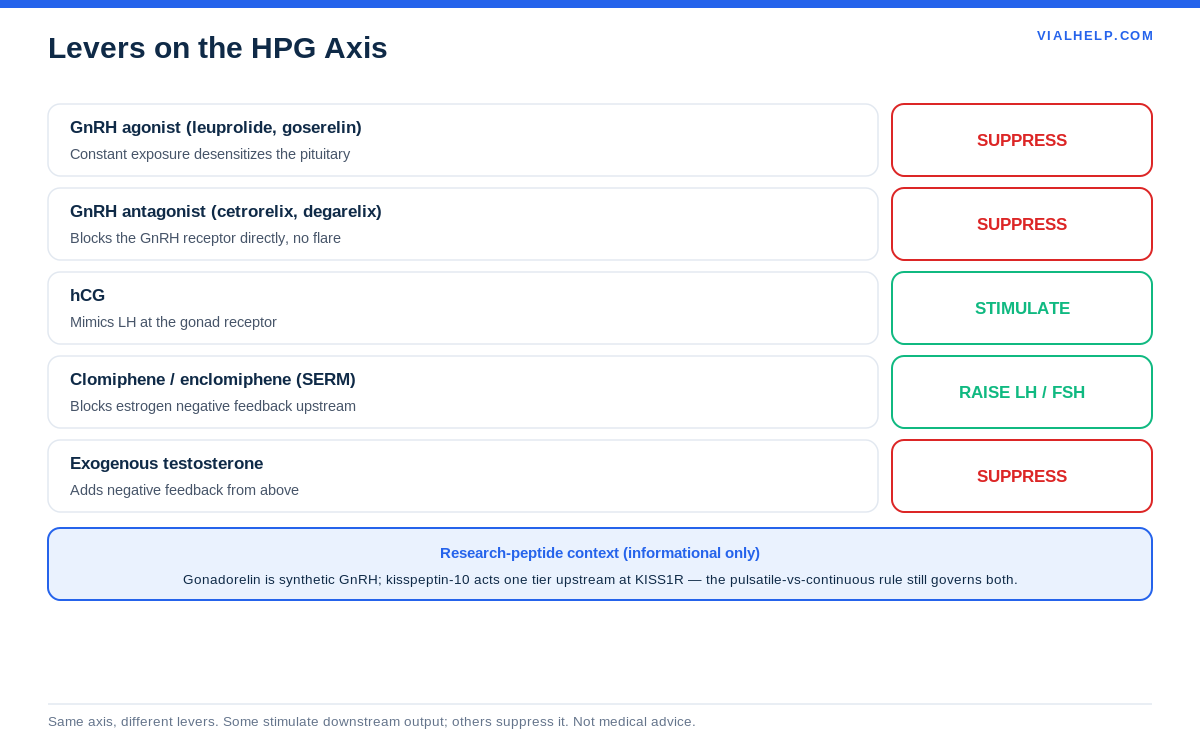
- GnRH agonists (leuprolide, goserelin) — continuous exposure desensitizes the pituitary, so despite an initial flare they ultimately suppress the axis.
- GnRH antagonists (cetrorelix, degarelix, oral elagolix) — block the receptor directly and suppress immediately, with no flare.
- hCG — mimics LH at the gonad, stimulating testosterone or steroid production while bypassing the pituitary.
- Clomiphene / enclomiphene (SERMs) — block estrogen’s negative feedback in the brain, which raises the body’s own LH and FSH.
In the research-peptide world, two compounds map directly onto this biology. Gonadorelin is simply synthetic GnRH, so the pulsatile-versus-continuous rule governs it exactly. Kisspeptin-10 acts one tier further upstream at KISS1R. Both are studied for their effects on the axis; neither is a proven therapy, and the same agonist-desensitization considerations apply. For the receptor pharmacology behind all of this, see what a GPCR is and agonists versus antagonists.
Frequently asked questions
Is the HPG axis the same in men and women?
The architecture is identical — GnRH, then LH and FSH, then the gonads — but the output differs. Men run in a relatively steady state; women cycle, and only women have the estradiol positive-feedback switch that produces an ovulatory LH surge.
Why does taking testosterone shut down natural production?
Exogenous testosterone adds to the negative-feedback signal. The hypothalamus and pituitary sense abundant hormone and cut GnRH, LH and FSH — which is why testicular testosterone and sperm output fall. This is physiology, not advice; decisions about hormone therapy belong with a clinician.
Why is pulsatile dosing such a big deal?
Because the pituitary responds to the pattern of GnRH. Deliver it in pulses and the axis stays on; deliver it continuously and the receptors desensitize and the axis shuts down. The same molecule can stimulate or suppress depending only on timing.
What is kisspeptin’s role?
Kisspeptin, through KISS1R, is the upstream trigger that activates GnRH neurons. It is essential for the onset of puberty and is an active area of reproductive research.
References
- Belchetz PE, Plant TM, Nakai Y, et al. Hypophysial responses to continuous and intermittent delivery of GnRH. Science. 1978;202(4368):631–633. PMID 100883
- Marques P, et al. Physiology of GnRH and gonadotrophin secretion. Endotext. NBK279070
- Physiology, Gonadotropin-Releasing Hormone. StatPearls. NBK558992
- Seminara SB, et al. The GPR54 gene as a regulator of puberty. N Engl J Med. 2003;349(17):1614–1627. NEJMoa035322
- Uenoyama Y, et al. The hypothalamic GnRH pulse generator and kisspeptin neurons. PMC6600864
- Leuprolide acetate (Lupron) FDA prescribing information. FDA label
Informational only — not medical advice · 21+. VialHelp does not sell or recommend peptides. Hormone-therapy decisions belong with a qualified healthcare professional.