
How Much BAC Water for a Target Concentration: The Reconstitution Math
Reconstitution math · Tools
Figuring out how much BAC water to add is a single division problem: water volume = the amount in the vial divided by the concentration you want. Get that one relationship and the rest of reconstitution math falls into place. This guide walks through the equation, worked examples, and the practical reasons people pick one water volume over another — all as lab math, not dosing advice.
The one equation that governs reconstitution
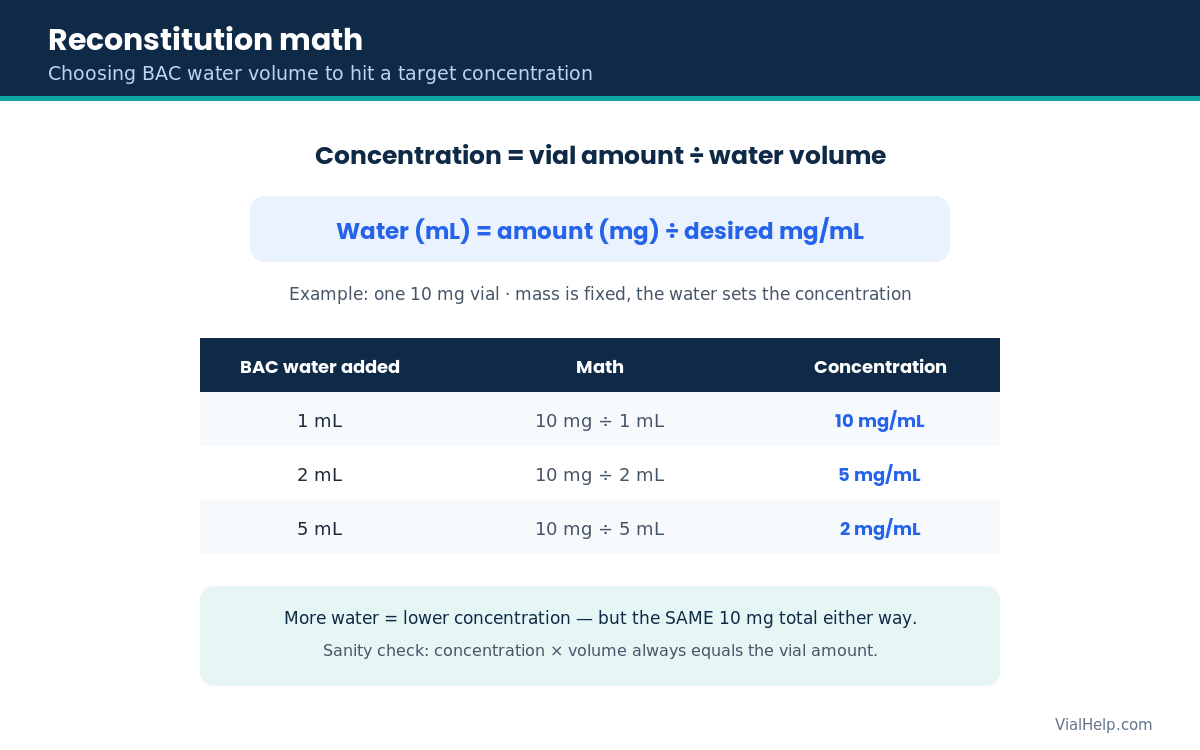
A dry vial holds a fixed amount of compound, measured in milligrams (mg). Adding bacteriostatic (BAC) water does not change that amount — it only spreads it through a volume of liquid. So concentration is just amount divided by volume:
Rearranged for the number you actually choose:
BAC water (mL) = amount in vial (mg) ÷ desired concentration (mg/mL)
Those are the same equation written two ways. The amount is fixed; you trade water volume against concentration.
Worked examples (a 10 mg vial)
Say a vial contains 10 mg. Here is what different water volumes produce:
- Add 1 mL → 10 mg ÷ 1 mL = 10 mg/mL
- Add 2 mL → 10 mg ÷ 2 mL = 5 mg/mL
- Add 5 mL → 10 mg ÷ 5 mL = 2 mg/mL
The total is 10 mg in every row — only the concentration changes. A quick sanity check: concentration × volume should always equal the vial amount (5 mg/mL × 2 mL = 10 mg). If it doesn’t, the arithmetic slipped. You can run any of these instantly with the reconstitution calculator or work backward with the BAC water calculator.
Tying concentration to the syringe
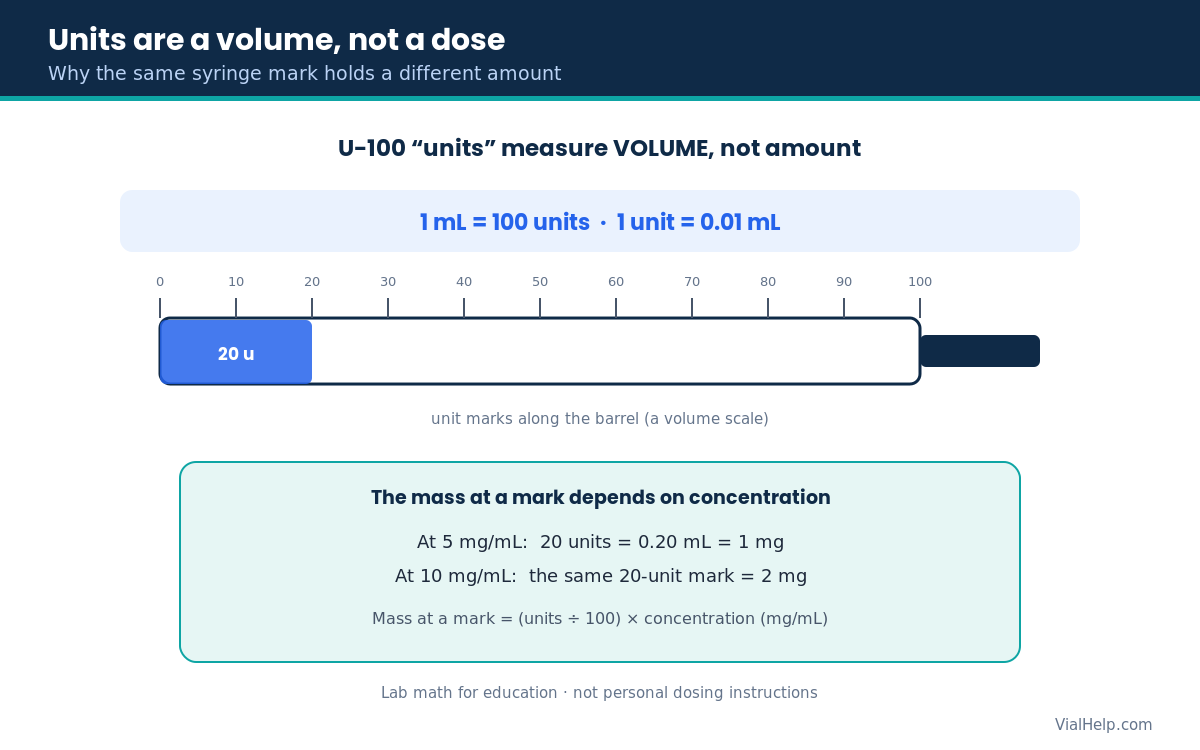
U-100 insulin syringes are marked in “units,” where 1 mL = 100 units, so 1 unit = 0.01 mL. Those units are a volume scale, not an amount. The mass sitting at any mark depends entirely on the concentration you mixed:
At 5 mg/mL, the 20-unit mark (0.20 mL) holds 1 mg; the 40-unit mark holds 2 mg. Mix the same vial at 10 mg/mL instead and that same 20-unit mark now holds 2 mg. This is the real lever behind choosing a water volume: pick a concentration that makes your target amounts land on clean, easy-to-read marks. For more on why units are not a dose, see IU vs mL.
Why people pick a particular water volume
There is no single “correct” volume — it is a trade-off between readability and practicality:
- Measurement precision. A U-100 syringe resolves to about one unit (0.01 mL). If a concentration is so high that a target amount occupies only a few units, small reading errors become large percentage errors. Spreading the amount across more units (lower concentration) improves readability.
- Syringe and vial capacity. A standard U-100 syringe holds at most 1 mL (100 units), and the compound vial itself can only hold so much liquid. You cannot add more water than the vial fits.
- Dead space. A little liquid is always unrecoverable in the needle hub and tip, which is one reason ultra-low fill volumes are avoided.
- Multi-use over time. BAC water’s benzyl-alcohol preservative is what lets a vial be entered repeatedly, so people often size a mix to last a sensible interval rather than to a single use.
What BAC water actually is
Per the manufacturer prescribing information, Bacteriostatic Water for Injection, USP is sterile water containing about 0.9% (9 mg/mL) benzyl alcohol as a bacteriostatic preservative, supplied in a multiple-dose container “from which repeated withdrawals may be made.” That preservative is the functional difference from plain Sterile Water for Injection, which has none and is not intended for repeated entry. The label is explicit that BAC water is only for diluting or dissolving drugs, is not for fluid replacement, and is not for use in neonates. For more, see the bacteriostatic water guide.
Common pitfalls
- mg vs mcg. Many compounds are labeled in micrograms (1 mg = 1000 mcg). Mixing units in one calculation causes 1000-fold errors — keep everything in the same unit before dividing.
- Treating “units” as a dose. Units are hundredths of a millilitre, not a fixed amount; the same mark means different amounts at different concentrations.
- Over-dilution. Too much water pushes target amounts past the syringe’s capacity or the vial’s volume, making draws imprecise or impossible.
- Skipping the sanity check. Always confirm concentration × volume equals the labeled vial amount.
Frequently asked questions
Does adding more BAC water change the total amount of compound?
No. The amount is fixed when the vial is filled. Water only sets the concentration — more water means a lower mg/mL spread over more volume, but the same total milligrams.
What water volume should I use?
That is a math-and-convenience decision. Using volume = amount ÷ desired concentration, pick a concentration that puts your target amounts on clean unit marks while keeping draws large enough to read and small enough to fit the syringe and vial.
Why BAC water instead of sterile water?
BAC water contains benzyl alcohol as a preservative, which is why its label permits repeated withdrawals from a multiple-dose container. Plain sterile water has no preservative and is not meant for multi-entry use over time.
How long is a reconstituted multi-dose vial usable?
For the preservative-driven limit, USP <797> assigns an entered, preserved multiple-dose container a beyond-use date of 28 days unless the manufacturer states otherwise. The dissolved compound’s own chemical stability is a separate limit governed by that compound’s data.
References
- Bacteriostatic Water for Injection, USP — Prescribing Information (Pfizer/Hospira). labeling.pfizer.com
- Bacteriostatic Water for Injection — Label (DailyMed, U.S. NLM/FDA). dailymed.nlm.nih.gov
- USP General Chapter <797> Pharmaceutical Compounding — Sterile Preparations (beyond-use dating). uspnf.com
- The Pharmacist’s Guide to Assigning a Beyond-Use Date (ASHP). ashp.org
Informational only — not medical advice · 21+