
Tachyphylaxis vs. Tolerance vs. Downregulation: What They Really Mean
Pharmacology explained
Tachyphylaxis, tolerance, and downregulation are three words that get swapped around as if they were interchangeable — but they answer different questions. Tachyphylaxis and tolerance describe how fast a response fades; downregulation is one of the cellular mechanisms that can cause it. Getting the distinction straight makes a lot of peptide and receptor pharmacology click into place.
Tachyphylaxis, tolerance, and downregulation are not synonyms
The umbrella term is desensitization: the biological response to a drug diminishes when it is given repeatedly or continuously. Underneath that umbrella, the three terms this article untangles each mean something specific.
Tachyphylaxis is desensitization that develops very rapidly — over minutes to hours, sometimes even after the first repeat dose. Tolerance is conventionally used for a more gradual loss of response that builds over days or weeks, often needing a larger dose to get the same effect. There is no hard boundary between them; the different timescales simply hint that different mechanisms are at work.
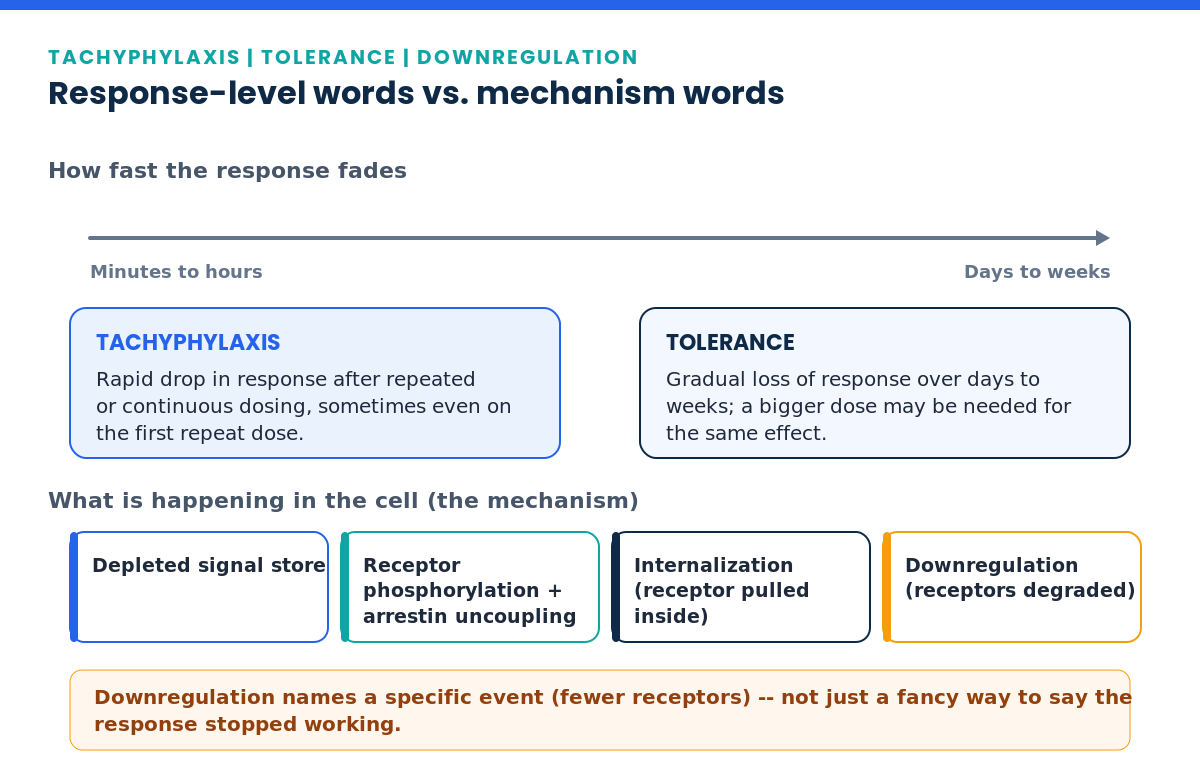
Downregulation is different in kind. It is not a description of the response — it is a mechanism: the cell reduces the actual number of receptors it displays. So “the drug stopped working” (a tolerance or tachyphylaxis observation) might be caused by downregulation, but the two words are not saying the same thing.
How fast versus why: two separate questions
A clean way to think about it: the response-level word you choose tells the reader how fast the effect faded, and the mechanism word tells them why and how reversible it is likely to be.
Fast loss of response (tachyphylaxis) tends to point to quick, often reversible events — the depletion of a stored signaling chemical, or rapid receptor phosphorylation that uncouples the receptor from its machinery. Slower loss (tolerance) more often involves changes in receptor numbers or counter-regulatory adjustments by the body. The International Union of Basic and Clinical Pharmacology (IUPHAR) frames the split exactly this way.
What actually happens at the receptor
For the large family of G-protein-coupled receptors (GPCRs), the textbook desensitization cascade runs in a defined order:
- With continued agonist exposure, enzymes called GRKs (G-protein-coupled receptor kinases) add phosphate groups to the receptor.
- The phosphorylated receptor recruits beta-arrestin, which physically blocks further coupling to the G-protein — the receptor is still there, but “unplugged.”
- Beta-arrestin also flags the receptor for internalization: it is pulled off the cell surface into the cell.
- From there the receptor is either recycled back to the surface (fast, reversible — when agonist falls) or degraded, which lowers total receptor number. That degradation is downregulation.
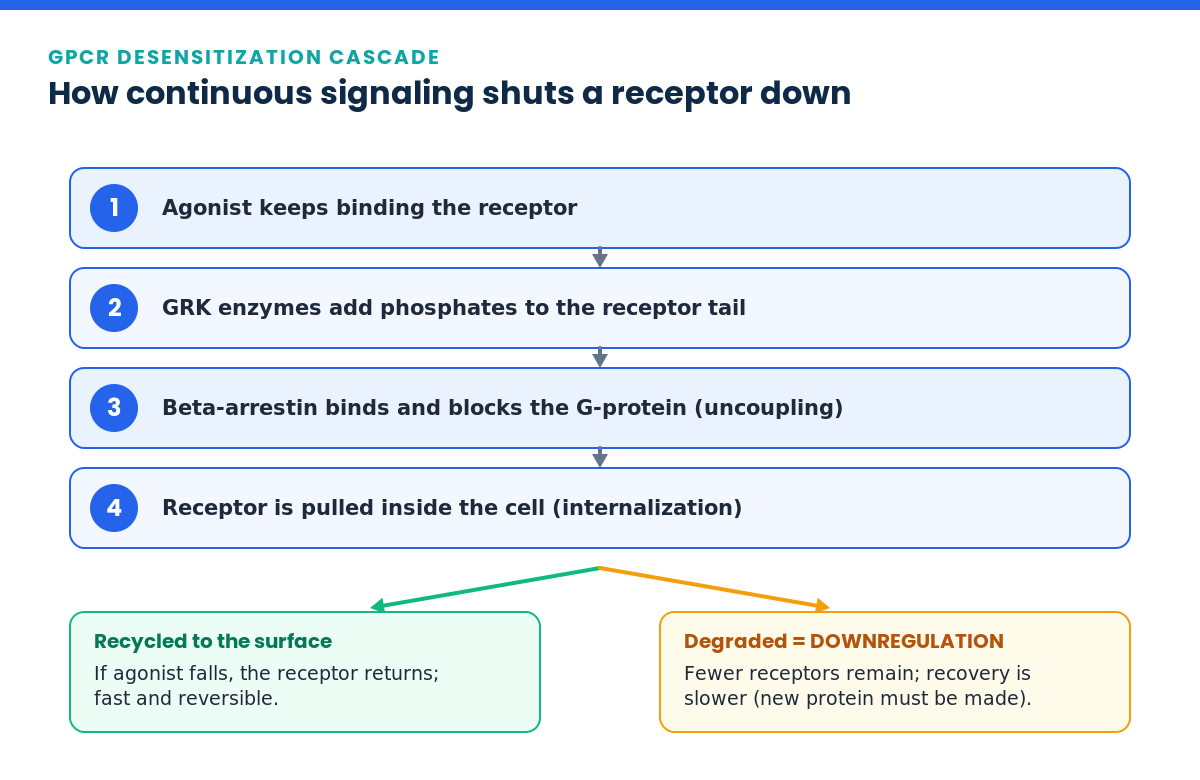
This is why internalization and downregulation should not be blurred together. Internalization can be quickly reversed by recycling. Downregulation means fewer receptor proteins exist, so recovery is slower — the cell has to synthesize new receptors.
The clearest peptide example: pulsatile versus continuous GnRH
Gonadotropin-releasing hormone (GnRH) gives the single best illustration that pattern, not just dose, controls the outcome. In a classic 1978 experiment in rhesus monkeys, Belchetz and colleagues showed that continuous GnRH infusion failed to sustain the pituitary’s output of LH and FSH, whereas delivering the same peptide in hourly pulses restored it — and switching from pulses back to continuous suppressed it again.
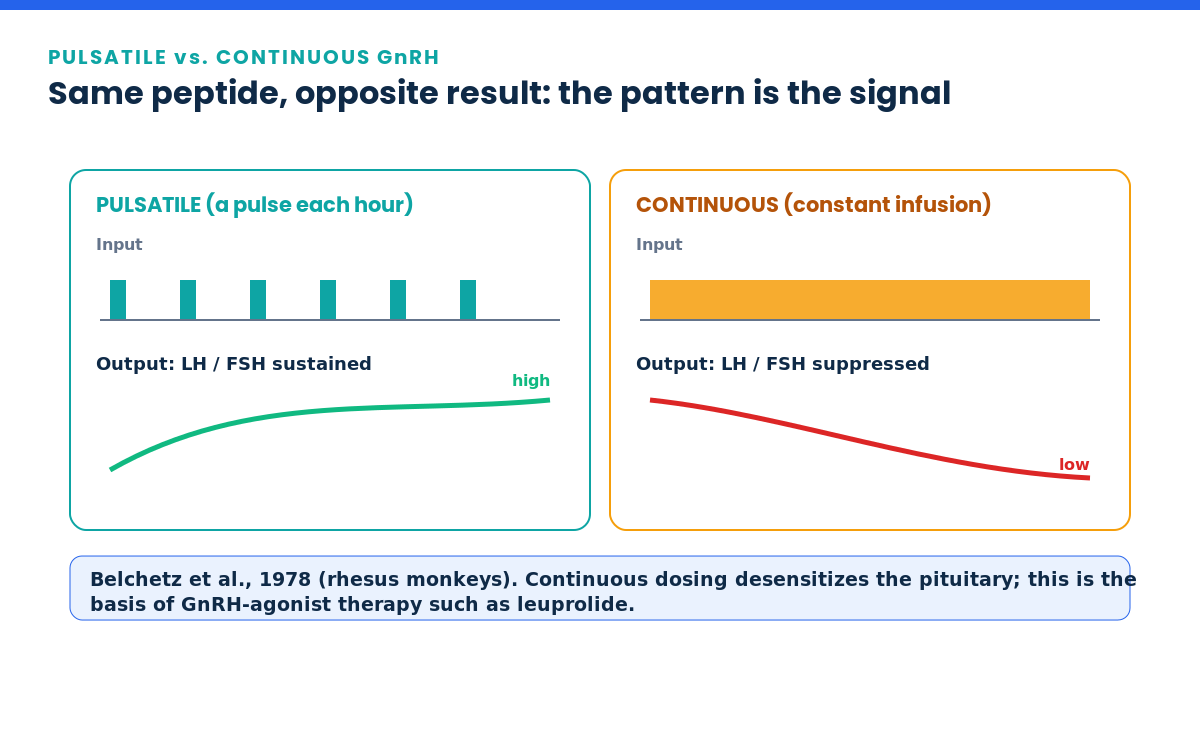
That single insight underpins a whole class of medicines. GnRH-receptor agonists such as leuprolide are given continuously on purpose: after an initial stimulatory “flare,” constant occupancy desensitizes the receptors and reduces their number, so LH, FSH, and downstream sex hormones fall — the basis of hormone-suppressing therapy. It is the same molecule producing opposite effects depending entirely on the delivery pattern. You can read more on the receptors involved on our gonadorelin and kisspeptin-10 reference pages.
A non-peptide contrast: ephedrine and store depletion
Tachyphylaxis does not always involve receptors at all. Ephedrine acts largely indirectly — it works by displacing stored norepinephrine and blocking its reuptake, so its effect depends on the neurotransmitter the nerve terminal has in stock. Give it repeatedly and those stores run down, so the response fades quickly. That is why it is dosed as intermittent boluses rather than a continuous drip. It is the textbook example of rapid tachyphylaxis driven by depletion, not by receptor downregulation — a clean contrast with the leuprolide story.
Why the distinction matters for how molecules are dosed
Once you separate the “how fast” from the “why,” dosing logic follows:
- Pattern can flip the outcome. Pulsatile versus continuous delivery of the same molecule can produce opposite biological results — the GnRH lesson.
- Depletion-limited agents need spacing. When an effect draws on a finite store, intermittent dosing lets the store recover; continuous exposure just exhausts it.
- Desensitization can be the goal. When suppression is wanted, clinicians deliberately drive downregulation with continuous agonist exposure.
For the handling and measurement side of working with any research compound, see our reconstitution calculator and browse related explainers in the guides section.
Frequently asked questions
Is tachyphylaxis just fast tolerance?
Roughly, yes — the two describe the same idea (a fading response) on different timescales, with tachyphylaxis being the rapid, minutes-to-hours version. The faster onset usually implies a different underlying mechanism, such as store depletion or rapid receptor uncoupling.
Does downregulation always happen when a drug stops working?
No. A response can fade from store depletion, receptor phosphorylation and arrestin uncoupling, or internalization — none of which necessarily reduce total receptor number. Downregulation specifically means fewer receptor proteins, and it is generally slower to reverse.
Is desensitization permanent?
Usually not. Uncoupled or internalized receptors can recover quickly once the agonist falls. Downregulated receptors take longer because the cell must make new protein. Whether it fully reverses depends on the mechanism and the tissue.
Do all peptides cause tachyphylaxis?
No. It depends on the receptor and the exposure pattern. Some peptide systems desensitize readily under continuous exposure; others do not. Broad claims that a given peptide “always” desensitizes — or that a specific off-cycle prevents it — are frequently unsupported.
- IUPHAR Pharmacology Education Project. Desensitisation and tachyphylaxis. pharmacologyeducation.org
- Plant TM. Recognition that sustained pituitary gonadotropin secretion requires pulsatile GnRH stimulation. Fertil Steril Rep. 2022. fertstertreports.org
- Belchetz PE, Plant TM, Nakai Y, Keogh EJ, Knobil E. Hypophysial responses to continuous and intermittent delivery of GnRH. Science. 1978;202:631-633 (PMID 100883). pubmed.ncbi.nlm.nih.gov/100883
- Jaffe CA, et al. Effects of a prolonged GH-releasing peptide infusion on pulsatile GH secretion in normal men. J Clin Endocrinol Metab. 1993;77:1641-1647 (PMID 7903313). doi.org/10.1210/jcem.77.6.7903313
- StatPearls: Ephedrine (NBK547661). ncbi.nlm.nih.gov/books/NBK547661
- StatPearls: Leuprolide (NBK551662). ncbi.nlm.nih.gov/books/NBK551662
Informational only — not medical advice. For research and educational use by adults 21+. Consult a qualified professional for medical decisions.
In Plain English
BPC-157 is a lab-made copy of a small piece of a protein found naturally in the stomach. In animal studies it appears to help injured tissue — like muscle, tendon, and the gut lining — heal faster. Researchers are interested in it as a possible all-purpose recovery aid, but almost all of the evidence so far comes from animals rather than people.
BPC-157 (Body Protection Compound-157) is a synthetic chain of 15 amino acids based on a sequence found in human gastric juice. First described by a research group in Zagreb in the early 1990s, it has become one of the most-studied “healing” peptides in preclinical science. This profile summarizes what BPC-157 is, how researchers describe its activity, and what the published literature actually shows — for informational purposes only.
What is BPC-157?
BPC-157 is a stable gastric pentadecapeptide — “pentadecapeptide” simply means a peptide of fifteen amino acids. It is a partial sequence derived from a larger body-protection compound isolated from gastric juice, and it is notably stable in human gastric acid, which is part of why it attracted research interest. You may also see it referred to as Body Protection Compound 157, PL 14736, or bepecin. It is a research compound and is not approved by the FDA or other regulators for human use.
How BPC-157 is studied to work
Across animal studies, researchers have proposed several overlapping mechanisms rather than a single mode of action. The most consistently reported is an effect on angiogenesis — the formation of new blood vessels — which supports tissue repair by improving blood supply to an injured area.
- VEGFR2 activation: BPC-157 is reported to up-regulate and activate the VEGFR2 receptor, a central switch in blood-vessel growth.
- Nitric-oxide pathway: downstream signaling through the Src–Caveolin-1–eNOS pathway is described, increasing nitric-oxide availability and influencing vascular tone.
- Growth-factor and Egr-1 signaling: studies also point to interactions with growth-factor pathways and early growth response factor-1, which help coordinate cell migration and repair.

A 2025 narrative review in Current Reviews in Musculoskeletal Medicine organized three decades of work around four mechanistic pillars: VEGFR2-mediated angiogenesis, eNOS coupling, ERK1/2 signaling, and anti-inflammatory modulation. Importantly, almost all of this evidence comes from cell and rodent models.
Reported effects and benefits in the research literature
In published animal research, the effects most often associated with BPC-157 cluster around connective-tissue repair and protection of the gut. These are the outcomes that have driven interest in the peptide:
- Tendon and ligament models: faster healing, tendon-cell outgrowth, and improved cell survival and migration after injury.
- Muscle injury: recovery signaling reported after crush and strain injuries in rodents.
- Gastrointestinal tract: protective effects on the stomach lining and gut in ulcer and inflammatory-bowel models — consistent with its gastric-juice origin.
- Blood vessels and wound healing: pro-angiogenic activity linked to the VEGFR2 / nitric-oxide pathway described above.
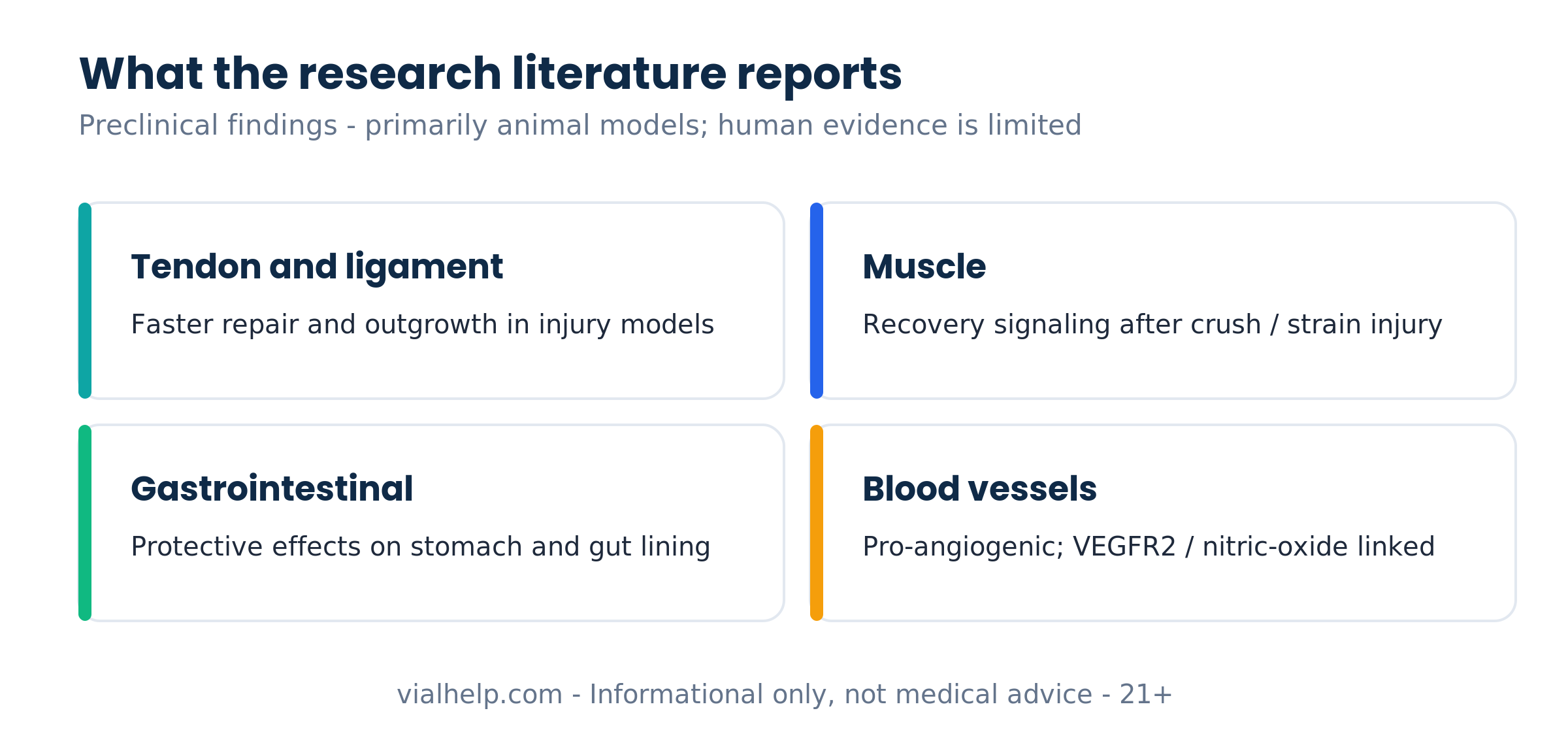
What this does not mean: these are preclinical findings. They should not be read as evidence that BPC-157 is safe or effective in people. The enthusiasm often seen online runs well ahead of the controlled human data, which remains very limited.
What the human evidence shows
Well-controlled human trials of BPC-157 are lacking. The bulk of the literature is animal and laboratory work, much of it from a single research group, with a growing but still small set of independent replications. Because of this evidence gap, regulators have taken a cautious stance.
In September 2023, the U.S. FDA placed BPC-157 in its Category 2 list of bulk drug substances for compounding — substances flagged as potentially presenting significant safety risks. The agency cited concerns including possible immunogenicity for certain routes of administration and difficulty characterizing peptide-related impurities, alongside limited safety data. In practice this restricts traditional compounding pharmacies from preparing it.
Handling, storage and reconstitution (research context)
Like most research peptides, BPC-157 is typically supplied as a lyophilized (freeze-dried) powder that is reconstituted with bacteriostatic water before use in the lab.
- Lyophilized powder: store cool and dark; long-term storage is usually at −20°C.
- After reconstitution: refrigerate at 2–8°C and use within a few weeks.
- Measurement: work in concentration (mg/mL) and volume rather than “units.” Our reconstitution calculator turns vial mg + water volume into concentration and draw volume, and the explainer IU vs mL: why “units” are not a dose clears up the most common measurement mistake.
Cautions and considerations
- BPC-157 is a research compound and is not FDA-approved; it is not a medicine.
- Human safety and efficacy are not established — most evidence is preclinical.
- Purity and identity vary between sources; a Certificate of Analysis (COA) showing purity and identity is essential for any research-grade material.
- This page is informational only and is not medical advice.
Frequently asked questions
Is BPC-157 FDA-approved?
No. BPC-157 is not approved for human use, and in 2023 the FDA placed it on its Category 2 bulk-substances list, citing safety concerns and limited data.
What is BPC-157’s molecular weight and formula?
BPC-157 has the molecular formula C62H98N16O22 and a molecular weight of about 1419.5 g/mol (CAS 137525-51-0).
What is its half-life?
Reported plasma half-life is short — on the order of minutes — though detailed human pharmacokinetic data are limited.
How is BPC-157 stored?
As a lyophilized powder it is kept cool and dark (long-term −20°C); once reconstituted it is refrigerated at 2–8°C and used within a few weeks.
Related compounds and further reading
- Ipamorelin — a selective growth-hormone secretagogue studied in a different research area.
- Browse the full peptide library for more compound profiles.
- Storage, stability and handling guides for research peptides.
- IU vs mL: why “units” are not a dose — the measurement basics behind every calculation.
- How to reconstitute peptides — step-by-step reconstitution method and concentration math.
- Sterile technique — aseptic handling and contamination prevention for research vials.