
Why Peptides Are Banned in Sport: The WADA List Explained
Regulation and sport
Peptides are banned in sport under the WADA Prohibited List — and the reason catches most people out: a peptide does not need to be named on the List to be prohibited. The categories that capture research peptides are written as catch-alls, and one of them is triggered by the exact phrase vendors use to market these compounds. If you compete under any anti-doping code, this is the part worth understanding properly.
What WADA is, and what the List does
The World Anti-Doping Agency maintains the Prohibited List, one of eight International Standards binding on signatories of the World Anti-Doping Code. It is revised every year: the 2026 List was approved on 11 September 2025, published on 24 September 2025, and came into force on 1 January 2026. The Code currently in force is the 2021 Code; a 2027 Code was adopted in Busan in December 2025 and takes effect in 2027.
A substance is considered for the List if WADA determines it meets any two of three criteria (Code Article 4.3.1):
- Evidence it has the potential to enhance, or does enhance, sport performance
- Evidence its use represents an actual or potential health risk
- WADA’s determination that its use violates the spirit of sport
Two of three. Note what that permits: a substance can be listed on health risk plus spirit of sport, with no established performance benefit. A separate rule, Article 4.3.2, adds anything with masking potential regardless. And Article 4.3.3 settles the argument before it starts — WADA’s decisions on what goes on the List “shall not be subject to any challenge by an Athlete or other Person.”
S0: the category that catches everything else
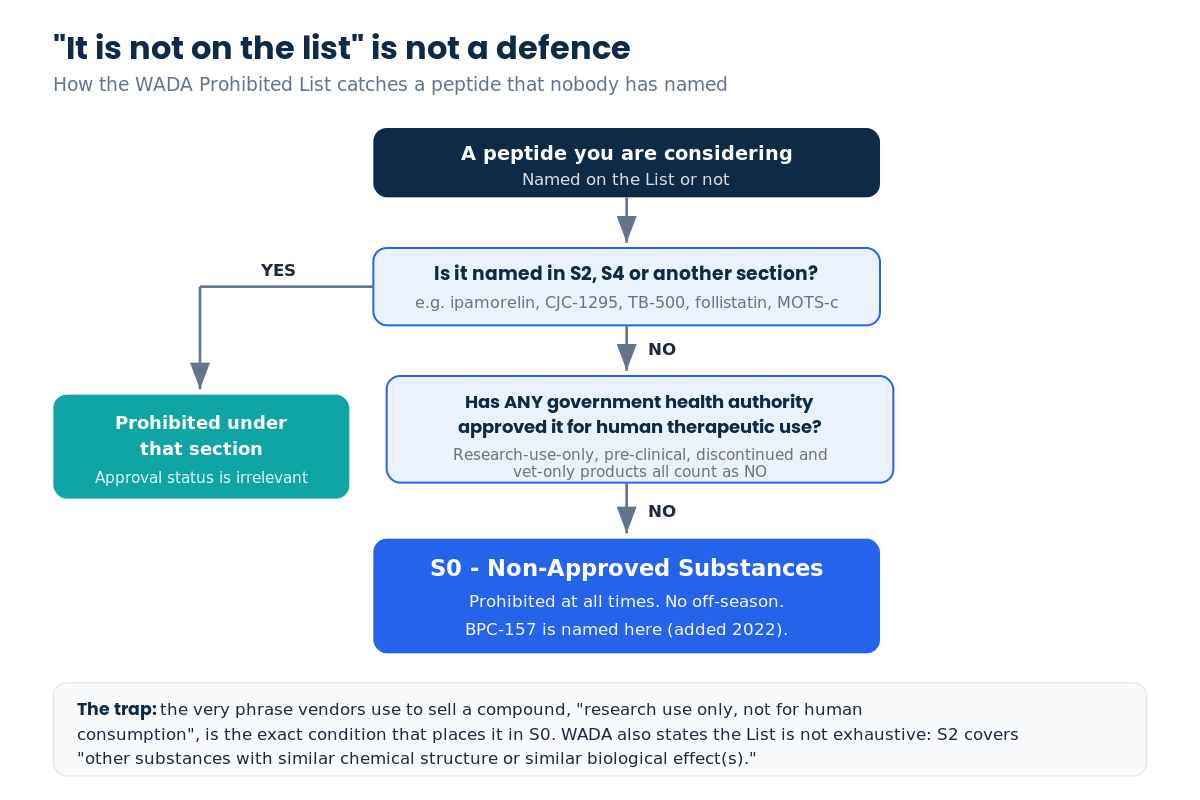
S0 covers “any pharmacological substance which is not addressed by any of the subsequent sections of the List and with no current approval by any governmental regulatory health authority for human therapeutic use (e.g. drugs under pre-clinical or clinical development or discontinued, designer drugs, substances approved only for veterinary use).” It is prohibited at all times.
S0 lists BPC-157 by name, along with 2,4-dinitrophenol, ryanodine receptor stabilizers and troponin activators. All S0 substances are Specified Substances.
S2: peptide hormones, growth factors and mimetics
S2 is the dedicated peptide category, prohibited at all times, and everything in it is non-Specified. Its chapeau matters as much as its contents: it covers the named substances “and other substances with similar chemical structure or similar biological effect(s).”
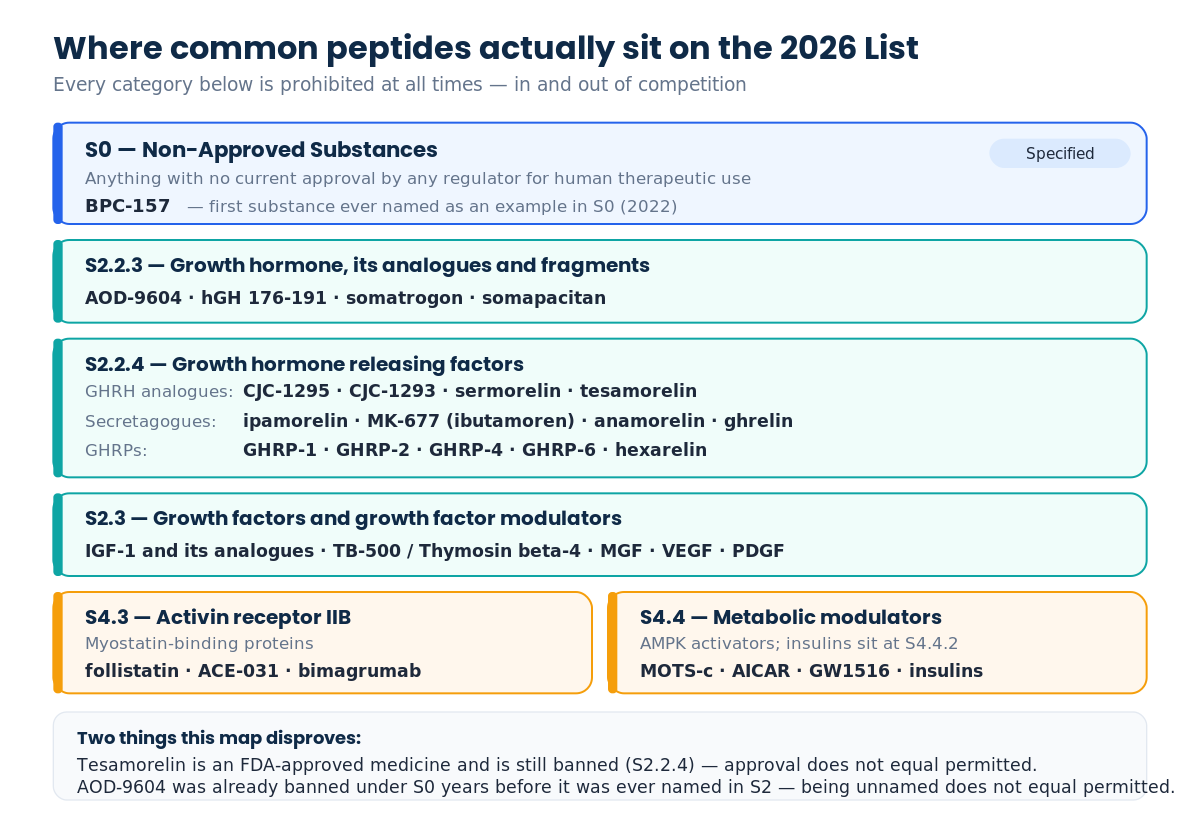
- S2.1 — erythropoietins and agents affecting erythropoiesis (EPO, darbepoetins, HIF activators like roxadustat, GATA inhibitors, TGF-beta signalling inhibitors).
- S2.2.1 — testosterone-stimulating peptides in males: chorionic gonadotrophin, LH, GnRH (gonadorelin) and its agonist analogues, and kisspeptin and its agonist analogues.
- S2.2.2 — corticotrophins and their releasing factors.
- S2.2.3 — growth hormone, its analogues and fragments, including AOD-9604 and hGH 176-191.
- S2.2.4 — growth hormone releasing factors: GHRH analogues (CJC-1295, CJC-1293, sermorelin, tesamorelin); secretagogues and mimetics (ipamorelin, MK-677/ibutamoren, anamorelin, ghrelin, macimorelin); and GHRPs (GHRP-1, -2, -3, -4, -5, -6, hexarelin/examorelin).
- S2.3 — growth factors and modulators: IGF-1 and its analogues, MGF, thymosin-beta-4 and its derivatives including TB-500, VEGF, PDGF, FGFs, HGF — plus a functional catch-all for anything else affecting muscle or tendon protein synthesis, vascularisation or fibre-type switching.
S4 and M3: the categories people forget
S4.3 covers agents preventing activin receptor IIB activation — this is where follistatin lives, alongside myostatin propeptide, ACE-031 and antibodies like bimagrumab. S4.4.1 covers AMPK activators, which is where MOTS-c and AICAR sit, along with PPAR-delta agonists such as GW1516. S4.3 and S4.4 are non-Specified.
M3 covers gene and cell doping. New for 2026, M3.2 extends to cell components — “nuclei and organelles such as mitochondria and ribosomes” — which brings mitochondrial transplantation into scope.
Prohibited at all times vs in-competition only
S6 to S9 (stimulants, narcotics, cannabinoids, glucocorticoids) are prohibited in-competition only. Everything relevant to peptides — S0, S2, S4, M3 — is prohibited at all times. There is no off-season.
And the in-competition window is not a grace period for the rest. WADA’s own athlete guide states that if an in-competition-banned substance shows up in an in-competition sample, “the athlete may be sanctioned, even if the substance was taken out of competition.”
Strict liability: intent is irrelevant
Code Article 2.1.1 is unambiguous: “It is the Athletes’ personal duty to ensure that no Prohibited Substance enters their bodies… it is not necessary that intent, Fault, Negligence or knowing Use on the Athlete’s part be demonstrated in order to establish an anti-doping rule violation.”
The comment to that article names the principle directly: various CAS decisions call this “Strict Liability.” Fault is not irrelevant everywhere — it is weighed under Article 10 when deciding the length of a ban. But it has no bearing on whether a violation happened.
Two compounds that break the common assumptions
AOD-9604 demolishes “it’s not on the list, so it’s fine.” WADA published a statement that AOD-9604 was still in development, unapproved, and therefore “falls into the S.0 category” under the 2013 List. It was only named explicitly in S2.2.3 from the 2018 List onward. Being named later did not change whether it was banned — only which drawer it sat in, and with it, whether it counted as Specified.
Tesamorelin demolishes the opposite assumption. It is an approved human medicine, and it is still prohibited, under S2.2.4. Insulin and EPO are the same story: entirely legitimate medicines, entirely prohibited. Regulatory approval and sport eligibility are unrelated questions.
Therapeutic Use Exemptions
A TUE permits an athlete to use a prohibited substance where all four of WADA’s conditions hold: the medication is necessary to treat a diagnosed condition; it will not enhance performance beyond a return to normal health; there is no permitted alternative; and the need is not the consequence of prior non-TUE use of that substance. TUEs are granted for a set period, dose, frequency and route — national-level athletes apply to their NADO, international-level athletes to their International Federation.
Those criteria explain why S0 substances are effectively un-TUE-able. A TUE requires a diagnosed condition the medication is approved to treat — and a substance is in S0 precisely because no health authority anywhere has approved it to treat anything. USADA states this outright for BPC-157: since it is not an approved therapeutic agent in any country, there is no basis for granting a TUE.
Banned is not the same as illegal, or unsafe, or effective
Three separate questions get collapsed into one constantly, so it is worth separating them:
- Banned does not mean illegal. The List includes insulin, EPO, tamoxifen, morphine and salbutamol. It governs sport eligibility, and binds only Code signatories.
- Legal does not mean permitted. Cannabidiol is expressly excepted from S8; caffeine and nicotine sit on the Monitoring Program and are explicitly not prohibited. Legality tells you nothing either way.
- Banned does not mean it works. Two of three criteria are enough. On growth hormone, Baumann’s review in Endocrine Reviews concluded that “the scientific evidence for the ergogenicity of GH is weak, a fact that is not widely appreciated in athletic circles or by the general public.”
Nor does listing imply that safety data exists. It frequently means the opposite — see our write-ups on BPC-157 and TB-500 side effects and IGF-1 side effects for how thin the human evidence actually is.
Frequently asked questions
My peptide is not named on the Prohibited List. Am I safe to use it?
Almost certainly not, and the List says so itself. WADA states it is not exhaustive, S2 extends to substances with “similar chemical structure or similar biological effect(s),” and S0 sweeps up any unapproved pharmacological substance. Not being named is not a status.
Does “research use only” protect me?
It does the reverse. That phrase describes a substance with no regulatory approval for human therapeutic use — which is the definition that places it in S0, prohibited at all times.
What if a supplement was contaminated and I never knew?
Under strict liability, a violation is still established. UKAD puts it plainly: you are solely responsible for any banned substance in your system, regardless of how it got there or whether there was intent. Lack of fault can reduce a sanction under Article 10; it does not erase the finding.
Is BPC-157 banned, and since when?
Yes — added to the 2022 Prohibited List under S0. It was the first substance ever named as an example in S0, which until then had operated as a pure catch-all with no named examples. WADA said only that it followed “a recent re-evaluation of its status”; it gave no further reason.
References
- WADA. The 2026 Prohibited List (in force 1 January 2026). wada-ama.org/en/resources/2026-prohibited-list
- WADA. Athlete and Athlete Support Personnel Guide to the 2026 Prohibited List. wada-ama.org (PDF)
- WADA. World Anti-Doping Code 2021 (Art. 2.1.1 strict liability; Art. 4.3 inclusion criteria). wada-ama.org (PDF)
- WADA. Statement on the substance AOD-9604 (S0 classification under the 2013 List). wada-ama.org
- USADA. Athlete Advisory: Key Changes on the 2024 WADA Prohibited List (MOTS-c and MK-677 additions). usada.org
- UK Anti-Doping. The 2026 Prohibited List: Summary of Changes. ukad.org.uk
- Baumann GP. Growth Hormone Doping in Sports: A Critical Review of Use and Detection Strategies. Endocr Rev. 2012;33(2):155-186. PMID 22368183
Informational only — not medical advice · 21+. This page explains sport-eligibility rules; it is not legal advice and does not address the legality of any substance in any jurisdiction. VialHelp does not sell or recommend peptides. Athletes should verify current status with their NADO or International Federation, as the List changes annually.