
JAK-STAT Signaling Explained
Cell signaling
JAK-STAT signaling is one of the most direct routes a cell has for turning an outside message into a change in its genes. It is the pathway growth hormone, leptin, erythropoietin and dozens of immune cytokines rely on — and its defining trick is simple: the receptor has no built-in enzyme of its own, so it borrows one.
What is JAK-STAT signaling?
JAK-STAT signaling is a pathway used by cytokine receptors and several peptide-hormone receptors, and reviews describe it as one of the best-understood signal-transduction cascades in biology. Its distinguishing feature is what the receptor lacks. Unlike a receptor tyrosine kinase, whose enzyme is built into its own tail, a cytokine receptor is essentially a binding scaffold with no catalytic activity of its own. It borrows that activity from a Janus kinase (a JAK) parked on its inner tail.
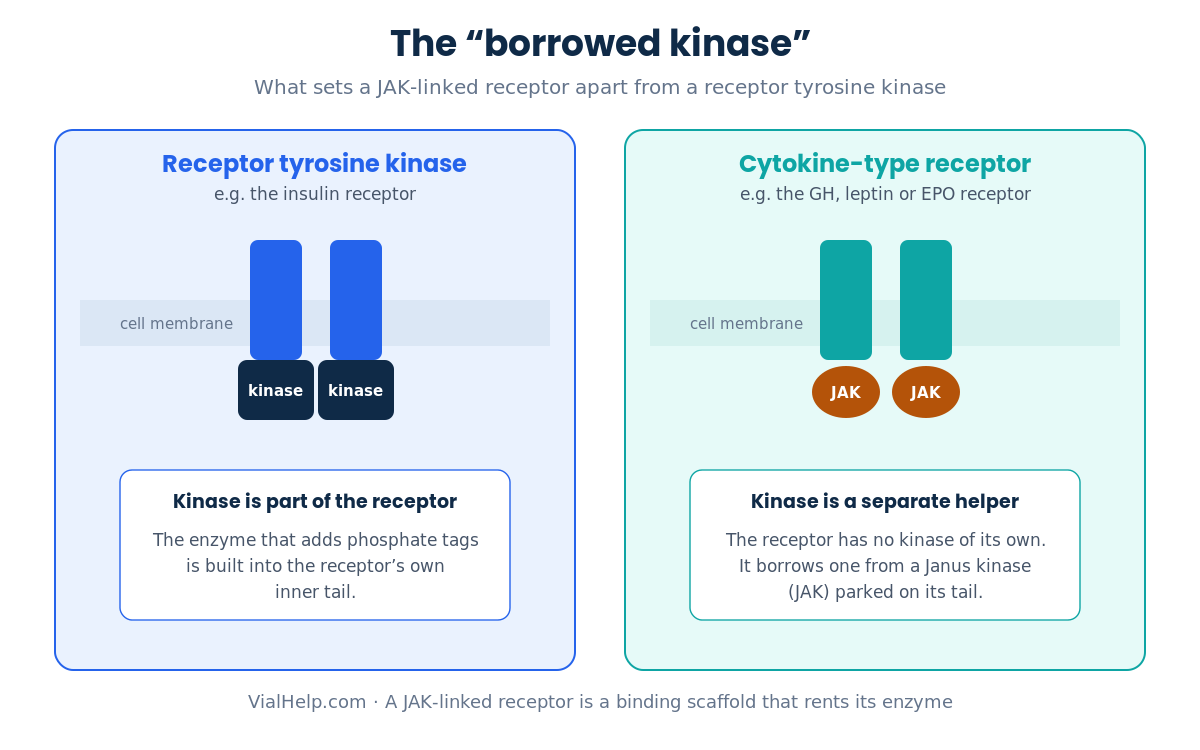
That places JAK-STAT neatly among the other major receptor systems. GPCRs act through G proteins and diffusible second messengers such as cAMP and calcium. Receptor tyrosine kinases carry their kinase inside the receptor. Nuclear hormone receptors skip the cell surface entirely, because their lipid-soluble ligand comes to them. JAK-STAT uses tyrosine phosphorylation like an RTK, but with a separate, borrowed kinase — and it takes a notably short path from the membrane to the nucleus.
The players: JAKs and STATs
Two protein families do the work. The Janus kinases — JAK1, JAK2, JAK3 and TYK2 — are the borrowed enzymes. They are named for Janus, the two-faced Roman god, because each carries two kinase-like domains: an active kinase and a neighboring “pseudokinase” that keeps it in check. Three of the four are broadly expressed, but JAK3 is largely restricted to blood and immune cells, where it partners with receptors that share a common gamma chain (the interleukin-2 family).
The STATs — Signal Transducers and Activators of Transcription — are the couriers that carry the signal to the nucleus. There are seven: STAT1, STAT2, STAT3, STAT4, STAT5A, STAT5B and STAT6. Each has an SH2 domain that reads phosphate tags and a key tyrosine that gets tagged in turn.
How the JAK-STAT signal travels
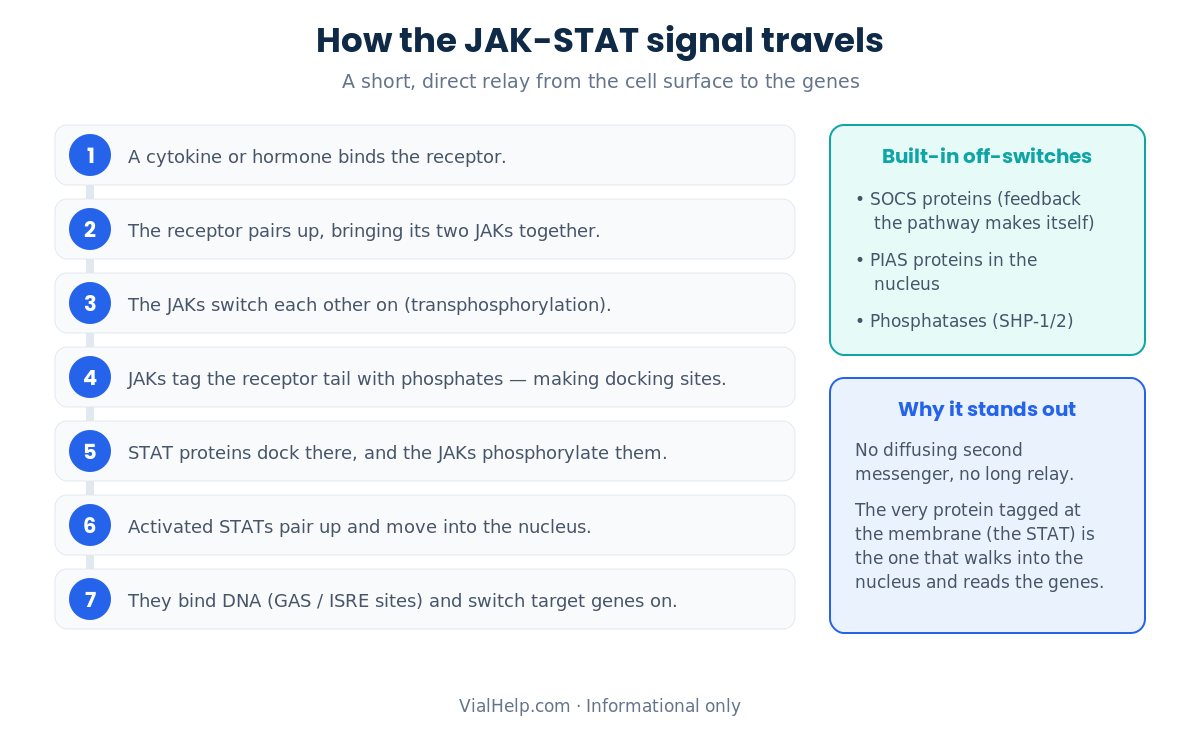
When a cytokine or hormone binds, the receptor pairs up, bringing its two attached JAKs close together. The neighboring JAKs switch each other on by trading phosphates (transphosphorylation), then tag specific tyrosines on the receptor’s inner tail. Those tags become docking sites. STAT proteins dock onto them through their SH2 domains, and the JAKs phosphorylate the docked STATs. The activated STATs release, pair up, and move into the nucleus, where they bind specific DNA sequences — called GAS and ISRE elements — and switch target genes on.
What stands out is how short the relay is. There is no diffusing second messenger and no long kinase chain: the very protein tagged at the membrane is the one that walks into the nucleus and reads the genes. That directness is a big part of why JAK-STAT is such an efficient way to translate a hormone at the surface into a change in gene activity.
The pathway also builds in its own brakes. SOCS proteins are themselves made as target genes of the pathway, so switching it on triggers its own negative feedback; they bind the JAKs or the receptor and shut the signal down. PIAS proteins act on STAT pairs in the nucleus, and phosphatases such as SHP-1 and SHP-2 strip the activating phosphates back off.
Which messengers use JAK-STAT
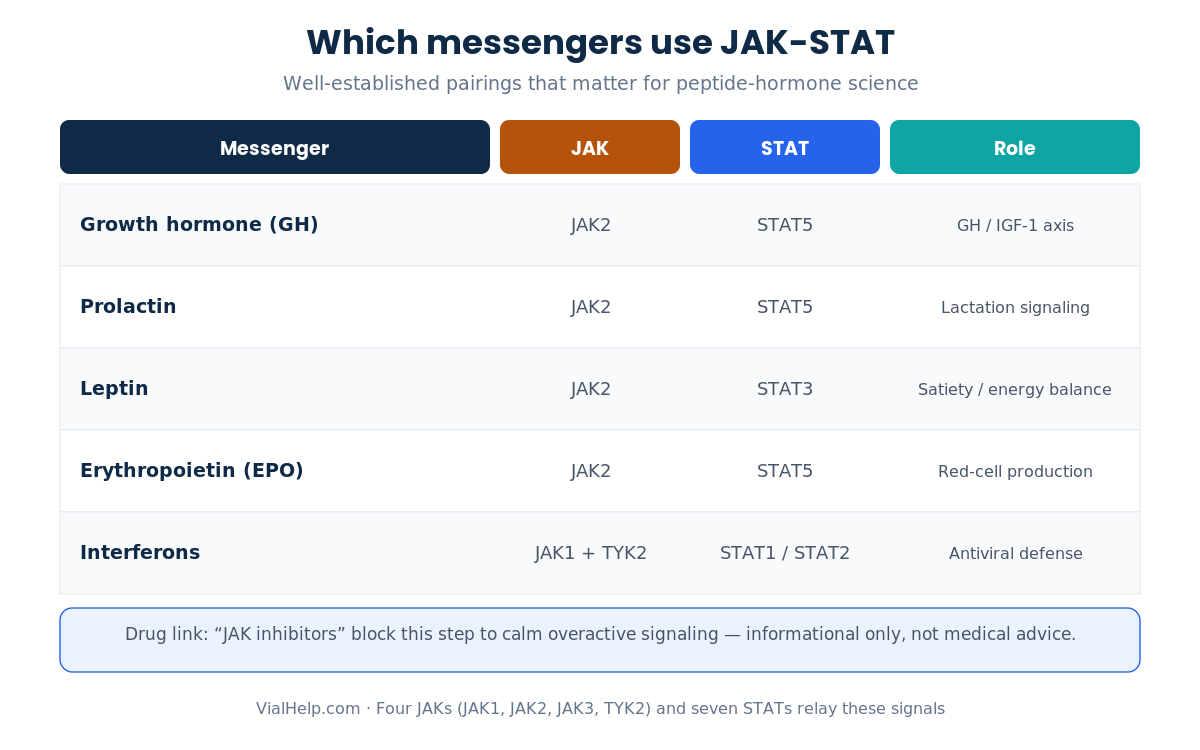
Many of the ligands that use JAK-STAT are directly relevant to peptide-hormone science. Growth hormone signals through JAK2 and STAT5 — the opening step of the GH/IGF-1 axis. Prolactin uses the same JAK2/STAT5 pairing. Leptin, the satiety hormone, works through JAK2 and STAT3. Erythropoietin, which drives red-blood-cell production, acts through JAK2. The interferons, central to antiviral defense, use JAK1 with TYK2 and the STAT1/STAT2 pair. Many interleukins, thrombopoietin and colony-stimulating factors round out the list. Across all of them, the same four JAKs and seven STATs are mixed and matched to give each cytokine its own response.
When JAK-STAT goes wrong
Because the pathway drives cell growth and blood-cell production, mutations that jam it “on” can cause disease. The best-known is JAK2 V617F, a single change in JAK2’s pseudokinase brake that removes its restraint and leaves the pathway active without a signal. It is present in the great majority of polycythemia vera cases (one review reports around 97%) and a smaller share of other myeloproliferative neoplasms, and it was identified in 2005. That discovery launched a drug class: the JAK inhibitors, or “jakinibs” — such as ruxolitinib, tofacitinib, baricitinib and upadacitinib — used across conditions from myelofibrosis to rheumatoid arthritis, and carrying class safety warnings around infection and clotting risk. This is background information only, not medical advice.
Why JAK-STAT matters for peptide science
JAK-STAT is the piece that connects several familiar peptide hormones to what actually happens inside the cell. When you read that growth hormone raises IGF-1, or that leptin signals fullness, JAK-STAT is the machinery doing the reading. It also completes the set of receptor systems worth knowing alongside GPCRs, receptor tyrosine kinases, second messengers and nuclear hormone receptors — together they cover essentially every route a hormone can take to deliver its message. For the bigger picture of how these messengers are grouped, see our overview of what a hormone is.
Frequently asked questions
What does JAK-STAT stand for?
JAK stands for Janus kinase, the enzyme that starts the signal; STAT stands for Signal Transducer and Activator of Transcription, the protein that carries it into the nucleus and switches genes on.
How is JAK-STAT different from a receptor tyrosine kinase?
A receptor tyrosine kinase has its enzyme built into the receptor itself. A JAK-linked cytokine receptor has no enzyme of its own — it borrows a separate Janus kinase that sits on its inner tail.
How many JAKs and STATs are there?
Four JAKs (JAK1, JAK2, JAK3 and TYK2) and seven STATs (STAT1, STAT2, STAT3, STAT4, STAT5A, STAT5B and STAT6). Different combinations give different cytokines their specific effects.
What are JAK inhibitors?
They are drugs that block JAK enzymes to turn down overactive JAK-STAT signaling, used in certain blood and inflammatory disorders. Mentioned here for background only — not medical advice.
References
- Hu X, Li J, Fu M, et al. The JAK/STAT signaling pathway: from bench to clinic. Signal Transduct Target Ther. 2021.
- Physiology, Leptin. StatPearls, NCBI Bookshelf (leptin and JAK2/STAT3).
- Physiology, Pituitary Gland. StatPearls, NCBI Bookshelf (GH and prolactin JAK-STAT).
- Dodington DW, Desai HR, Woo M. JAK/STAT – Emerging Players in Metabolism. Trends Endocrinol Metab. 2018.
- Darnell JE Jr, Kerr IM, Stark GR. Jak-STAT pathways and transcriptional activation in response to IFNs and other extracellular signaling proteins. Science. 1994.
- Xin P, et al. A comprehensive overview of globally approved JAK inhibitors. Pharmaceutics / PMC9146299. 2022.
Informational and educational only — not medical advice, and not a recommendation to use or purchase any substance. Intended for adults 21+. Consult a qualified healthcare professional for medical questions.