
The Hypothalamus Explained: The Brain’s Endocrine Command Center
Endocrine biology · How the body’s chemistry is run
The hypothalamus is a small region at the base of the brain that acts as the body’s endocrine command center — the bridge where the nervous system meets the hormonal system. Sitting just above the pituitary gland, it senses what is happening inside and outside the body and responds by releasing hormones that tell the pituitary what to do.
What the hypothalamus is and where it sits
The hypothalamus lies in the ventral (lower) part of the brain, below the thalamus and above the pituitary gland, to which it connects by a stalk called the infundibulum. Anatomically it is tiny, but functionally it is one of the busiest regions in the body: it integrates neural signals, blood-borne hormones, temperature, and nutrient status, then coordinates a response through both nerves and hormones. Because it converts nervous-system information into hormonal instructions, physiologists describe it as the master link of neuroendocrine control.
It does this by talking to the pituitary gland, the pea-sized structure that in turn commands many of the body’s other glands. Understanding the hypothalamus is really about understanding those two connections.
Two routes from the hypothalamus to the pituitary
The hypothalamus controls the front and back halves of the pituitary in completely different ways.
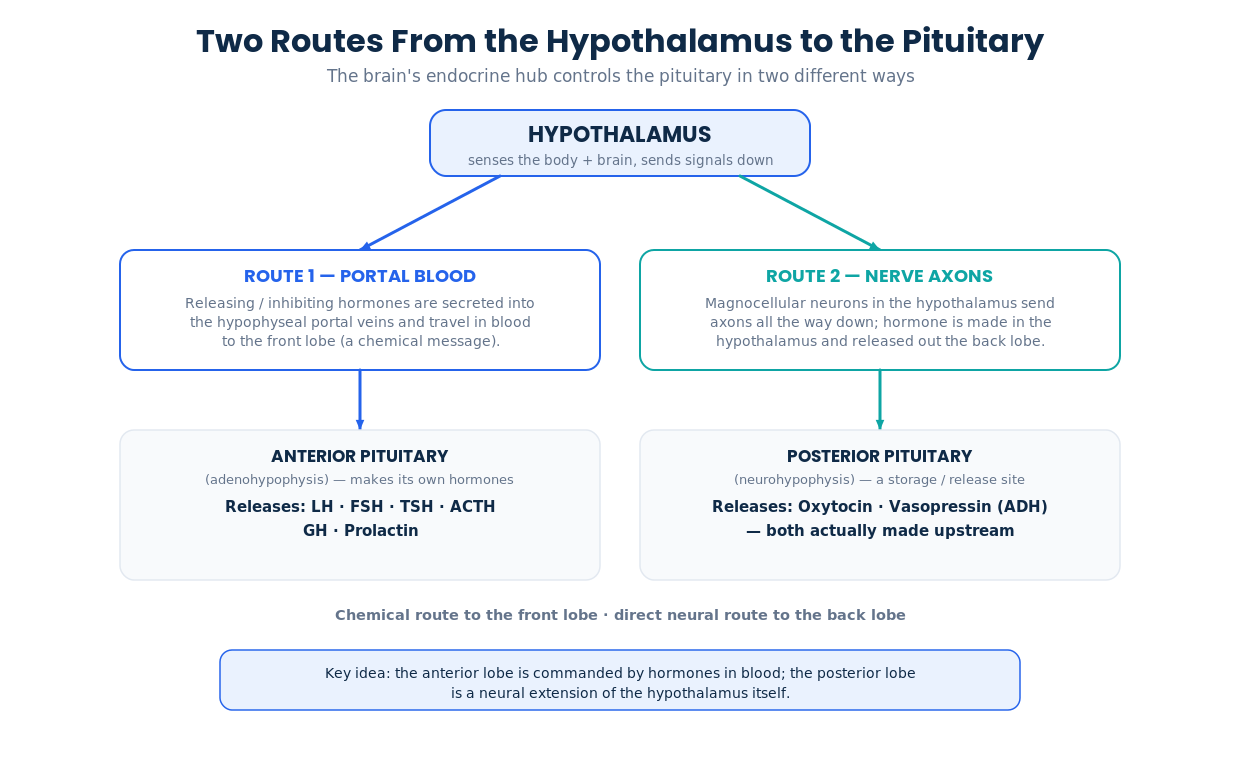
Route 1 — the portal blood system (anterior pituitary). The front lobe, or adenohypophysis, is controlled chemically. Hypothalamic neurons secrete small “releasing” and “inhibiting” hormones into a dedicated set of blood vessels — the hypophyseal portal system — that carry them a short distance directly to the anterior pituitary. There, they switch the pituitary’s own hormones on or off.
Route 2 — direct nerve axons (posterior pituitary). The back lobe, or neurohypophysis, is controlled neurally. Large neurons in the hypothalamus send their axons all the way down the stalk and release hormone directly into the posterior pituitary’s blood supply. In this case the posterior pituitary is essentially a release site for hormones made upstream in the hypothalamus itself.
The hypothalamic releasing and inhibiting hormones
Through the portal route, the hypothalamus sends a handful of signalling molecules to the anterior pituitary. Most are small peptides; one is an amine.
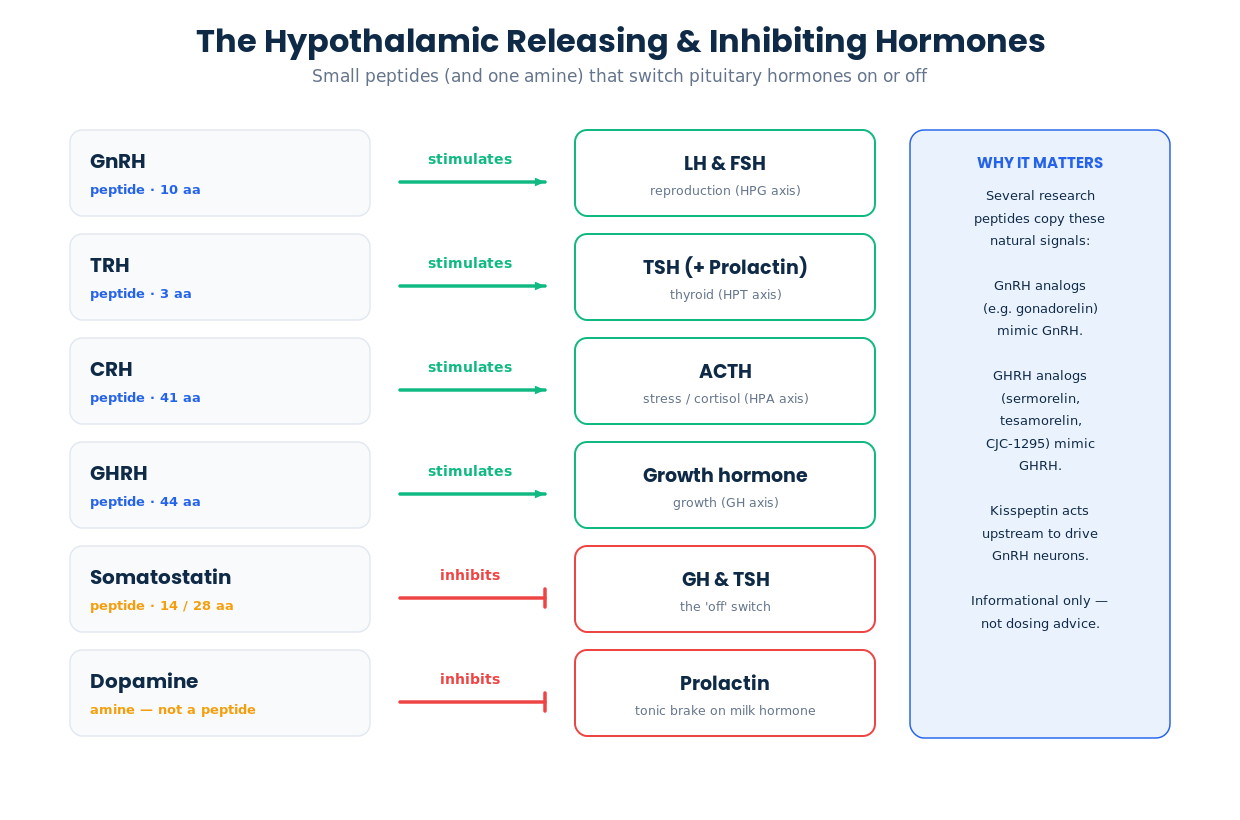
- GnRH (gonadotropin-releasing hormone, a 10-amino-acid peptide) stimulates release of LH and FSH — the reproductive axis.
- TRH (thyrotropin-releasing hormone, a 3-amino-acid peptide) stimulates TSH, and also prolactin.
- CRH (corticotropin-releasing hormone, a 41-amino-acid peptide) stimulates ACTH — the stress axis.
- GHRH (growth-hormone-releasing hormone, a 44-amino-acid peptide) stimulates growth hormone.
- Somatostatin (14- and 28-amino-acid forms) is an inhibitor — it puts the brakes on growth hormone and TSH.
- Dopamine is the odd one out: it is an amine, not a peptide, and it tonically inhibits prolactin.
Hormones made in the hypothalamus itself
Two well-known hormones are not just controlled by the hypothalamus — they are manufactured there. Neurons in the supraoptic and paraventricular nuclei synthesize oxytocin and vasopressin (ADH), both nine-amino-acid peptides (nonapeptides). These travel down the axons of Route 2 and are released from the posterior pituitary. Vasopressin acts on the kidney to conserve water; oxytocin drives uterine contractions in labor and milk let-down during breastfeeding.
Feedback and the four endocrine axes
The hypothalamus does not shout into the void — it listens. Hormones produced by the downstream glands circulate back and feed back on the hypothalamus and pituitary, usually turning the signal down (negative feedback). This creates the classic hormonal axes that organize much of human physiology:
- HPA axis: CRH → ACTH → cortisol (stress).
- HPT axis: TRH → TSH → thyroid hormone (metabolism).
- HPG axis: GnRH → LH/FSH → sex hormones (reproduction).
- GH axis: GHRH and somatostatin → growth hormone → IGF-1 (growth).
Pulsatile vs. continuous GnRH: timing is the message
One of the most striking facts about hypothalamic signalling is that the pattern of a signal can matter as much as its presence. GnRH is normally released in rhythmic pulses, and those pulses stimulate the pituitary to release LH and FSH. If GnRH is instead applied continuously, the pituitary does the opposite: it down-regulates and LH and FSH fall.
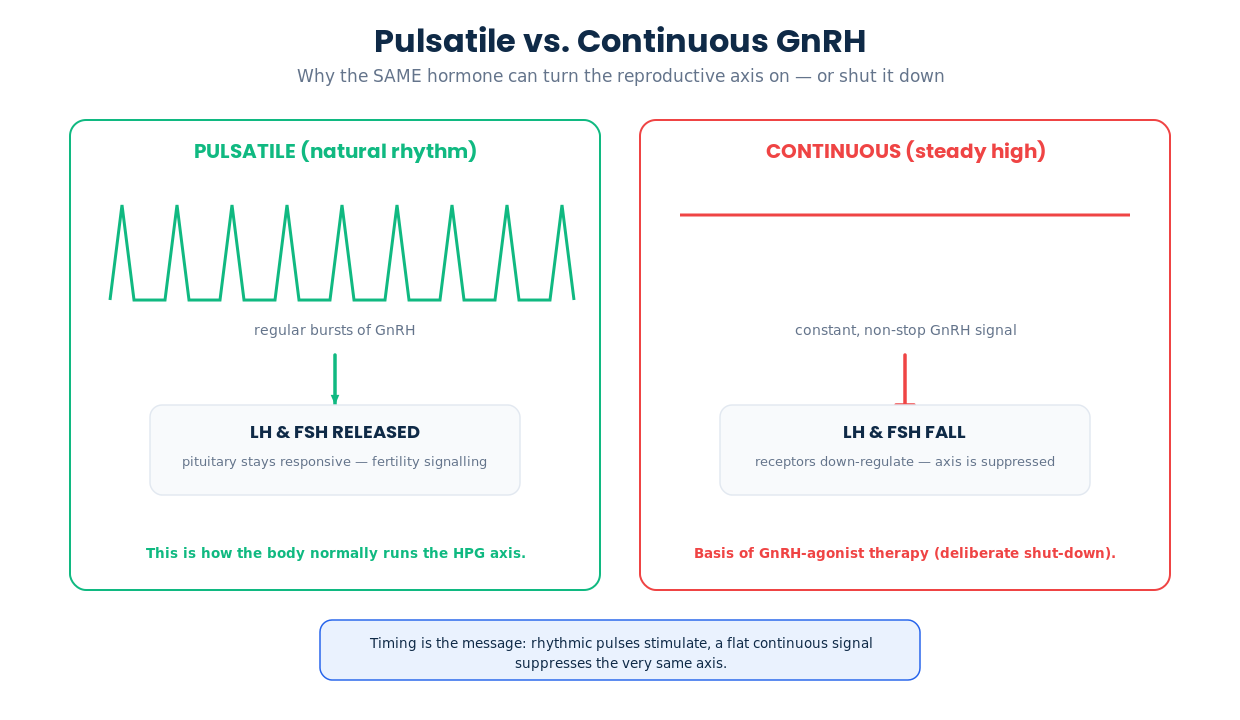
This is not a quirk — it is the basis of GnRH-agonist therapy, where deliberately overriding the natural rhythm shuts the axis down.
Beyond hormones: the hypothalamus as a control panel
The hypothalamus also runs several non-endocrine housekeeping systems. Its arcuate nucleus senses appetite and energy signals — the fat-derived hormone leptin and the stomach hormone ghrelin — and balances “stop eating” neurons (POMC) against “keep eating” neurons (AgRP). Other regions regulate body temperature, the suprachiasmatic nucleus keeps the circadian clock in step with light, and osmosensitive areas govern thirst and water balance.
Why this matters for peptide research
For anyone reading about research peptides, the hypothalamus is where a surprising number of them make sense. Compounds in the GnRH-analog family (such as gonadorelin) copy the hypothalamus’s own GnRH signal to the pituitary. Compounds in the GHRH-analog family (such as sermorelin, tesamorelin, and CJC-1295) imitate GHRH. Kisspeptin acts one step upstream, on the GnRH neurons themselves. In every case, the research interest comes from mimicking or modulating a natural hypothalamic releasing signal described above. This is background biology only — not a protocol or dosing guidance.
Frequently asked questions
Is the hypothalamus part of the brain or the endocrine system?
Both. It is brain tissue that also functions as an endocrine organ, which is exactly why it is called a neuroendocrine structure — it turns nerve signals into hormone signals.
What is the difference between the hypothalamus and the pituitary?
The hypothalamus is the controller; the pituitary is the gland it controls. The hypothalamus sends releasing and inhibiting signals, and the pituitary responds by secreting its own hormones to the rest of the body.
Are the hypothalamic hormones peptides?
Most are. GnRH, TRH, CRH, GHRH, somatostatin, oxytocin, and vasopressin are all peptides. Dopamine, used here to inhibit prolactin, is an amine rather than a peptide.
Why do some research peptides target the hypothalamic pathways?
Because the hypothalamic releasing hormones are the natural “on switches” for whole endocrine axes. Analogs that mimic GnRH or GHRH, or that act on kisspeptin neurons, are studied precisely because they engage these upstream signals. It remains informational biology, not medical advice.
References
- Shahid Z, Asuka E, Singh G. Physiology, Hypothalamus. StatPearls, NCBI Bookshelf.
- Bear MH, Reddy V, Bollu PC. Neuroanatomy, Hypothalamus. StatPearls, NCBI Bookshelf.
- Anatomy, Adenohypophysis (Anterior Pituitary). StatPearls, NCBI Bookshelf.
- Lechan RM, Toni R. Functional Anatomy of the Hypothalamus and Pituitary. Endotext, NCBI Bookshelf.
- UniProt Consortium. GNRH1 / Progonadoliberin-1 (P01148).
- Kisspeptin signalling in the hypothalamic arcuate nucleus regulates GnRH pulse generator frequency. PMC.
Informational and educational only — not medical advice. Consult a qualified healthcare professional. Intended for adults 21+.