
What Are Stapled Peptides? Locking a Helix Into Shape
Guides · Peptide chemistry
Stapled peptides are short peptide chains chemically locked into a stable alpha-helix shape, using an all-carbon “staple” installed by a technique called hydrocarbon stapling. The staple doesn’t just hold the peptide together — it holds it in one specific fold, which is the whole point.
What are stapled peptides?
Most short peptides are floppy in water. Outside of a folded protein, a chain of 15–20 amino acids rarely commits to one shape — it samples many conformations, gets cut apart by protease enzymes within minutes, and struggles to cross a cell membrane. That is a problem, because many of the most interesting drug and research targets sit inside cells, at protein-protein interfaces that only recognize a peptide already folded into an alpha-helix.
Hydrocarbon stapling, pioneered by Gregory Verdine’s lab at Harvard in the early 2000s, solves this by chemically welding two points on the peptide backbone together with a rigid hydrocarbon bridge. The result pre-organizes the chain into the helical shape its target expects, before the peptide ever meets that target.
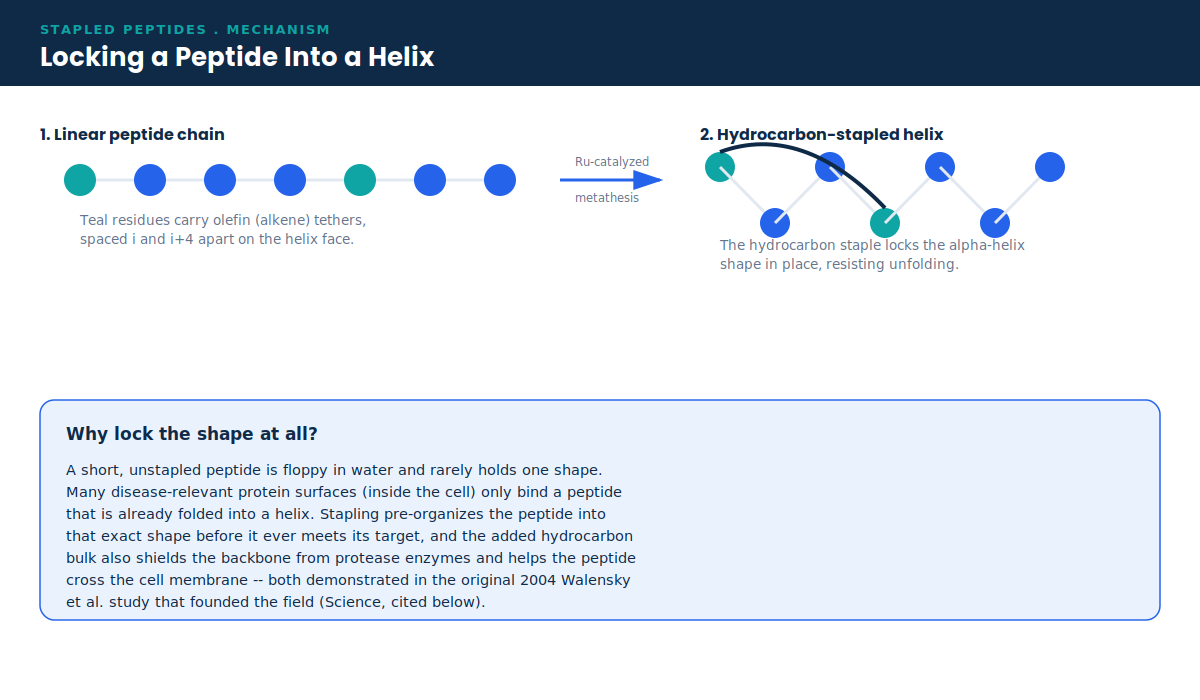
How stapling locks the shape
In practice, two non-natural amino acids carrying olefin (alkene) side chains are inserted into the sequence, spaced either four or seven residues apart — a spacing chosen because it places both olefins on the same face of an alpha-helix. A ruthenium catalyst then drives ring-closing metathesis, joining the two olefins into a single all-carbon macrocycle: the staple. That staple physically bridges one turn (or two) of the helix, so the peptide can no longer unfold without breaking the bridge.
What locking the helix actually buys you
The 2004 study that founded the field, from Walensky, Verdine, Korsmeyer and colleagues, stapled a BH3-domain peptide from the pro-apoptotic protein BID (the resulting molecule is called SAHBA) and tested it directly. Three things changed relative to the unstapled version: the peptide resisted breakdown by serum proteases for longer, it entered leukemia cells and localized to mitochondria, and in a mouse xenograft model it suppressed tumor growth and extended survival compared to untreated controls. A separate stapled peptide targeting HIV capsid assembly (NYAD-1) showed a similar pattern — dramatically better cell entry and tighter target binding than its unstapled precursor.
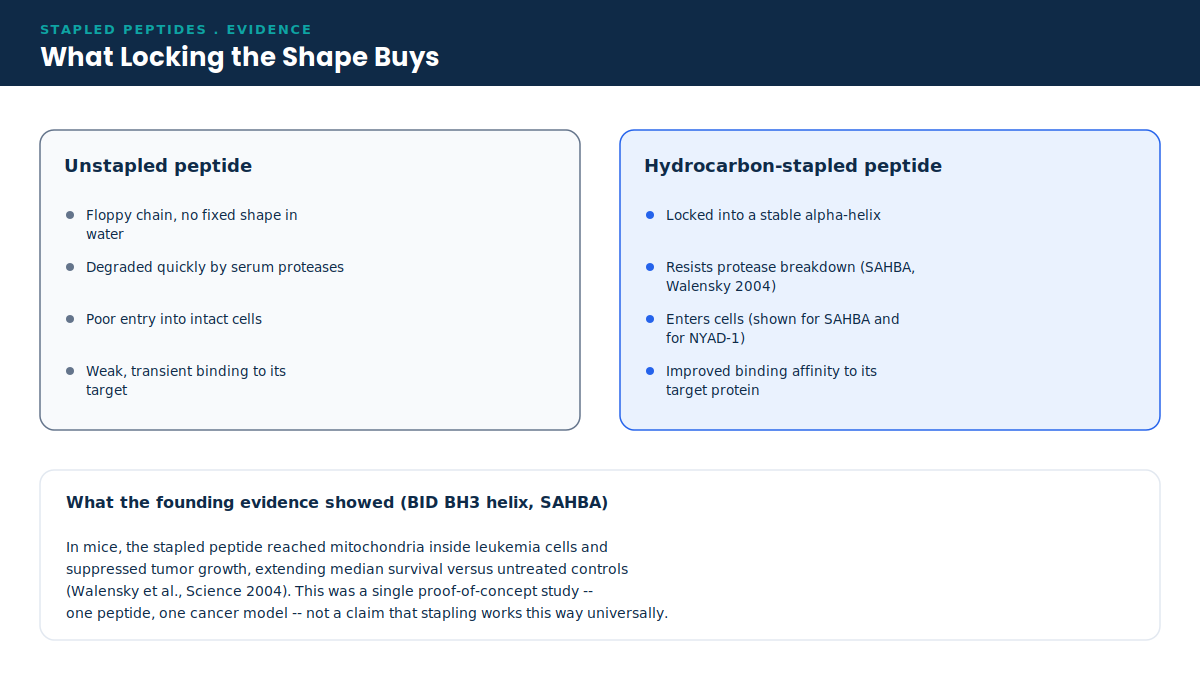
It’s worth being precise about what this evidence does and doesn’t establish: these are results from specific peptides against specific targets, not a guarantee that stapling improves every peptide it’s applied to. Helicity, permeability and affinity gains are case-by-case, and a poorly designed staple position can just as easily disrupt binding as improve it.
How this differs from cyclic peptides generally
Hydrocarbon stapling is best understood as one specific technique within the much broader field of peptide macrocyclization — the general strategy of closing a peptide into a ring, which we cover in depth in our guide to cyclic peptides and macrocyclization. Most macrocyclization approaches (head-to-tail amide bonds, disulfide bridges, lactam linkages) close a ring mainly to buy protease resistance or oral stability, and the resulting shape can be a turn, a sheet, or something irregular. Stapling is narrower in purpose: it specifically uses a non-natural, all-carbon tether to lock one particular secondary structure — the alpha-helix — in place. If general cyclization is about closing a loop, stapling is about freezing a fold.
How far has this reached the clinic?
The most clinically advanced stapled peptide is ALRN-6924 (sulanemadlin), developed by Aileron Therapeutics as a dual inhibitor of MDM2 and MDMX — two proteins that suppress the tumor-suppressor p53. Described in its own medicinal chemistry paper as “the first cell-permeating, stabilized alpha-helical peptide in clinical development,” it progressed through Phase 1 trials in solid tumors and lymphomas, and a first-in-pediatric study for advanced hematologic and solid malignancies. A Phase 1b trial in p53-mutant breast cancer was later terminated.
As of its most recent public update, the picture is mixed: Aileron rebranded to Rein Therapeutics in January 2025 and shifted its own pipeline entirely to pulmonary fibrosis, while a separate option agreement (October 2024) gave the nonprofit Advancium Health Network rights to pursue ALRN-6924 specifically for retinoblastoma, a rare pediatric eye cancer. No public update on that option’s status has surfaced since. No hydrocarbon-stapled peptide has yet received FDA approval — ALRN-6924 remains the furthest any candidate in this class has traveled, and it illustrates just how long the road from mechanism to approved drug can be, even for a well-validated chemistry platform.
Limitations and open questions
Stapled peptides are harder and more expensive to synthesize than ordinary linear peptides — they require non-natural amino acid building blocks and an extra metathesis step. The staple’s placement matters enormously and is not always predictable in advance; a staple that works well for one helix-target pair can fail for another. And, as ALRN-6924’s trajectory shows, stability and cell entry solve only part of the problem — clinical development still has to clear the same safety and efficacy bars as any other drug candidate. The technique has also been applied beyond BCL-2 family and MDM2/MDMX targets, including in combination with targeted-protein-degradation (PROTAC) approaches, but most of that work remains preclinical.
Frequently asked questions
What does “stapling” a peptide actually mean, chemically?
It means inserting two non-natural, olefin-bearing amino acids into the sequence at a set spacing, then using a ruthenium-catalyzed reaction (ring-closing metathesis) to join those two side chains into one rigid, all-carbon ring that bridges across the peptide backbone.
Is a stapled peptide the same thing as a cyclic peptide?
Stapling is a specific type of macrocyclization. What sets it apart is the chemistry (an all-carbon hydrocarbon tether from metathesis, rather than an amide or disulfide bond) and the purpose (locking in an alpha-helix specifically, rather than closing a ring in general).
Has the FDA approved any stapled peptide drug?
Not as of this writing. The furthest-advanced candidate, ALRN-6924 (sulanemadlin), has reached Phase 1 and Phase 1b/2a stages but has not been approved.
Why are researchers interested in intracellular protein targets specifically?
Many disease-relevant protein-protein interactions happen inside the cell, where conventional antibody drugs can’t reach and small molecules often can’t find a good binding groove. A peptide that can both hold a specific fold and cross the cell membrane is one way to reach those “undruggable” interfaces.
References
- Walensky LD, et al. “Activation of Apoptosis In Vivo by a Hydrocarbon-Stapled BH3 Helix.” Science, 2004.
- Schafmeister CE, Po J, Verdine GL. “An All-Hydrocarbon Cross-Linking System for Enhancing the Helicity and Metabolic Stability of Peptides.” JACS, 2000.
- “Structural and Pharmacological Effects of Ring-Closing Metathesis in Peptides.” Review, PMC.
- Guerlavais V, et al. “Discovery of Sulanemadlin (ALRN-6924), the First Cell-Permeating, Stabilized alpha-Helical Peptide in Clinical Development.” J Med Chem, 2023.
- Meric-Bernstam F, et al. “Phase I trial of a novel stapled peptide ALRN-6924…”. J Clin Oncol, 2017.
- “A Review of Stapled Peptides and Small Molecules to Inhibit Protein-Protein Interactions in Cancer.” PubMed.
Informational only. This guide is for educational and laboratory-measurement purposes and is not medical advice. It does not recommend or instruct personal human use. Consult a qualified healthcare professional for any health decision. Content is intended for adults 21+. Verify scientific details against the primary sources cited.