
Corticotropin-Releasing Hormone (CRH) and the Urocortins Explained
Articles · Hormones & the stress axis
Corticotropin-releasing hormone (CRH) is a 41-amino-acid hypothalamic peptide that starts the body’s stress-hormone cascade, and it belongs to a family that includes the urocortins. This article covers the peptides, their CRF1 and CRF2 receptors, and what trials of CRF-blocking drugs have shown, for educational purposes only.
What is corticotropin-releasing hormone?
Corticotropin-releasing hormone (CRH), also called corticotropin-releasing factor (CRF), is a 41-amino-acid peptide made in the hypothalamus. Wylie Vale’s group characterised it in 1981 from ovine (sheep) hypothalamic tissue as the factor that stimulates secretion of corticotropin (ACTH) and beta-endorphin. It sits at the top of the stress axis described in our HPA axis and cortisol article: CRH prompts the pituitary to release ACTH, which in turn drives cortisol from the adrenal glands.
CRH is not alone. In 1995 Vaughan and colleagues identified urocortin in rat midbrain, reporting that it is about 63% identical to fish urotensin I and 45% identical to CRF, that it stimulates ACTH secretion, and that it is more potent than CRF at the CRF2 receptor. Two further relatives, urocortin II and urocortin III, were described later; their paper titles report CRF2-selective binding. Reviews group CRH, the urocortins, and the fish and amphibian peptides urotensin and sauvagine into one peptide family.
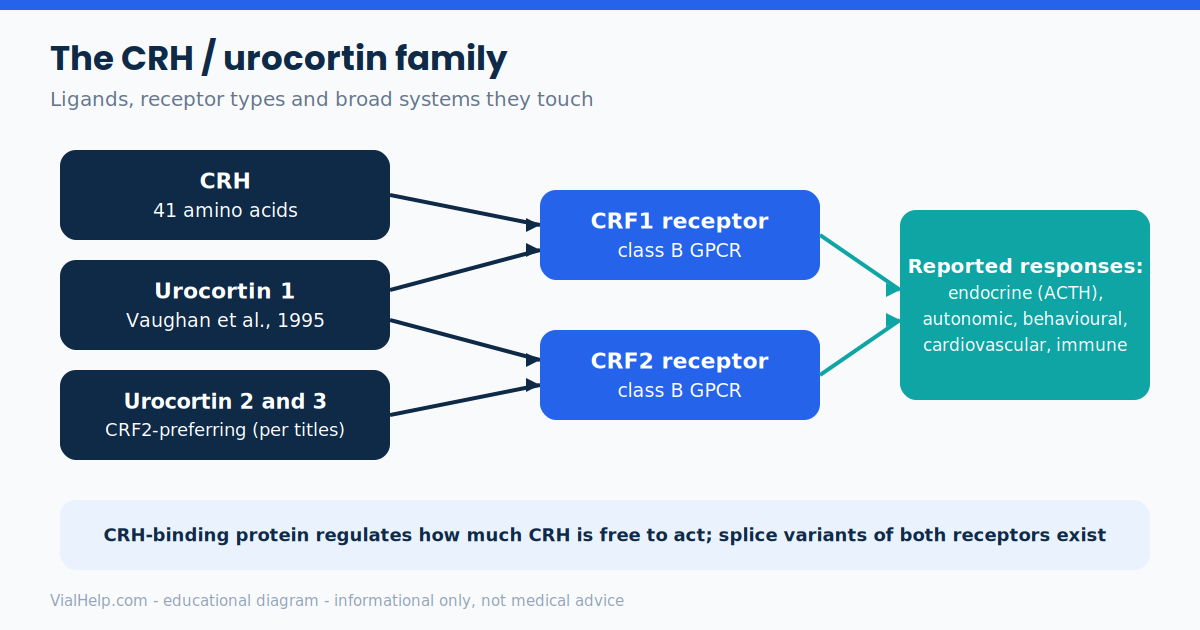
How the CRH family is studied to work
These peptides act on two receptor types, CRF1 and CRF2, encoded by separate genes. Both are class B G-protein-coupled receptors, and both have splice variants (see what is a GPCR for the general mechanism). A circulating CRH-binding protein regulates how much CRH is free to act. A 2002 review by Hillhouse and colleagues describes the family as coordinating autonomic, behavioural, cardiovascular, immune and endocrine responses, which is why CRH biology shows up well beyond the pituitary.
Reported roles in the research literature
In pregnancy, a 2022 review in Biology reports that maternal plasma CRH rises through gestation and peaks in the third trimester, and that it may help trigger labour. The same review links CRH to intestinal barrier function and immune cells. These are research observations from a review article, not clinical guidance, and the details of the placental “clock” idea remain a subject of study.
What the human evidence shows
The pharmacology of the family is a useful case study in how a strong biological rationale can fail in the clinic, then succeed in a narrower setting.
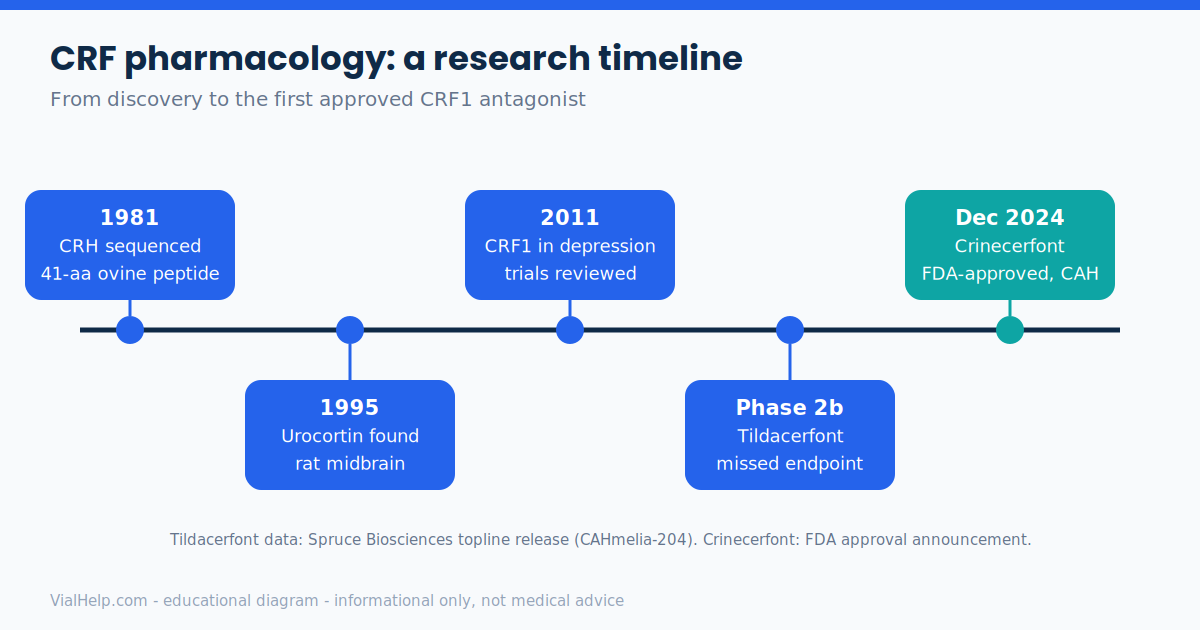
Depression and anxiety. A 2011 review by Koob and Zorrilla in Neuropsychopharmacology summarises CRF1-antagonist attempts in psychiatry: R121919 and PF-00572778 were discontinued for liver toxicity, ONO-2333Ms and CP-316,311 showed negative efficacy in placebo-controlled depression trials, and verucerfont lacked effectiveness. The authors suggest such drugs may be better suited to acute-stress conditions than to depression.
Congenital adrenal hyperplasia (CAH). In CAH, the pituitary drives excess adrenal androgen production. Tildacerfont, an oral CRF1 antagonist, missed its primary endpoint in the phase 2b CAHmelia-204 trial (100 adults; placebo-adjusted change in daily glucocorticoid dose through week 24 of 0.7 mg hydrocortisone-equivalent, 95% CI −4.3 to 2.9), and the sponsor stopped the programme. By contrast, the FDA approved crinecerfont (Crenessity) on 13 December 2024 as an adjunct to glucocorticoids in classic CAH for adults and children aged 4 and older. In the announced adult trial (24 weeks; 122 on drug, 60 on placebo) the glucocorticoid dose fell 27% versus 10% on placebo while androstenedione stayed controlled, and in the paediatric trial (28 weeks; 69 on drug, 34 on placebo) it fell 18% versus a 6% rise on placebo.
Diagnostics. Synthetic ovine CRH (corticorelin ovine triflutate, Acthrel) is a 41-amino-acid peptide identical in sequence to ovine CRH, and its FDA label lists use in differentiating pituitary from ectopic ACTH production in ACTH-dependent Cushing’s syndrome. It is a clinician-run diagnostic test, not a treatment.
Handling and measurement considerations (research context)
CRH-family peptides are handled like other lyophilised research peptides: follow the supplier’s sheet, use aseptic technique, and record concentration arithmetic carefully. Our reconstitution calculator, concentration converter and sterile technique guide cover the basics.
Cautions and considerations
The drugs discussed here are prescription products or clinical-trial compounds. This article does not recommend using any of them or any CRH-related product outside supervised care. Regulatory statements reflect the sources cited and may change.
Frequently asked questions
What is the difference between CRH and CRF?
They are the same 41-amino-acid peptide; CRF (corticotropin-releasing factor) is the older name and CRH the hormone name.
What are urocortins?
A group of CRH-related peptides. Urocortin was identified in rat midbrain in 1995, and urocortins II and III were reported later with preference for the CRF2 receptor.
Did CRF1 blockers work for depression?
A 2011 review found several candidates were stopped for liver toxicity or showed negative efficacy in placebo-controlled trials.
Is any CRF1 antagonist approved?
Crinecerfont (Crenessity) was FDA-approved in December 2024 for classic congenital adrenal hyperplasia, as an add-on to glucocorticoids.
References
- Vale W, Spiess J, Rivier C, Rivier J. Characterization of a 41-residue ovine hypothalamic peptide that stimulates secretion of corticotropin and beta-endorphin. Science, 1981
- Vaughan J, et al. Urocortin, a mammalian neuropeptide related to fish urotensin I and to corticotropin-releasing factor. Nature, 1995
- Hillhouse EW, Randeva H, Ladds G, Grammatopoulos D. Corticotropin-releasing hormone receptors. Biochem Soc Trans 30(4):428-32, 2002
- Koob GF, Zorrilla EP. Update on corticotropin-releasing factor pharmacotherapy for psychiatric disorders: a revisionist view. Neuropsychopharmacology, 2011
- Corticotropin-Releasing Hormone: Biology and Therapeutic Opportunities. Biology 11(12):1785, 2022
- Spruce Biosciences: topline results of the phase 2b CAHmelia-204 trial of tildacerfont
- FDA approves new treatment for congenital adrenal hyperplasia (crinecerfont, Crenessity), December 2024
- Acthrel (corticorelin ovine triflutate) prescribing information, FDA
Informational only. This guide is for educational and laboratory/measurement purposes and is not medical advice. It does not recommend or instruct personal human use. Consult a qualified healthcare professional for any health decision. Content is intended for adults 21+. Verify scientific details against the primary sources cited.